

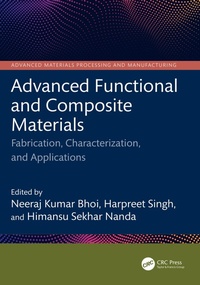
Advanced Functional and Composite Materials
Fabrication, Characterization, and Applications
1st Edition
Published on 30. September 2025
380 pages
978-1-040-42823-8 (ISBN)
Description

This book provides an in-depth understanding of the properties, characterization, and applications of advanced functional and composite materials for energy, electronics, biomedicine, and aerospace fields. Divided into four sections, it covers sustainable smart and composite materials, intelligent techniques for optimization of material properties, their characterization and processing, case studies based on modernization in processes and systems, sustainability-based approaches and novel strategies, and sustainability and Industry 4.0-based contents.
Key Highlights
Provides smart materials and sustainability, novel product design, and materials implementation
Reviews molecular dynamics simulation techniques
Includes Industry 4.0 and sustainability interventions in functional composites
Discusses life cycle engineering and analysis in composite processing
Covers microwave-assisted processing of composites
This book is aimed at graduate students and researchers in materials sciences and metallurgy, mechanical and manufacturing engineering.
Key Highlights
Provides smart materials and sustainability, novel product design, and materials implementation
Reviews molecular dynamics simulation techniques
Includes Industry 4.0 and sustainability interventions in functional composites
Discusses life cycle engineering and analysis in composite processing
Covers microwave-assisted processing of composites
This book is aimed at graduate students and researchers in materials sciences and metallurgy, mechanical and manufacturing engineering.
More details
Series
Edition
1. Auflage
Language
English
Place of publication
London
United Kingdom
Publishing group
Taylor & Francis Ltd
Target group
College/higher education
Professional and scholarly
Illustrations
22 Tables, black and white; 158 Line drawings, black and white; 32 Halftones, black and white; 190 Illustrations, black and white
File size
97,53 MB
ISBN-13
978-1-040-42823-8 (9781040428238)
Copyright in bibliographic data and cover images is held by Nielsen Book Services Limited or by the publishers or by their respective licensors: all rights reserved.
Schweitzer Classification
Other editions
Additional editions
Neeraj Kumar Bhoi | Harpreet Singh | Himansu Sekhar Nanda
Advanced Functional and Composite Materials
Fabrication, Characterization, and Applications
Book
09/2025
1st Edition
CRC Press
€230.50
Shipment within 10-20 days
Persons
Neeraj Kumar Bhoi is currently working as Assistant Professor in the Department of Mechanical Engineering at O.P. Jindal University, Raigarh, Chhattisgarh, India. Previously, he worked as Assistant Professor in the School of Automation (Mechatronics Engineering) at Banasthali Vidyapith, Banasthali, Rajasthan, India, from September 2022 to June 2025. He received his B.E. in Mechanical Engineering with distinction from Bhilai Institute of Technology, Durg, in 2014, and his M.Tech. in Production Engineering from Veer Surendra Sai University of Technology, Burla (formerly UCE Burla), in 2016. He earned his Ph.D. from the Department of Mechanical Engineering at the Indian Institute of Information Technology, Design and Manufacturing, Jabalpur, India. He serves as an academic editor for Advances in Materials Science and Engineering (John Wiley & Sons Ltd.) and as an editorial board member for Scientific Reports and Discover Materials (Springer Nature Publications). His research interests include microwave-assisted processing, electronic waste recycling, sustainable manufacturing, and 3D-printed soft actuation systems for medical rehabilitation. Dr. Bhoi is the recipient of the 35th Madhya Pradesh Young Scientist Award for his research titled "An Innovative and Sustainable Manufacturing Process for Uniform Sintering and Cladding in the Microwave Field", awarded by the Madhya Pradesh Council of Science and Technology, Bhopal, Madhya Pradesh, India. He has authored over 23 peer-reviewed articles in prestigious journals, edited two books, contributed to seven book chapters, and eight international conference article. He also serves as a reviewer for several book proposals and international journals.
Harpreet Singh is currently serving as Assistant Professor in the Mechanical Engineering Department at the National Institute of Technology, Jalandhar, India. Before the current assignment, he was Assistant Professor in the Mechanical Engineering Department at IIIT Jabalpur during 2017-22. He received his Ph.D. degree from the Department of Mechanical and Industrial Engineering at the Indian Institute of Technology, Roorkee. His research interests are broadly related to the advancement of precision machining processes, nano-finishing science and technology, green manufacturing methods, microwave processing of metals and composites, polymer processing and PMCs, and material processing and characterizations. He is one of the first researchers in the world to propose and develop a pulse DC supply-controlled and ultrasonic vibration-assisted ECH machine. Presently, he, along with his research group, is working for the new era of nano-finishing science and technology, namely CMMRAF, for biomedical applications, which was first proposed for nano-finishing of complex shapes. His research group is also making tremendous contributions to studying green manufacturing processes such as microwave heating of metals, alloys, and composites and establishing near-to-net shape manufacturing possibilities. Similarly, studies on PMCs using graphite and aluminum oxide and natural composites provide remarkable data for genuine improvements in the defense and gear industries. He has over 14 years of research and teaching experience at UG and PG levels. He has published more than 70 research papers in international peer-reviewed journals of repute, national and international conferences in India and abroad, and 2 patents. He has also guided a number of Ph.D. (awarded: 3, ongoing: 7), M.Tech (awarded: 18), and B.Tech (6-month intern project: awarded: 37, ongoing: 21) students. He is a reviewer for various government-funded projects and leading international journals of repute. He has been a resource person and delivered invited lectures in several national and international conferences, STTPs, and QIP programs.
Himansu Sekhar Nanda received Ph.D. in Materials Science and Engineering, majoring in Biomaterials, from National Institute for Materials Science (NIMS), Japan. He was a Post-Doctoral Fellow at King Abdullah University of Science and Technology (KAUST), Saudi Arabia, and a Post-Doctoral Research Fellow at Nanyang Technological University (NTU) Singapore. Currently, he is working as an Assistant Professor at the Indian Institute of Information Technology Design and Manufacturing (IIITDM) Jabalpur, India (an Institute of National Importance, Ministry of Education, Government of India) and heading Laboratory of Biomaterials and Biomanufacturing at IIITDM. From August 2022-Jan 2023, he was a Research Scientist at Terasaki Institute for Biomedical Innovation (TIBI), Los Angeles, USA. Since Feb 2023, he has been working as an Affiliate Faculty at TIBI and has collaborated with the core scientific team of Dr. Ali Khademhosseini. He holds a few visiting positions: as an adjunct Assistant professor at the Beijing University of Chemical Technology and a Visiting Scientist at the State Key Lab of Molecular Engineering of Polymers, Fudan University, China. Apart from these visiting positions, he also holds the position of Founding President for Sustainable Biomanufacturer and Research Society. He has edited the special issues "Biomaterials: Future of Biomaterials 2021" and Biomaterials: Intelligent Biomaterials 2023" in the journal Current Opinion in Biomedical Engineering (Elsevier, 2022 IF: 4.16), "Biodegradable Polymers for Biomedical Applications Vol-1 and Vol-2" in Frontier in Materials, (Frontiers, 2022 IF: 3.5) and "Advances in Metallic Biomaterials" in Bioengineering (MDPI, 2022 IF: 5.05) and "Recent Progress in Biosensor Technologies for Detection of Exosomes" in Biosensors (MDPI, 2022 IF: 5.74). His research interests include Biodesign and Biomimetics, Biomanufacturing for Tissue Engineering and Regenerative Medicine and Sustainable Science and Engineering for Better Human Health.
Harpreet Singh is currently serving as Assistant Professor in the Mechanical Engineering Department at the National Institute of Technology, Jalandhar, India. Before the current assignment, he was Assistant Professor in the Mechanical Engineering Department at IIIT Jabalpur during 2017-22. He received his Ph.D. degree from the Department of Mechanical and Industrial Engineering at the Indian Institute of Technology, Roorkee. His research interests are broadly related to the advancement of precision machining processes, nano-finishing science and technology, green manufacturing methods, microwave processing of metals and composites, polymer processing and PMCs, and material processing and characterizations. He is one of the first researchers in the world to propose and develop a pulse DC supply-controlled and ultrasonic vibration-assisted ECH machine. Presently, he, along with his research group, is working for the new era of nano-finishing science and technology, namely CMMRAF, for biomedical applications, which was first proposed for nano-finishing of complex shapes. His research group is also making tremendous contributions to studying green manufacturing processes such as microwave heating of metals, alloys, and composites and establishing near-to-net shape manufacturing possibilities. Similarly, studies on PMCs using graphite and aluminum oxide and natural composites provide remarkable data for genuine improvements in the defense and gear industries. He has over 14 years of research and teaching experience at UG and PG levels. He has published more than 70 research papers in international peer-reviewed journals of repute, national and international conferences in India and abroad, and 2 patents. He has also guided a number of Ph.D. (awarded: 3, ongoing: 7), M.Tech (awarded: 18), and B.Tech (6-month intern project: awarded: 37, ongoing: 21) students. He is a reviewer for various government-funded projects and leading international journals of repute. He has been a resource person and delivered invited lectures in several national and international conferences, STTPs, and QIP programs.
Himansu Sekhar Nanda received Ph.D. in Materials Science and Engineering, majoring in Biomaterials, from National Institute for Materials Science (NIMS), Japan. He was a Post-Doctoral Fellow at King Abdullah University of Science and Technology (KAUST), Saudi Arabia, and a Post-Doctoral Research Fellow at Nanyang Technological University (NTU) Singapore. Currently, he is working as an Assistant Professor at the Indian Institute of Information Technology Design and Manufacturing (IIITDM) Jabalpur, India (an Institute of National Importance, Ministry of Education, Government of India) and heading Laboratory of Biomaterials and Biomanufacturing at IIITDM. From August 2022-Jan 2023, he was a Research Scientist at Terasaki Institute for Biomedical Innovation (TIBI), Los Angeles, USA. Since Feb 2023, he has been working as an Affiliate Faculty at TIBI and has collaborated with the core scientific team of Dr. Ali Khademhosseini. He holds a few visiting positions: as an adjunct Assistant professor at the Beijing University of Chemical Technology and a Visiting Scientist at the State Key Lab of Molecular Engineering of Polymers, Fudan University, China. Apart from these visiting positions, he also holds the position of Founding President for Sustainable Biomanufacturer and Research Society. He has edited the special issues "Biomaterials: Future of Biomaterials 2021" and Biomaterials: Intelligent Biomaterials 2023" in the journal Current Opinion in Biomedical Engineering (Elsevier, 2022 IF: 4.16), "Biodegradable Polymers for Biomedical Applications Vol-1 and Vol-2" in Frontier in Materials, (Frontiers, 2022 IF: 3.5) and "Advances in Metallic Biomaterials" in Bioengineering (MDPI, 2022 IF: 5.05) and "Recent Progress in Biosensor Technologies for Detection of Exosomes" in Biosensors (MDPI, 2022 IF: 5.74). His research interests include Biodesign and Biomimetics, Biomanufacturing for Tissue Engineering and Regenerative Medicine and Sustainable Science and Engineering for Better Human Health.
Content
1 Functionally Graded Materials in Medical Applications. 2. Sustainable smart materials and composite structures. 3. Polymer Materials Properties and Characterization Study with Focus on Sustainability. 4. Tensile and Piezoelectric Performance of Polyvinylidene Fluoride (PVDF), Boron Nitride Nanosheets (BNNSs) and Graphene Nano Platelets (GNPs) Hybrid Composite. 5. Emerging trends and prospects of Noble metal-based nanocomposites for electrochemical sensing and anticancer activity. 6. Mechanical Properties and Water Absorption Behavior of Jute/Nettle Hybrid Epoxy Composite. 7. Utilizing Artificial Intelligence for Characterization and Quantification of Damage in Fiber Reinforced Composites: Advanced Techniques and Applications. 8. Molecular Dynamics Simulation of Mechanical Behavior of Penta-Graphene. 9. Blast Performance Assessment of Metallic Plate and Composite Laminate: A Comparative Numerical Study. 10. Critical Review on Impact of Nano Fillers in of Bio Polymer Composites. 11. The Various Types of Severe Plastic Deformation Processes to Develop Ultra-Fine Grain structure in Materials with Enhanced Mechanical Properties. 12. Aluminum based composites with TiB2 and multicomponent alloy reinforcements: Processing, microstructure, and property enhancement. 13. Introduction to functionally graded materials. 14. Functionally graded materials in medical applications (e.g. implants, drug delivery, tissue engineering)
