

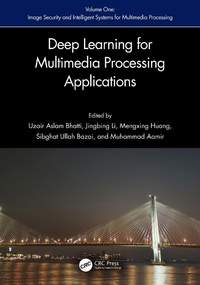
Deep Learning for Multimedia Processing Applications
Volume One: Image Security and Intelligent Systems for Multimedia Processing
1st Edition
Published on 21. February 2024
312 pages
978-1-003-82795-5 (ISBN)
Description

Deep Learning for Multimedia Processing Applications is a comprehensive guide that explores the revolutionary impact of deep learning techniques in the field of multimedia processing. Written for a wide range of readers, from students to professionals, this book offers a concise and accessible overview of the application of deep learning in various multimedia domains, including image processing, video analysis, audio recognition, and natural language processing.
Divided into two volumes, Volume One begins by introducing the fundamental concepts of deep learning, providing readers with a solid foundation to understand its relevance in multimedia processing. Readers will discover how deep learning techniques enable accurate and efficient image recognition, object detection, semantic segmentation, and image synthesis. The book also covers video analysis techniques, including action recognition, video captioning, and video generation, highlighting the role of deep learning in extracting meaningful information from videos.
Furthermore, the book explores audio processing tasks such as speech recognition, music classification, and sound event detection using deep learning models. It demonstrates how deep learning algorithms can effectively process audio data, opening up new possibilities in multimedia applications. Lastly, the book explores the integration of deep learning with natural language processing techniques, enabling systems to understand, generate, and interpret textual information in multimedia contexts.
Throughout the book, practical examples, code snippets, and real-world case studies are provided to help readers gain hands-on experience in implementing deep learning solutions for multimedia processing. Deep Learning for Multimedia Processing Applications is an essential resource for anyone interested in harnessing the power of deep learning to unlock the vast potential of multimedia data.
Divided into two volumes, Volume One begins by introducing the fundamental concepts of deep learning, providing readers with a solid foundation to understand its relevance in multimedia processing. Readers will discover how deep learning techniques enable accurate and efficient image recognition, object detection, semantic segmentation, and image synthesis. The book also covers video analysis techniques, including action recognition, video captioning, and video generation, highlighting the role of deep learning in extracting meaningful information from videos.
Furthermore, the book explores audio processing tasks such as speech recognition, music classification, and sound event detection using deep learning models. It demonstrates how deep learning algorithms can effectively process audio data, opening up new possibilities in multimedia applications. Lastly, the book explores the integration of deep learning with natural language processing techniques, enabling systems to understand, generate, and interpret textual information in multimedia contexts.
Throughout the book, practical examples, code snippets, and real-world case studies are provided to help readers gain hands-on experience in implementing deep learning solutions for multimedia processing. Deep Learning for Multimedia Processing Applications is an essential resource for anyone interested in harnessing the power of deep learning to unlock the vast potential of multimedia data.
More details
Edition
1. Auflage
Language
English
Place of publication
London
United Kingdom
Publishing group
Taylor & Francis Ebooks
Target group
College/higher education
Professional and scholarly
Illustrations
75 Tables, black and white; 36 Line drawings, color; 12 Line drawings, black and white; 26 Halftones, color; 41 Halftones, black and white; 62 Illustrations, color; 53 Illustrations, black and white
ISBN-13
978-1-003-82795-5 (9781003827955)
Copyright in bibliographic data and cover images is held by Nielsen Book Services Limited or by the publishers or by their respective licensors: all rights reserved.
Schweitzer Classification
Other editions
Additional editions
Uzair Aslam Bhatti | Huang Mengxing | Jingbing Li
Deep Learning for Multimedia Processing Applications
Volume One: Image Security and Intelligent Systems for Multimedia Processing
Book
approx. 12/2025
1st Edition
CRC Press
€99.30
Not yet published
Uzair Aslam Bhatti | Huang Mengxing | Jingbing Li
Deep Learning for Multimedia Processing Applications
Volume One: Image Security and Intelligent Systems for Multimedia Processing
Book
02/2024
1st Edition
CRC Press
€159.10
Shipment within 10-20 days
Persons
Uzair Aslam Bhatti was born in 1986. He received his PhD degree in information and communication engineering, Hainan University, Haikou, Hainan, in 2019. He completed his postdoctoral from Nanjing Normal University, Nanjing, China, in implementing Clifford algebra algorithms in analysing the geospatial data using artificial intelligence (AI). He is currently working as an associate professor in the School of Information and Communication Engineering in Hainan University. His areas of specialty include AI, machine learning, and image processing. He is serving as guest editor of various journals including Frontier in Plant Science, Frontier in Environmental Science, Computer Materials and Continua, PLoS One, IEEE Access, etc., and has reviewed many IEEE Transactions and Elsevier journals.
Jingbing Li is a doctor, professor, doctoral supervisor, and the vice president of Hainan Provincial Invention Association. He has been awarded honorary titles of Leading Talents in Hainan Province, Famous Teaching Teachers in Hainan Province, Outstanding Young and Middle-aged Backbone Teachers in Hainan Province, and Excellent Teachers in Baosteel. He has also won the second prize of the Hainan Provincial Science and Technology Progress Award three times (the first completer twice, the second completer once). He has obtained 13 authorized national invention patents, published 5 monographs such as medical image digital watermarking, and published more than 80 SCI/EI retrieved academic papers (including 22 SCI retrieved papers) as the first author or corresponding author. He has presided over two projects of the National Natural Science Foundation of China, and five projects of Hainan Province's key research and development projects and Hainan Province's international scientific and technological cooperation projects.
Dr. Huang Mengxing is dean of the School of Information, at Hainan University. He has occupied many roles, such as the leader of the talent team of "Smart Service", the chief scientist of the National Key R&D Program, a member of the Expert Committee of Artificial Intelligence and Blockchain of the Science and Technology Committee of the Ministry of Education, the executive director of the Postgraduate Education Branch of the China Electronics Education Society, and the Computer Professional Teaching Committee of the Ministry of Education, among others. His main research areas include big data and intelligent information processing, multi-source information perception and fusion, artificial intelligence and intelligent services, etc. In recent years, he has published more than 230 academic papers as the first author and corresponding author, has obtained 36 invention patents authorized by the state, 96 software copyrights, published 4 monographs, and translated 2 books. He has won first prize and second prize in the Hainan Provincial Science and Technology Progress Award as the first person who completed it; and won two Hainan Provincial Excellent Teaching Achievement Awards and Excellent Teacher Awards. He has presided over and undertaken more than 30 national, provincial, and ministerial-level projects, such as national key research and development plan projects, national science and technology support plans, and National Natural Science Foundation projects.
Sibghat Ullah Bazai completed his undergraduate and graduate studies in computer engineering at the Balochistan University of Information Technology, Engineering, and Management Sciences (BUITEMS) in Quetta, Pakistan. He received his PhD (IT) in cybersecurity from Massey University in Auckland, New Zealand, in 2020. As part of his research, he is interested in applying cybersecurity, identifying diseases with deep learning, automating exams with natural language processing, developing local language sentiment data sets, and planning smart cities. Sibghat is a guest editor and reviewer for several journals' special issues in MDPI, Hindawi, CMC, PLoS One, Frontier, and others.
Muhammad Aamir received the bachelor of engineering degree in computer systems engineering from Mehran University of Engineering & Technology Jamshoro, Sindh, Pakistan, in 2008, the master of engineering degree in software engineering from Chongqing University, China, in 2014, and the PhD degree in computer science and technology from Sichuan University, Chengdu, China, in 2019. He is currently an associate professor at the Department of Computer, Huanggang Normal University, China. His main research interests include pattern recognition, computer vision, image processing, deep learning, and fractional calculus.
Jingbing Li is a doctor, professor, doctoral supervisor, and the vice president of Hainan Provincial Invention Association. He has been awarded honorary titles of Leading Talents in Hainan Province, Famous Teaching Teachers in Hainan Province, Outstanding Young and Middle-aged Backbone Teachers in Hainan Province, and Excellent Teachers in Baosteel. He has also won the second prize of the Hainan Provincial Science and Technology Progress Award three times (the first completer twice, the second completer once). He has obtained 13 authorized national invention patents, published 5 monographs such as medical image digital watermarking, and published more than 80 SCI/EI retrieved academic papers (including 22 SCI retrieved papers) as the first author or corresponding author. He has presided over two projects of the National Natural Science Foundation of China, and five projects of Hainan Province's key research and development projects and Hainan Province's international scientific and technological cooperation projects.
Dr. Huang Mengxing is dean of the School of Information, at Hainan University. He has occupied many roles, such as the leader of the talent team of "Smart Service", the chief scientist of the National Key R&D Program, a member of the Expert Committee of Artificial Intelligence and Blockchain of the Science and Technology Committee of the Ministry of Education, the executive director of the Postgraduate Education Branch of the China Electronics Education Society, and the Computer Professional Teaching Committee of the Ministry of Education, among others. His main research areas include big data and intelligent information processing, multi-source information perception and fusion, artificial intelligence and intelligent services, etc. In recent years, he has published more than 230 academic papers as the first author and corresponding author, has obtained 36 invention patents authorized by the state, 96 software copyrights, published 4 monographs, and translated 2 books. He has won first prize and second prize in the Hainan Provincial Science and Technology Progress Award as the first person who completed it; and won two Hainan Provincial Excellent Teaching Achievement Awards and Excellent Teacher Awards. He has presided over and undertaken more than 30 national, provincial, and ministerial-level projects, such as national key research and development plan projects, national science and technology support plans, and National Natural Science Foundation projects.
Sibghat Ullah Bazai completed his undergraduate and graduate studies in computer engineering at the Balochistan University of Information Technology, Engineering, and Management Sciences (BUITEMS) in Quetta, Pakistan. He received his PhD (IT) in cybersecurity from Massey University in Auckland, New Zealand, in 2020. As part of his research, he is interested in applying cybersecurity, identifying diseases with deep learning, automating exams with natural language processing, developing local language sentiment data sets, and planning smart cities. Sibghat is a guest editor and reviewer for several journals' special issues in MDPI, Hindawi, CMC, PLoS One, Frontier, and others.
Muhammad Aamir received the bachelor of engineering degree in computer systems engineering from Mehran University of Engineering & Technology Jamshoro, Sindh, Pakistan, in 2008, the master of engineering degree in software engineering from Chongqing University, China, in 2014, and the PhD degree in computer science and technology from Sichuan University, Chengdu, China, in 2019. He is currently an associate professor at the Department of Computer, Huanggang Normal University, China. His main research interests include pattern recognition, computer vision, image processing, deep learning, and fractional calculus.
Content
1. A Novel Robust Watermarking Algorithm for Encrypted Medical Images Based on Non-Subsampled Shearlet Transform and Schur Decomposition Meng Yang, Jingbing Li1, Uzair Aslam Bhatti, Yiyi Yuan, and QinQing Zhang. 2. Robust Zero Watermarking Algorithm for Encrypted Medical Images Based on SUSAN-DCT Jingbing Li, Qinqing Zhang, Meng Yang, and Yiyi Yuan. 3. Robust Watermarking Algorithm for Encrypted Medical Volume Data Based on PJFM and 3D-DCT Lei Cao, Jingbing Li, and Uzair Aslam Bhatti. 4. Robust Zero Watermarking Algorithm for Medical Images Based on BRISK and DCT Fangchun Dong, Jingbing Li, and Uzair Aslam Bhatt. 5. Robust Color Images Zero Watermarking Algorithm Based on Smooth Wavelet Transform and Daisy descriptor Yiyi Yuan, Jingbing Li1, Uzair Aslam Bhatti, Meng Yang, and Qinqing Zhang. 6. Robust Multi-Watermarking Agorithm based on Darknet53 Convolutional Neural Network Dekai Li, Jingbing Li, and Uzair Aslam Bhatti. 7. Robust Multi-Watermarking Algorithm for Medical Images Based on Squeezenet Transfer Learning Pengju Zhang, Jingbing Li, and Uzair Aslam Bhatti. 8. Deep Learning Applications in Digital Image Security: Latest Methods And Techniques Saqib Ali Nawaz, Jingbing Li, Uzair Aslam Bhatti, Muhammad Usman Shoukat, and Raza Muhammad Ahmad. 9. Image Fusion Techniques and Applications for Remote Sensing Images and Medical Images Emadalden Alhatami, MengXing Huang, and Uzair Aslam Bhatti. 10. Detecting Phishing URLs Through Deep Learning Models Shah Noor, Sibghat Ullah Bazai, Saima Tareen, and Shafi Ullah. 11. Augmenting Multimedia Analysis: A Fusion of Deep Learning with Differential Privacy Iqra Tabassum and Dr. Sibghat Ullah Bazai. 12. Multi-Classification Deep Learning Models for Detecting Multiple Chest Infection using Cough and Breath Sound Amna Tahir, Hassaan Malik, and Muhammad Umar Chaudhry. 13. Classifying Traffic Signs using Convolutional Neural Networks based on Deep Learning Models Saira Akram, Sibghat Ullah Bazai, and Shah Marjan. 14. Cloud-Based Intrusion Detection System using Deep Neural Network and Human-in-the-Loop Decision-Making Hootan Alavizadeh and Hooman Alavizadeh.
