

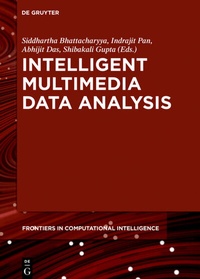
Intelligent Multimedia Data Analysis
Description

This volume comprises eight well-versed contributed chapters devoted to report the latest findings on the intelligent approaches to multimedia data analysis. Multimedia data is a combination of different discrete and continuous content forms like text, audio, images, videos, animations and interactional data. At least a single continuous media in the transmitted information generates multimedia information.
Due to these different types of varieties, multimedia data present varied degrees of uncertainties and imprecision, which cannot be easy to deal by the conventional computing paradigm. Soft computing technologies are quite efficient to handle the imprecision and uncertainty of the multimedia data and they are flexible enough to process the real-world information. Proper analysis of multimedia data finds wide applications in medical diagnosis, video surveillance, text annotation etc.
This volume is intended to be used as a reference by undergraduate and post graduate students of the disciplines of computer science, electronics and telecommunication, information science and electrical engineering.
THE SERIES: FRONTIERS IN COMPUTATIONAL INTELLIGENCE
The series Frontiers In Computational Intelligence is envisioned to provide comprehensive coverage and understanding of cutting edge research in computational intelligence. It intends to augment the scholarly discourse on all topics relating to the advances in artifi cial life and machine learning in the form of metaheuristics, approximate reasoning, and robotics. Latest research fi ndings are coupled with applications to varied domains of engineering and computer sciences. This field is steadily growing especially with the advent of novel machine learning algorithms being applied to different domains of engineering and technology. The series brings together leading researchers that intend to continue to advance the fi eld and create a broad knowledge about the most recent state of the art.
More details
Other editions
Additional editions
Persons
Content
- Intro
- Preface
- Contents
- 1. Medical color image enhancement: Problems, challenges &
- recent techniques
- 2. Exploring the scope of intelligent algorithms for various community detection techniques
- 3. An unsupervised graph-based approach for the representation of coronary arteries in X-ray angiograms
- 4. A study of recent trends in content based image classification
- 5. Intelligent monitoring and evaluation of digital geometry figures drawn by students
- 6. Rough set and soft set models in image processing
- 7. Quantum inspired simulated annealing technique for automatic clustering
- 8. Intelligent greedy model for influence maximization in multimedia data networks
- Index
