

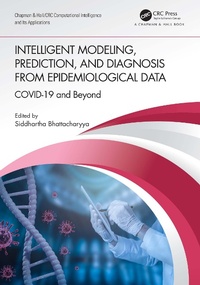
Intelligent Modeling, Prediction, and Diagnosis from Epidemiological Data
COVID-19 and Beyond
1st Edition
Published on 22. November 2021
232 pages
978-1-000-47470-1 (ISBN)
Description

Intelligent Modeling, Prediction, and Diagnosis from Epidemiological Data: COVID-19 and Beyond is a handy treatise to elicit and elaborate possible intelligent mechanisms for modeling, prediction, diagnosis, and early detection of diseases arising from outbreaks of different epidemics with special reference to COVID-19. Starting with a formal introduction of the human immune systems, this book focuses on the epidemiological aspects with due cognizance to modeling, prevention, and diagnosis of epidemics. In addition, it also deals with evolving decisions on post-pandemic socio-economic structure.
The book offers a comprehensive coverage of the most essential topics, including:
A general overview of pandemics and their outbreak behavior
A detailed overview of CI techniques
Intelligent modeling, prediction, and diagnostic measures for pandemics
Prognostic models
Post-pandemic socio-economic structure
The accompanying case studies are based on available real-world data sets.
While other books may deal with this COVID-19 pandemic, none features topics covering the human immune system as well as influences on the environmental disorder due to the ongoing pandemic.
The book is primarily intended to benefit medical professionals and healthcare workers as well as the virologists who are essentially the frontline fighters of this pandemic. In addition, it also serves as a vital resource for relevant researchers in this interdisciplinary field as well as for tutors and postgraduate and undergraduate students of information sciences.
The book offers a comprehensive coverage of the most essential topics, including:
A general overview of pandemics and their outbreak behavior
A detailed overview of CI techniques
Intelligent modeling, prediction, and diagnostic measures for pandemics
Prognostic models
Post-pandemic socio-economic structure
The accompanying case studies are based on available real-world data sets.
While other books may deal with this COVID-19 pandemic, none features topics covering the human immune system as well as influences on the environmental disorder due to the ongoing pandemic.
The book is primarily intended to benefit medical professionals and healthcare workers as well as the virologists who are essentially the frontline fighters of this pandemic. In addition, it also serves as a vital resource for relevant researchers in this interdisciplinary field as well as for tutors and postgraduate and undergraduate students of information sciences.
More details
Series
Edition
1. Auflage
Language
English
Place of publication
London
United Kingdom
Publishing group
Taylor & Francis Ltd
Target group
Professional and scholarly
College/higher education
Illustrations
33 Tables, black and white; 79 Line drawings, black and white; 79 Illustrations, black and white
ISBN-13
978-1-000-47470-1 (9781000474701)
Copyright in bibliographic data and cover images is held by Nielsen Book Services Limited or by the publishers or by their respective licensors: all rights reserved.
Schweitzer Classification
Other editions
Additional editions
Siddhartha Bhattacharyya
Intelligent Modeling, Prediction, and Diagnosis from Epidemiological Data
COVID-19 and Beyond
Book
10/2024
1st Edition
Chapman & Hall/CRC
€80.60
Shipment within 15-20 days
Siddhartha Bhattacharyya
Intelligent Modeling, Prediction, and Diagnosis from Epidemiological Data
COVID-19 and Beyond
Book
11/2021
1st Edition
Chapman & Hall/CRC
€184.70
Shipment within 15-20 days
Person
Dr. Siddhartha Bhattacharyya did his Bachelors in Physics, Bachelors in Optics and Optoelectronics and Masters in Optics and Optoelectronics from University of Calcutta, India in 1995, 1998 and 2000 respectively. He completed PhD in Computer Science and Engineering from Jadavpur University, India in 2008. He is the recipient of the University Gold Medal from the University of Calcutta for his Masters. He is the recipient of several coveted awards including the Distinguished HoD Award and Distinguished Professor Award conferred by Computer Society of India, Mumbai Chapter, India in 2017, the Honorary Doctorate Award (D. Litt.) from The University of South America and the South East Asian Regional Computing Confederation (SEARCC) International Digital Award ICT Educator of the Year in 2017. He has been appointed as the ACM Distinguished Speaker for the tenure 2018-2020. He has been inducted into the People of ACM hall of fame by ACM, USA in 2020. He has been appointed as the IEEE Computer Society Distinguished Visitor for the tenure 2021-2023.
He is currently serving as the Principal of Rajnagar Mahavidyalaya, Rajnagar, Birbhum. He served as a Professor in the Department of Computer Science and Engineering of Christ University, Bangalore. He served as the Principal of RCC Institute of Information Technology, Kolkata, India during 2017-2019. He has also served as a Senior Research Scientist in the Faculty of Electrical Engineering and Computer Science of VSB Technical University of Ostrava, Czech Republic (2018-2019). Prior to this, he was the Professor of Information Technology of RCC Institute of Information Technology, Kolkata, India. He served as the Head of the Department from March, 2014 to December, 2016. Prior to this, he was an Associate Professor of Information Technology of RCC Institute of Information Technology, Kolkata, India from 2011-2014. Before that, he served as an Assistant Professor in Computer Science and Information Technology of University Institute of Technology, The University of Burdwan, India from 2005-2011. He was a Lecturer in Information Technology of Kalyani Government Engineering College, India during 2001-2005. He is a co-author of 6 books and the co-editor of 75 books and has more than 300 research publications in international journals and conference proceedings to his credit. He has got two PCTs to his credit. He has been the member of the organizing and technical program committees of several national and international conferences. He is the founding Chair of ICCICN 2014, ICRCICN (2015, 2016, 2017, 2018), ISSIP (2017, 2018) (Kolkata, India). He was the General Chair of several international conferences like WCNSSP 2016 (Chiang Mai, Thailand), ICACCP (2017, 2019) (Sikkim, India) and (ICICC 2018 (New Delhi, India) and ICICC 2019 (Ostrava, Czech Republic).
He is the Associate Editor of several reputed journals including Applied Soft Computing, IEEE Access, Evolutionary Intelligence and IET Quantum Communications. He is the editor of International Journal of Pattern Recognition Research and the founding Editor in Chief of International Journal of Hybrid Intelligence, Inderscience. He has guest edited several issues with several international journals. He is serving as the Series Editor of IGI Global Book Series Advances in Information Quality and Management (AIQM), De Gruyter Book Series Frontiers in Computational Intelligence (FCI), CRC Press Book Series(s) Computational Intelligence and Applications & Quantum Machine Intelligence, Wiley Book Series Intelligent Signal and Data Processing, Elsevier Book Series Hybrid Computational Intelligence for Pattern Analysis and Understanding and Springer Tracts on Human Centered Computing.
His research interests include hybrid intelligence, pattern recognition, multimedia data processing, social networks and quantum computing.
Dr. Bhattacharyya is a life fellow of Optical Society of India (OSI), India, life fellow of International Society of Research and Development (ISRD), UK, a fellow of Institution of Engineering and Technology (IET), UK, a fellow of Institute of Electronics and Telecommunication Engineers (IETE), India and a fellow of Institution of Engineers (IEI), India. He is also a senior member of Institute of Electrical and Electronics Engineers (IEEE), USA, International Institute of Engineering and Technology (IETI), Hong Kong and Association for Computing Machinery (ACM), USA. He is a life member of Cryptology Research Society of India (CRSI), Computer Society of India (CSI), Indian Society for Technical Education (ISTE), Indian Unit for Pattern Recognition and Artificial Intelligence (IUPRAI), Center for Education Growth and Research (CEGR), Integrated Chambers of Commerce and Industry (ICCI), and Association of Leaders and Industries (ALI). He is a member of Institution of Engineering and Technology (IET), UK, International Rough Set Society, International Association for Engineers (IAENG), Hong Kong, Computer Science Teachers Association (CSTA), USA, International Association of Academicians, Scholars, Scientists and Engineers (IAASSE), USA, Institute of Doctors Engineers and Scientists (IDES), India, The International Society of Service Innovation Professionals (ISSIP) and The Society of Digital Information and Wireless Communications (SDIWC). He is also a certified Chartered Engineer of Institution of Engineers (IEI), India. He is on the Board of Directors of International Institute of Engineering and Technology (IETI), Hong Kong.
He is currently serving as the Principal of Rajnagar Mahavidyalaya, Rajnagar, Birbhum. He served as a Professor in the Department of Computer Science and Engineering of Christ University, Bangalore. He served as the Principal of RCC Institute of Information Technology, Kolkata, India during 2017-2019. He has also served as a Senior Research Scientist in the Faculty of Electrical Engineering and Computer Science of VSB Technical University of Ostrava, Czech Republic (2018-2019). Prior to this, he was the Professor of Information Technology of RCC Institute of Information Technology, Kolkata, India. He served as the Head of the Department from March, 2014 to December, 2016. Prior to this, he was an Associate Professor of Information Technology of RCC Institute of Information Technology, Kolkata, India from 2011-2014. Before that, he served as an Assistant Professor in Computer Science and Information Technology of University Institute of Technology, The University of Burdwan, India from 2005-2011. He was a Lecturer in Information Technology of Kalyani Government Engineering College, India during 2001-2005. He is a co-author of 6 books and the co-editor of 75 books and has more than 300 research publications in international journals and conference proceedings to his credit. He has got two PCTs to his credit. He has been the member of the organizing and technical program committees of several national and international conferences. He is the founding Chair of ICCICN 2014, ICRCICN (2015, 2016, 2017, 2018), ISSIP (2017, 2018) (Kolkata, India). He was the General Chair of several international conferences like WCNSSP 2016 (Chiang Mai, Thailand), ICACCP (2017, 2019) (Sikkim, India) and (ICICC 2018 (New Delhi, India) and ICICC 2019 (Ostrava, Czech Republic).
He is the Associate Editor of several reputed journals including Applied Soft Computing, IEEE Access, Evolutionary Intelligence and IET Quantum Communications. He is the editor of International Journal of Pattern Recognition Research and the founding Editor in Chief of International Journal of Hybrid Intelligence, Inderscience. He has guest edited several issues with several international journals. He is serving as the Series Editor of IGI Global Book Series Advances in Information Quality and Management (AIQM), De Gruyter Book Series Frontiers in Computational Intelligence (FCI), CRC Press Book Series(s) Computational Intelligence and Applications & Quantum Machine Intelligence, Wiley Book Series Intelligent Signal and Data Processing, Elsevier Book Series Hybrid Computational Intelligence for Pattern Analysis and Understanding and Springer Tracts on Human Centered Computing.
His research interests include hybrid intelligence, pattern recognition, multimedia data processing, social networks and quantum computing.
Dr. Bhattacharyya is a life fellow of Optical Society of India (OSI), India, life fellow of International Society of Research and Development (ISRD), UK, a fellow of Institution of Engineering and Technology (IET), UK, a fellow of Institute of Electronics and Telecommunication Engineers (IETE), India and a fellow of Institution of Engineers (IEI), India. He is also a senior member of Institute of Electrical and Electronics Engineers (IEEE), USA, International Institute of Engineering and Technology (IETI), Hong Kong and Association for Computing Machinery (ACM), USA. He is a life member of Cryptology Research Society of India (CRSI), Computer Society of India (CSI), Indian Society for Technical Education (ISTE), Indian Unit for Pattern Recognition and Artificial Intelligence (IUPRAI), Center for Education Growth and Research (CEGR), Integrated Chambers of Commerce and Industry (ICCI), and Association of Leaders and Industries (ALI). He is a member of Institution of Engineering and Technology (IET), UK, International Rough Set Society, International Association for Engineers (IAENG), Hong Kong, Computer Science Teachers Association (CSTA), USA, International Association of Academicians, Scholars, Scientists and Engineers (IAASSE), USA, Institute of Doctors Engineers and Scientists (IDES), India, The International Society of Service Innovation Professionals (ISSIP) and The Society of Digital Information and Wireless Communications (SDIWC). He is also a certified Chartered Engineer of Institution of Engineers (IEI), India. He is on the Board of Directors of International Institute of Engineering and Technology (IETI), Hong Kong.
Content
1. Human Immune System and Infectious Disease
Faruk Bin Poyen
2. A Systematic Review of Predictive Models on COVID-19 with a Special Focus on CARD Modeling with SEI Formulation-An Indian Scenario
Sougata Mazumder, Debjit Majumder, and Prasun Ghosal
3. Data Analytics to Assess the Outbreak of the Coronavirus Epidemic: Opportunities and Challenges
Mourade Azrour and Jamal Mabrouki
4. Leveraging Artificial Intelligence (AI) during the Coronavirus Pandemic: Applications and Challenges
Prabha Susy Mathew, Anitha S. Pillai, and Bindu Menon
5. Early Prediction of Coronavirus Epidemic Outbreak Using Stacked Long Short-Term Memory Networks
Debanjan Konar, Siddhartha Bhattacharyya, Sourav De, Aparajita Das, Jan Platos, Sergey V. Gorbachev, and Khan Muhammad
6. Use of Satellite Sensors to Diagnose Changes in Air Quality in Africa Before and During the COVID-19 Pandemic
Loubna Bouhachlaf, Jamal Mabrouki, Fatimazahra Mousli, Souad El Hajjaji, and Driss Dhiba
7. Public Sentiments Analysis through Tweets on the COVID-19 Pandemic: A Comparative Study and Performance Assessment
Bhagwati Prasad Pande and Koushal Kumar
8. Exploring Twitter Data to Understand the Impact of COVID-19 Pandemic in India Using NLP and Deep Learning
Rahul Deb Das, Ananda Sankar Pal, Madorina Paul, and Anjan Mandal
9. Novel Coronavirus (COVID-19): Tracking, Health Care Precautions, Alerts, and Early Warnings
Anupam Mondal and Naba Kumar Mondal
10. Edge Computing-Based Smart Healthcare System for Home Monitoring of Quarantine Patients: Security Threat and Sustainability Aspects
Biswajit Debnath, Adrija Das, Ankita Das, Rohit Roy Chowdhury, Saswati Gharami, and Abhijit Das
Faruk Bin Poyen
2. A Systematic Review of Predictive Models on COVID-19 with a Special Focus on CARD Modeling with SEI Formulation-An Indian Scenario
Sougata Mazumder, Debjit Majumder, and Prasun Ghosal
3. Data Analytics to Assess the Outbreak of the Coronavirus Epidemic: Opportunities and Challenges
Mourade Azrour and Jamal Mabrouki
4. Leveraging Artificial Intelligence (AI) during the Coronavirus Pandemic: Applications and Challenges
Prabha Susy Mathew, Anitha S. Pillai, and Bindu Menon
5. Early Prediction of Coronavirus Epidemic Outbreak Using Stacked Long Short-Term Memory Networks
Debanjan Konar, Siddhartha Bhattacharyya, Sourav De, Aparajita Das, Jan Platos, Sergey V. Gorbachev, and Khan Muhammad
6. Use of Satellite Sensors to Diagnose Changes in Air Quality in Africa Before and During the COVID-19 Pandemic
Loubna Bouhachlaf, Jamal Mabrouki, Fatimazahra Mousli, Souad El Hajjaji, and Driss Dhiba
7. Public Sentiments Analysis through Tweets on the COVID-19 Pandemic: A Comparative Study and Performance Assessment
Bhagwati Prasad Pande and Koushal Kumar
8. Exploring Twitter Data to Understand the Impact of COVID-19 Pandemic in India Using NLP and Deep Learning
Rahul Deb Das, Ananda Sankar Pal, Madorina Paul, and Anjan Mandal
9. Novel Coronavirus (COVID-19): Tracking, Health Care Precautions, Alerts, and Early Warnings
Anupam Mondal and Naba Kumar Mondal
10. Edge Computing-Based Smart Healthcare System for Home Monitoring of Quarantine Patients: Security Threat and Sustainability Aspects
Biswajit Debnath, Adrija Das, Ankita Das, Rohit Roy Chowdhury, Saswati Gharami, and Abhijit Das
