

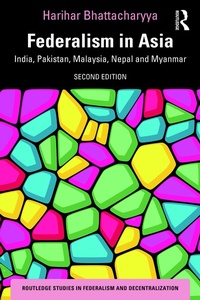
Federalism in Asia
India, Pakistan, Malaysia, Nepal and Myanmar
2nd Edition
Published on 4. August 2020
262 pages
978-1-000-06928-0 (ISBN)
Description

This comprehensive book critically analyzes the successes and failures of federalism in India, Pakistan, Malaysia, Nepal and Myanmar for the political accommodation of ethno-regional diversity and assesses their comparative democratic significance for other countries in Asia.
This revised new edition incorporates updated demographic, religious and linguistic data for the case study countries and examines some of the major changes that have taken place in formally federal states since 2010, including the 18th Amendment of the Constitution in Pakistan in 2010, which gave a major turn to decentralization by empowering the provinces; the new federal democratic Constitution that was introduced in Nepal in 2015; and the abolition of the Planning Commission and the National Development Council in India. The author thematically examines the growing tensions between nation and state-building in ethnically plural societies; modes of federation-building in Asia; persistent ethnic tensions in federations and the relationship between federalism and democracy; and federalism and decentralization.
The book will be of use to advanced undergraduate and postgraduate students of Asian politics, comparative federalism and modern Asian political history and institutions, as well as policy makers on ethnic conflict regulation and peace studies and stakeholders in ethnic power-sharing and political order.
This revised new edition incorporates updated demographic, religious and linguistic data for the case study countries and examines some of the major changes that have taken place in formally federal states since 2010, including the 18th Amendment of the Constitution in Pakistan in 2010, which gave a major turn to decentralization by empowering the provinces; the new federal democratic Constitution that was introduced in Nepal in 2015; and the abolition of the Planning Commission and the National Development Council in India. The author thematically examines the growing tensions between nation and state-building in ethnically plural societies; modes of federation-building in Asia; persistent ethnic tensions in federations and the relationship between federalism and democracy; and federalism and decentralization.
The book will be of use to advanced undergraduate and postgraduate students of Asian politics, comparative federalism and modern Asian political history and institutions, as well as policy makers on ethnic conflict regulation and peace studies and stakeholders in ethnic power-sharing and political order.
Reviews / Votes
"Anyone interested in South & South East Asian federations should start with Professor Bhattacharyya's survey; it addresses the established federations, the emergent Nepalese federation, and the more precarious case of Myanmar." - Brendan O'Leary, University of Pennsylvania, USA"Federalism as a political institution holds diverse societies together through an adroit conflation of self rule and shared rule, generating governance, political order, and legitimacy. Bhattacharyya applies this core idea critically to five federations of Asia. A hugely enjoyable book that enriches the classic wisdom and takes it forward." - Subrata K Mitra, Heidelberg University, Germany "Anyone interested in South & South East Asian federations should start with Professor Bhattacharyya's survey; it addresses the established federations, the emergent Nepalese federation, and the more precarious case of Myanmar." - Brendan O'Leary, University of Pennsylvania, USA
"Federalism as a political institution holds diverse societies together through an adroit conflation of self rule and shared rule, generating governance, political order, and legitimacy. Bhattacharyya applies this core idea critically to five federations of Asia. A hugely enjoyable book that enriches the classic wisdom and takes it forward." - Subrata K Mitra, Heidelberg University, Germany
"The major achievement of this work is conceptual clarity and conciseness. Prof Bhattacharyya, who has written extensively on federalism in India, and is arguably the leading authority on the subject today, takes the reader through complex and challenging debates with an ease that is normally missing in the literature on the subject... Overall, this is a signi?cant work of synthesis that brings together history, recent developments and a strong comparative dimension." - Gurharpal Singh, SOAS University of London, UK
More details
Series
Edition
2nd edition
Language
English
Place of publication
London
United Kingdom
Publishing group
Taylor & Francis Ltd
Target group
College/higher education
Professional and scholarly
Illustrations
18 Tables, black and white
ISBN-13
978-1-000-06928-0 (9781000069280)
Copyright in bibliographic data and cover images is held by Nielsen Book Services Limited or by the publishers or by their respective licensors: all rights reserved.
Schweitzer Classification
Other editions
Additional editions
Book
08/2020
2nd Edition
Routledge
€206.50
Shipment within 15-20 days
Book
08/2020
2nd Edition
Routledge
€63.40
Shipment within 15-20 days

Book
06/2020
Routledge
Unfortunately, price unknown
Available (delivery time upon request)
Person
Harihar Bhattacharyya is Professor of Political Science at Burdwan University, West Bengal, India. He has taught previously at Hull University, UK; Heidelberg University, Germany; and Delhi University, India. Known globally as an expert in Indian federalism and comparative federalism, he has published extensively on the subject. His book publications include Federalism in Asia (2010: Routledge); India as a Multicultural Federation: Asian Values, Democracy and Decentralisation (In comparison with Swiss Federalism) (2001); (co-authored) Radical Politics and Governance in India's North East: The Case of Tripura (2018: Routledge); and Politics and Governance in Indian States: Bihar, West Bengal and Tripura (2018: World Scientific). His journal articles include: 'Indian Federalism and Democracy: The Growing Salience of Diversity-claims over Equality-claims in Comparative and Indian Perspective' (Regional and Federal Studies 2015) and 'Pitfalls of India's Ethno-federal Model of Ethnic Conflict Management: Tension Between Tribal Ethnicity and Territory in India's North East' (Ethnopolitics 2019).
Content
Introduction: Federalism in Asia 1. Concept of federalism and its relevance 2. Ethno-national diversity and federalism 3. Origin and development of federalism: colonialism, decolonization and revolution 4. Federalism and Institutional Innovations 5. Dynamics of federalism: political parties and ethnic movements 6. Centre-State relations: structure and processes 7. Federalism and Forms of Decentralization 8. Federalism and Democracy: New questions asked Conclusion: Beyond the Diversity problematic
