

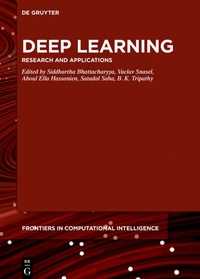
Deep Learning
Description

This book focuses on the fundamentals of deep learning along with reporting on the current state-of-art research on deep learning. In addition, it provides an insight of deep neural networks in action with illustrative coding examples.
Deep learning is a new area of machine learning research which has been introduced with the objective of moving ML closer to one of its original goals, i.e. artificial intelligence. Deep learning was developed as an ML approach to deal with complex input-output mappings. While traditional methods successfully solve problems where final value is a simple function of input data, deep learning techniques are able to capture composite relations between non-immediately related fields, for example between air pressure recordings and English words, millions of pixels and textual description, brand-related news and future stock prices and almost all real world problems.
Deep learning is a class of nature inspired machine learning algorithms that uses a cascade of multiple layers of nonlinear processing units for feature extraction and transformation. Each successive layer uses the output from the previous layer as input. The learning may be supervised (e.g. classification) and/or unsupervised (e.g. pattern analysis) manners. These algorithms learn multiple levels of representations that correspond to different levels of abstraction by resorting to some form of gradient descent for training via backpropagation. Layers that have been used in deep learning include hidden layers of an artificial neural network and sets of propositional formulas. They may also include latent variables organized layer-wise in deep generative models such as the nodes in deep belief networks and deep boltzmann machines. Deep learning is part of state-of-the-art systems in various disciplines, particularly computer vision, automatic speech recognition (ASR) and human action recognition.
More details
Other editions
Additional editions

Persons
Content
- Intro
- Preface
- Contents
- List of Contributors
- 1 Deep Learning - A State-of-the-Art Approach to Artificial Intelligence
- 2 Convolutional Neural Networks: A Bottom-Up Approach
- 3 Handwritten Digit Recognition Using Convolutional Neural Networks
- 4 Impact of Deep Neural Learning on Artificial Intelligence Research
- 5 Extraction of Common Feature of Dysgraphia Patients by Handwriting Analysis Using Variational Autoencoder
- 6 Deep Learning for Audio Signal Classification
- 7 Backpropagation Through Time Algorithm in Temperature Prediction
- Index
