

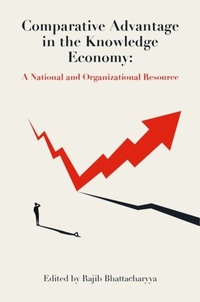
Comparative Advantage in the Knowledge Economy
A National and Organizational Resource
1st Edition
Published on 8. June 2021
296 pages
978-1-80071-042-9 (ISBN)
Description

Globalization and information and communications technology (ICT) have played a pivotal role in revolutionizing value creation through the development of human capital formation. The constantly changing needs and structure of the labour market are primarily responsible for the conversion of a traditional economy relying fundamentally on the application of physical abilities to a knowledge-based economy relying on ideas, technologies and innovations. In this economy, knowledge has to be created, acquired, developed, transmitted, preserved and utilized for the improvement of individual and social welfare.
Comparative Advantage in the Knowledge Economy: A National and Organizational Resource provides a comprehensive and insightful understanding of all the dimensions of a transition from a traditional to a knowledge economy. It attempts to explain how educational achievement, skilled manpower, investment in knowledge capital and analytics will be the key to success of a nation's comparative advantage in the globalized era.
The volume should be of interest to students, researchers and teachers of economics, policy makers and advanced graduate students with an interest in economic analyses and development policy.
Comparative Advantage in the Knowledge Economy: A National and Organizational Resource provides a comprehensive and insightful understanding of all the dimensions of a transition from a traditional to a knowledge economy. It attempts to explain how educational achievement, skilled manpower, investment in knowledge capital and analytics will be the key to success of a nation's comparative advantage in the globalized era.
The volume should be of interest to students, researchers and teachers of economics, policy makers and advanced graduate students with an interest in economic analyses and development policy.
More details
Language
English
Place of publication
Bingley
United Kingdom
Target group
Professional and scholarly
File size
3,81 MB
ISBN-13
978-1-80071-042-9 (9781800710429)
Copyright in bibliographic data and cover images is held by Nielsen Book Services Limited or by the publishers or by their respective licensors: all rights reserved.
Schweitzer Classification
Other editions
Additional editions
Rajib Bhattacharyya
Comparative Advantage in the Knowledge Economy
A National and Organizational Resource
Book
06/2021
Emerald Publishing Limited
€114.70
Shipment within 3-4 weeks
Person
Rajib Bhattacharyya is an Associate Professor in Economics in the Goenka College of Commerce and Business Administration, Kolkata, India. He has 19 years of teaching experience. His fields of research interests include international trade, finance, Indian economic development, and women's empowerment. He has contributed a good number of articles and has also worked as a member of the Editorial Board for reputed national and international journals and books published by IGI Global (USA), Emerald (U.K.) and Springer. He recently edited a book entitled Gains and Pains of Financial Integration and Trade Liberalization: Lessons from Emerging Economies (Emerald, 2020).
Content
Introduction; Rajib Bhattacharyya Chapter 1. Knowledge-Based Economy: Enhancing Economic Growth and Development of Human Capital through Information and Communications Technology Education; Napoleon Kurantin and Bertha Z. Osei-Hwedie
Chapter 2. Sub-Saharan African (SSA) Growth Trajectory: How far has Knowledge contributed?; Ezebuilo R. UKWUEZE, Oliver E. OGBONNA, Ozoemena S. NWODO, Chinasa E. URAMA, Tochukwu G. ONYECHI, and Augustine J. Mba
Chapter 3. Central Bank Independence & Economic Efficiency: Historical Analysis Based on Knowledge Economy; Partha Gangopadhya and James Glenn
Chapter 4. Reshaping Indian Higher Education post COVID-19: a Case for Blended Learning and Widespread Adoption of Learning Management Systems; Sudipta Roy
Chapter 5. Disruptive Technology and Development Dynamics: Case of Knowledge Economy with reference to India; Mainak Bhattacharjee and Sanghita Ghosh
Chapter 6. A Theoretical Approach of Understanding the Impact of Arbitrage Process by Implementing Knowledge Economy by a Country; Abhijit Dutta and Madhabendra Sinha
Chapter 7. Existence of speculative bubbles in the Indian stock market: Knowledge gained during the US Sub-prime Crisis; Sovik Mukherjee and Asim K. Karmakar
Chapter 8. E-knowledge of Indian Rural Consumers: A Field Survey Result Based on Durable Goods;
Debabrata Mukhopadhyay and Arun Kumar Mandal
Chapter 9. Impact of Information and Communication Technology on Human Development: A Cross-Country Analysis; Abhijit Bhattacharya
Chapter 10. Role of FDI in Developing the Base of Knowledge - An Analysis of the BRICS Nations; Nilendu Chatterjee and Dipak Kundu
Chapter 11. ICT as Enabler of Knowledge-Based Economy: An Empirical Investigation in India Based on NSSO Unit-level Data; AdwaitaMaiti, Sebak Kumar Jana, and Asim K. Karmakar
Chapter 12. Trade Openness and Skill Formation: Some Theoretical Issues in relation to Less Developed Economy; Mainak Bhattacharjee, Dipti Ghosh, and Debashis Mazumdar
Chapter 13. FDI and Transition to Knowledge Economy with Special Reference to India; Debjani Mitra
Chapter 14. Innovation in Utility Craftsmanship: Analysis Based on Human Capital; Jose G. Vargas-Hernandez and Lic. Jonathan Daniel Chavez Ascencio
Chapter 15. Agricultural Knowledge System in Ensuring Food Security in India; Rajat Jyoti Sarkar and Moumita Karmakar
Chapter 16. Managing & Leveraging Knowledge Assets of the Firm: The Call of the Day; Sandip Kumar Pandit
Chapter 17. Measuring Student Satisfaction of Master Level Students; Evidence from University of North Bengal; Kanchan Datta and Jannatul Firdous
Chapter 18. The Role of Trade Liberalization and Knowledge Exchange Programs in India and South Korea Relations: In Search of Soft Power Connectivity; Debasish Nandy
Chapter 19. Impact of Knowledge Flows and FDI on Intra-industry trade in Asian Region; Suvayan Neogi and Pragati Sharma
Chapter 20. A study on the Digital Economy and recent trends of digitalization in India with respect to the Nordic Region; Subhankar Parbat, Trupti Upadhyay and Adwitiraj Banerjee
Chapter 21. Investment on Higher Education: A Source of Knowledge Creation and Income Generation; Sujata Mukherjee and Rajat Jyoti Sarkar
Chapter 22. Application of Information and Communication Technology and its Relation with Urbanization in India; Mahananda Kanjilal
Chapter 2. Sub-Saharan African (SSA) Growth Trajectory: How far has Knowledge contributed?; Ezebuilo R. UKWUEZE, Oliver E. OGBONNA, Ozoemena S. NWODO, Chinasa E. URAMA, Tochukwu G. ONYECHI, and Augustine J. Mba
Chapter 3. Central Bank Independence & Economic Efficiency: Historical Analysis Based on Knowledge Economy; Partha Gangopadhya and James Glenn
Chapter 4. Reshaping Indian Higher Education post COVID-19: a Case for Blended Learning and Widespread Adoption of Learning Management Systems; Sudipta Roy
Chapter 5. Disruptive Technology and Development Dynamics: Case of Knowledge Economy with reference to India; Mainak Bhattacharjee and Sanghita Ghosh
Chapter 6. A Theoretical Approach of Understanding the Impact of Arbitrage Process by Implementing Knowledge Economy by a Country; Abhijit Dutta and Madhabendra Sinha
Chapter 7. Existence of speculative bubbles in the Indian stock market: Knowledge gained during the US Sub-prime Crisis; Sovik Mukherjee and Asim K. Karmakar
Chapter 8. E-knowledge of Indian Rural Consumers: A Field Survey Result Based on Durable Goods;
Debabrata Mukhopadhyay and Arun Kumar Mandal
Chapter 9. Impact of Information and Communication Technology on Human Development: A Cross-Country Analysis; Abhijit Bhattacharya
Chapter 10. Role of FDI in Developing the Base of Knowledge - An Analysis of the BRICS Nations; Nilendu Chatterjee and Dipak Kundu
Chapter 11. ICT as Enabler of Knowledge-Based Economy: An Empirical Investigation in India Based on NSSO Unit-level Data; AdwaitaMaiti, Sebak Kumar Jana, and Asim K. Karmakar
Chapter 12. Trade Openness and Skill Formation: Some Theoretical Issues in relation to Less Developed Economy; Mainak Bhattacharjee, Dipti Ghosh, and Debashis Mazumdar
Chapter 13. FDI and Transition to Knowledge Economy with Special Reference to India; Debjani Mitra
Chapter 14. Innovation in Utility Craftsmanship: Analysis Based on Human Capital; Jose G. Vargas-Hernandez and Lic. Jonathan Daniel Chavez Ascencio
Chapter 15. Agricultural Knowledge System in Ensuring Food Security in India; Rajat Jyoti Sarkar and Moumita Karmakar
Chapter 16. Managing & Leveraging Knowledge Assets of the Firm: The Call of the Day; Sandip Kumar Pandit
Chapter 17. Measuring Student Satisfaction of Master Level Students; Evidence from University of North Bengal; Kanchan Datta and Jannatul Firdous
Chapter 18. The Role of Trade Liberalization and Knowledge Exchange Programs in India and South Korea Relations: In Search of Soft Power Connectivity; Debasish Nandy
Chapter 19. Impact of Knowledge Flows and FDI on Intra-industry trade in Asian Region; Suvayan Neogi and Pragati Sharma
Chapter 20. A study on the Digital Economy and recent trends of digitalization in India with respect to the Nordic Region; Subhankar Parbat, Trupti Upadhyay and Adwitiraj Banerjee
Chapter 21. Investment on Higher Education: A Source of Knowledge Creation and Income Generation; Sujata Mukherjee and Rajat Jyoti Sarkar
Chapter 22. Application of Information and Communication Technology and its Relation with Urbanization in India; Mahananda Kanjilal
