

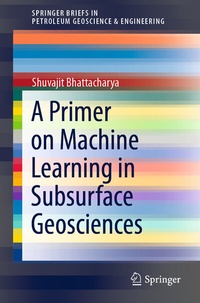
A Primer on Machine Learning in Subsurface Geosciences
Description

This book provides readers with a timely review and discussion of the success, promise, and perils of machine learning in geosciences. It explores the fundamentals of data science and machine learning, and how their advances have disrupted the traditional workflows used in the industry and academia, including geology, geophysics, petrophysics, geomechanics, and geochemistry. It then presents the real-world applications and explains that, while this disruption has affected the top-level executives, geoscientists as well as field operators in the industry and academia, machine learning will ultimately benefit these users. The book is written by a practitioner of machine learning and statistics, keeping geoscientists in mind. It highlights the need to go beyond concepts covered in STAT 101 courses and embrace new computational tools to solve complex problems in geosciences. It also offers practitioners, researchers, and academics insights into how to identify, develop, deploy, and recommend fit-for-purpose machine learning models to solve real-world problems in subsurface geosciences.
More details
Other editions
Additional editions
Person
Content
Introduction.- Brief Review of Statistical Measures.- Basic Steps in Machine Learning and Deep Learning Models.- Brief Review of Popular Machine Learning and Deep Learning Algorithms.- Applications of ML/DL in Geophysics and Petrophysics Domain.- Applications of ML/DL in Geology Domain.- Multi-scale Data Integration and Analytics.- The Road Ahead.
