

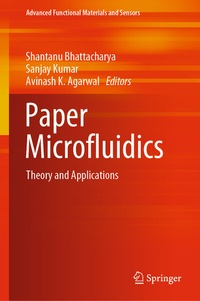
Paper Microfluidics
Description

More details
Other editions
Additional editions
Persons
Dr. Shantanu Bhattacharya (PhD) is a Dr. Gurumukh T. and Veena M. Mehta Chair and Professor of Mechanical Engineering and the Head of Design Program at the Indian Institute of Technology Kanpur. Prior to this, he completed his MS in Mechanical Engineering from the Texas Tech University, Lubbock, Texas and a PhD in Bioengineering from the University of Missouri at Columbia, United States of America. He completed his postdoctoral training at the Birck Nanotechnology Center at Purdue University. Dr. Bhattacharya's main research interests are Design and development of micro- nanosensors and actuation platforms, nano-energetic materials, micro and nanofabrication technologies, water remediation using visible light photocatalysis and product design and development. He has many awards and accolades to his credit which includes the Institution of Engineers Young engineer award, the Institute of Smart structures and systems young scientist award, the national design research best mechanical engineering award, fellowship from the high energetic materials institute at Australia, fellowship of the Institution of Engineers of India etc. Dr. Bhattacharya has guided many PhD and masters' students and has many peer-reviewed international journal publications, patents, books, and conference proceedings.
Dr. Sanjay Kumar is currently a Research Fellow at the National University of Singapore, Singapore. He received his PhD in design and fabrication of functionally engineered materials from the Department of Mechanical Engineering, Indian Institute of Technology Kanpur, India. His research focuses on the development of design and development of acoustic metamaterials, acoustic wave control, paper-based analytical devices for point-of-care diagnostic applications, synthesis of nanoscale materials with controllable size and shape, design of multifunctional materials through self-assembly of nanoparticles, additive manufacturing processes, theoretical modeling andoptimization, finite-element based numerical simulation, etc. He has published eight journal papers in peer reviewed international journals, six book chapters, and two US patent (filed). Along with Ms. Pulak Bhushan and Prof. Shantanu Bhattacharya, he received the Gandhian Young Technological Innovation (GYTI 2017) Award at Rashtrapati Bhavan, New Delhi, India for development of a dengue NS1 detection kit. He was also awarded the "IFMBE Young Investigator Award" at the 2nd International Conference for Innovation in Biomedical Engineering and Life Sciences (ICIBEL2017) held in conjunction with the 10th Asia Pacific Conference on Medical and Biological Engineering (APCMBE2017) Malaysia.
Prof. Avinash Kumar Agarwal joined IIT Kanpur in 2001. He worked at the Engine Research Center, UW@Madison, USA as a Post-Doctoral Fellow (1999 - 2001). His interests are IC engines, combustion, alternate and conventional fuels, lubricating oil tribology, optical diagnostics, laser ignition, HCCI, emissions and particulate control, and large bore engines. Prof. Agarwal has published 270+ peer reviewed international journal and conference papers, 35 edited books, 63 books chapters and has 7850+ Scopus and 11900+ Google scholar citations. He is associate editor of ASME Journal of Energy Resources Technology. He has edited "Handbook of Combustion" (5 Volumes; 3168 pages), published by Wiley VCH, Germany. Prof. Agarwal is a Fellow of SAE (2012), Fellow of ASME (2013), Fellow of NASI (2018), Fellow of Royal Society of Chemistry (2018), Fellow of ISEES (2015), and a Fellow of INAE (2015). He is recipient of several prestigious awards such as Clarivate Analystics India Citation Award-2017 in Engineering and Technology, NASI-Reliance Industries Platinum Jubilee Award-2012; INAE Silver Jubilee Young Engineer Award-2012; Dr. C. V. Raman Young Teachers Award: 2011; SAE Ralph R. Teetor Educational Award -2008; INSA Young Scientist Award-2007; UICT Young Scientist Award-2007; INAE YoungEngineer Award-2005. Prof. Agarwal received Prestigious Shanti Swarup Bhatnagar Award-2016 in Engineering Sciences.Content
Introduction to Paper Microfluidics.- Fluid Transport Mechanisms in Paper-Based Microfluidic Devices.- Fabrication Techniques for Paper-Based Microfluidic Devices.- Flow Control in Paper-Based Microfluidic Devices.- Sensing Mechanisms in paper-Based Devices.- Advances in Paper Based Point of Care Diagnostics for Blood/Plasma Separation.- Evolution of Paper Microfluidics as an Alternate Diagnostic Platform.- Paper-Based Microfluidic Systems for Detection of Infectious Diseases.- Paper Based Sensor for Clinical and Biomedical Applications.- Paper-Based Microfluidic Devices for Detection of DNA.- Nucleic Acid Amplification on Paper Substrates.- Paper: A Versatile Material for the Fabrication of Low-Cost Wearable Devices.- Paper-Based Devices for Wearable Diagnostic Applications.- Paper-Based Devices for Food Quality Control.- Environmental Monitoring Using Paper-Based Devices.- Paper-Based Devices for Energy Storage Applications.- Future of Paper Microfluidic Systems.
