

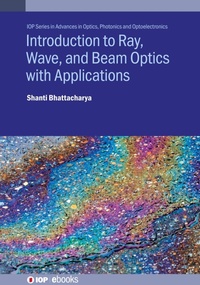
Introduction to Ray, Wave, and Beam Optics with Applications
Description

Optics is integral to our everyday lives, influencing everything from entertainment technologies to life-saving instruments. Despite its importance, optics is often not a core subject in many undergraduate engineering programs. This book aims to introduce the fundamentals of optics, making the subject accessible to all engineers and scientists, regardless of their background. While primarily designed for undergraduate students, it is also suitable for industry professionals who lack a formal optics education. By mastering the basics of optics, engineers will place themselves in a position to communicate more clearly with and better understand their colleagues. Beyond its educational purpose, this book also seeks to inspire a sense of wonder when observing natural phenomena and the fascinating optical effects produced by modern technology. A unique aspect of this textbook is that it includes a chapter on complex light. Beams that fall under this category are transforming the way imaging is done, and understanding how to generate and manipulate such beams is an essential skill for any aspiring optical engineer.
The book's approach, particularly in the first four chapters, is to present essential concepts related to optical systems, design, and aberrations, encouraging readers to simulate or model these ideas using optical design tools like OSLO (a registered trademark of Lambda Research Corporation) or Zemax OpticStudio (a registered trademark of Ansys). Later chapters introduce exercises that can be performed using programming tools like Matlab (a registered trademark of The MathWorks, Inc.), allowing readers to test their understanding.
More details
Other editions
Additional editions
Person
Shanti Bhattacharya obtained her Ph.D. in Physics from the Indian Institute of Technology, Madras, in 1997. She was awarded the Alexander von Humboldt award in 1998 and worked at the Technical University of Darmstadt, Germany for several years. She subsequently joined Analog Devices, Cambridge, USA, where she worked as a design engineer. She is currently a Professor at the Department of Electrical Engineering, IIT Madras. She has served on the board of OSA (now known as Optica) and is currently an Associate Editor of Optical Engineering and the Journal of Optical Microsystems, as well as being a member of the editorial board of the Journal of Optics (India). Her current research interests are design and fabrication of dielectric meta and diffractive optics, optical MEMS, and studies relating to imaging techniques. While she loves her work with light, she also loves her breaks, which more often than not involve escaping to the Himalayas for a while.
Content
Preface
Acknowledgements
Author biography
List of abbreviations
1 Introduction
2 Geometric Optics and imaging
3 Thick Lenses
4 Aberrations
5 Gaussian beams
6 Basics of Interference
7 Diffraction and diffractive optics
8 Introduction to complex light
9 Everyday optical systems and beyond
Appendix A: Using Zemax or OSLO to achieve optical design goals
