

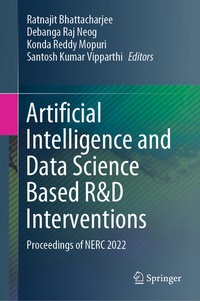
Artificial Intelligence and Data Science Based R&D Interventions
Proceedings of NERC 2022
1st Edition
Published on 4. September 2023
XXVIII, 205 pages
978-981-99-2609-1 (ISBN)
Description

This book title is a composition of multiple research efforts that are based on cutting-edge Artificial Intelligence (AI) techniques. Some of the signal processing problems are addressed with techniques from the broad areas of machine learning and deep learning.
More details
Series
Language
English
Place of publication
Singapore
Singapore
Publishing group
Springer Singapore
Product notice
Reflowable
Illustrations
XXVIII, 205 p. 113 illus., 85 illus. in color.
File size
6,71 MB
ISBN-13
978-981-99-2609-1 (9789819926091)
DOI
10.1007/978-981-99-2609-1
Schweitzer Classification
Other editions
Additional editions
Ratnajit Bhattacharjee | Debanga Raj Neog | Konda Reddy Mopuri
Artificial Intelligence and Data Science Based R&D Interventions
Proceedings of NERC 2022
Book
09/2023
Springer
€160.49
Shipment within 3-4 weeks
Persons
Dr. Ratnajit Bhattacharjee joined IIT Guwahati in the year 2002 and currently is a Professor in the Department of Electronics and Electrical Engineering. His research interests include Wireless communication, Wireless networks, Microstrip antennas, Microwave Engineering and Electromagnetics. He has co-authored about one hundred and sixty research papers. Nineteen research students have completed their PhD under his supervision and at present several research scholars are working under his guidance. He has served as a General Chair for 5th edition of IEEE Applied Electromagnetic Conference, AEMC 2015 and 22nd National Conference on Communications, NCC 2016, Chair for the 18th National Power System Conference, NPSC 2014 . He has served as Head, Electronics and Electrical Engineering, IIT Guwahati, from 2011 to 2014. He has delivered invited talks in a number of conferences, symposia and workshops. He has developed a web course on Electromagnetic theory and MOOC video course on Microwave Engineering under NPTEL. He has also been involved with several research projects. He is institute coordinator for the ongoing Virtual Lab project of Ministry of Education and served as the Chief Investigator for Ministry of Electronics and Information Technology (MeitY) sponsored project for setting up of an Electronics & ICT academy at IIT Guwahati. He is a member of the Research Advisory Committee of SAMEER (Society for Applied Microwave Electronics Engineering & Research). He is presently Head for the Mehta Family School of Data Science and Artificial Intelligence, IIT Guwahati and also Head of the Computer Communication Centre, IIT Guwahati. Prior to joining IIT Guwahati, he served as a faculty member in REC (at present NIT) Silchar from 1991 to 2002.
Dr. Bhattacharjee completed his B.E. degree (with First Class Hons.) in Electronics and Telecommunication Engineering from REC (at present NIT) Silchar, the M. Tech. degree in Electronics and Electrical Communication Engineering (Specialization: Microwave Engineering) from IIT Kharagpur and the Ph.D. degree in Engineering from Jadavpur University, Kolkata, India.
Dr. Debanga Raj Neog is an Assistant Professor at Mehta Family School of Data Science and Artificial Intelligence (MFSDS&AI), IIT Guwahati. He obtained his Ph.D. in Computer Science from The University of British Columbia (UBC), Vancouver, Canada in 2018 and his B.Tech. in Electronics and Communication Engineering from IIT Guwahati, India. His research interests span across computer vision, computer graphics, machine learning, and virtual/augmented reality. He is a recipient of the Mitacs Globalink Research Award under which he collaborated with researchers in INRIA Grenoble Rhone-Alpes, France. He joined MFSDS&AI, IIT Guwahati in September 2021.
Dr. Konda Reddy Mopuri is currently an assistant professor at the Department of Artificial Intelligence, IIT Hyderabad. Before this he served onthe faculty of IIT Guwahati and IIT Tirupati. He held a post-doctoral position at the School of Informatics, University of Edinburgh, UK. He received his PhD from Dept. of Computational and Data Sciences, IISc Bengaluru. His thesis won the IUPRAI Best doctoral dissertation award and the SPCOM Best doctoral dissertation award for 2018. He publishes his research in top-tier venues such as ICLR, ICML, CVPR, ECCV, WACV, BMVC, Trans. on PAMI, Tran. on Image processing, and Frontiers in Robotics and AI. His work lies broadly in Deep learning, AI, Computer Vision, Image/Signal processing, Data Science.
Dr. Santosh Kumar Vipparthi, a senior member of IEEE, has 12+ years of experience, including teaching and industry. Currently, he is an Assistant Professor at Indian Institute of Technology Ropar (IIT Ropar), India. Before this, he served at the Mehta Family School of Data Science and Artificial Intelligence, Indian Institute of Technology, Guwahati (IITGuwahati) and Malaviya National Institute of Technology (MNIT), Jaipur (An Institute of National Importance and one of the top NITs fully funded by the Ministry of Education, Government of India). He received Ph.D. and MTech degrees with Honors in Systems Engineering from the Indian Institute of Technology Varanasi (IIT Varanasi), BHU, India, and a B.E. degree in Electrical and Electronics Engineering from Andhra University, Andhra Pradesh, India. Dr. Vipparthi's research in the area of computer vision, affective computing, deep learning, etc.
Dr. Bhattacharjee completed his B.E. degree (with First Class Hons.) in Electronics and Telecommunication Engineering from REC (at present NIT) Silchar, the M. Tech. degree in Electronics and Electrical Communication Engineering (Specialization: Microwave Engineering) from IIT Kharagpur and the Ph.D. degree in Engineering from Jadavpur University, Kolkata, India.
Dr. Debanga Raj Neog is an Assistant Professor at Mehta Family School of Data Science and Artificial Intelligence (MFSDS&AI), IIT Guwahati. He obtained his Ph.D. in Computer Science from The University of British Columbia (UBC), Vancouver, Canada in 2018 and his B.Tech. in Electronics and Communication Engineering from IIT Guwahati, India. His research interests span across computer vision, computer graphics, machine learning, and virtual/augmented reality. He is a recipient of the Mitacs Globalink Research Award under which he collaborated with researchers in INRIA Grenoble Rhone-Alpes, France. He joined MFSDS&AI, IIT Guwahati in September 2021.
Dr. Konda Reddy Mopuri is currently an assistant professor at the Department of Artificial Intelligence, IIT Hyderabad. Before this he served onthe faculty of IIT Guwahati and IIT Tirupati. He held a post-doctoral position at the School of Informatics, University of Edinburgh, UK. He received his PhD from Dept. of Computational and Data Sciences, IISc Bengaluru. His thesis won the IUPRAI Best doctoral dissertation award and the SPCOM Best doctoral dissertation award for 2018. He publishes his research in top-tier venues such as ICLR, ICML, CVPR, ECCV, WACV, BMVC, Trans. on PAMI, Tran. on Image processing, and Frontiers in Robotics and AI. His work lies broadly in Deep learning, AI, Computer Vision, Image/Signal processing, Data Science.
Dr. Santosh Kumar Vipparthi, a senior member of IEEE, has 12+ years of experience, including teaching and industry. Currently, he is an Assistant Professor at Indian Institute of Technology Ropar (IIT Ropar), India. Before this, he served at the Mehta Family School of Data Science and Artificial Intelligence, Indian Institute of Technology, Guwahati (IITGuwahati) and Malaviya National Institute of Technology (MNIT), Jaipur (An Institute of National Importance and one of the top NITs fully funded by the Ministry of Education, Government of India). He received Ph.D. and MTech degrees with Honors in Systems Engineering from the Indian Institute of Technology Varanasi (IIT Varanasi), BHU, India, and a B.E. degree in Electrical and Electronics Engineering from Andhra University, Andhra Pradesh, India. Dr. Vipparthi's research in the area of computer vision, affective computing, deep learning, etc.
Content
Negation in A Language.- A Computational Approach for the Tonal Identification in Bodo Language.- Real-Time Detection of Natural Scene Assamese Texts using Deep Learning.- Development Of Directional Drilling Well Profile Design App Using Python.- Prediction and forecasting municipal solid waste generation of Northeastern cities by retrofitting ML models of Guwahati, India.
