
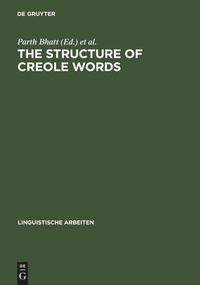
The Structure of Creole Words
Description
Alles über E-Books | Antworten auf Fragen rund um E-Books, Kopierschutz und Dateiformate finden Sie in unserem Info- & Hilfebereich.
This volume brings together articles that are focused on segmental, syllabic and morphological aspects of creole words, thus contributing to the ongoing debates about the nature of phonology and morphology and their role in emergence and development of these languages. The papers cover a wide range of creole languages with different lexifier languages and address empirical, typological, historical and theoretical issues, drawing our attention to hitherto unknown phenomena or offering interesting new analyses of established facts. With contributions from: Parth Bhatt, Alain Kihm, Thomas Klein, Emmanuel Nikiema, Ingo Plag, Marina Pucciarelli, Jean-Louis Rougé, Eric Russel-Webb, Shobha Satyanath, Emmanuel Schang, Mareile Schramm, Norval Smith, Marleen van de Vate and Tonjes Veenstra.
Reviews / Votes
"...a very worthwhile read and highly informative..."Michael Aceto in: Journal of Pidgin and Creole Languages, Nr. 23/1 (2008)More details
Other editions
Additional editions

System requirements
File format: PDF
Copy protection: Watermark-DRM (Digital Rights Management)
System requirements:
- Computer (Windows; MacOS X; Linux): Use the free software Adobe Reader, Adobe Digital Editions, or any other PDF viewer of your choice (see eBook Help).
- Tablet/Smartphone (Android; iOS): Install the free app Adobe Digital Editions or another reading app for eBooks, e.g., PocketBook (see eBook Help).
- E-reader: Bookeen, Kobo, Pocketbook, Sony, Tolino and many more (only limited: Kindle).
The file format PDF always displays a book page identically on any hardware. This makes PDF suitable for complex layouts such as those used in textbooks and reference books (images, tables, columns, footnotes). Unfortunately, on the small screens of e-readers or smartphones, PDFs are rather annoying, requiring too much scrolling.
This eBook uses Watermark-DRM, a „soft” copy protection. This means that there are no technical restrictions to prevent illegal distribution. However, there is a personalised watermark embedded in the eBook that can be used to identify the purchaser of the eBook in the event of misuse and to provide evidence for legal purposes.
For more information, see our eBook Help page.