

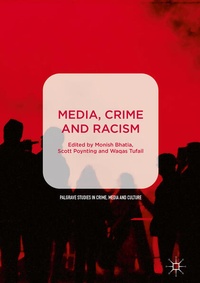
Media, Crime and Racism
Description

Reviews / Votes
"Monish Bhatia, Scott Poynting and Waqas Tufall deserve applause for producing such a diverse, rich and timely collection. It will prove invaluable to those researching crime and the media, and the social dynamics and structures of racial power and racism. With extraordinary foresight, the book also offers a valuable resource for making sense of today's turbulent world." (Jamie Bennett, Border Criminologies, law.ox.ac.uk, February 5, 2021)
"This book is a good read for journalism students who are of the minority, this can help further knowledge about media's coverage of minorities." (Morgan Jenkins, CBQ Communication Booknotes Quarterly, Vol. 51 (3-4), 2020)
"This powerful collection demonstrates how, in a neoliberal decentralised capitalist economic system, news organisations generate profits through racist, misleading, and often non-factual news, which contributes to the fabrication of moral panics and folk devils. The chapters in this collection are mostly supported by empirical studies and are often theoretically informed, which makes it an essential resource for criminologists exploring the connection between media, crime, and racism." (The Howard Journal of Crime and Justice, Vol. 58 (4), 2019)
"Media, Crime and Racism, offers engaged scholarship that explores the complex processes through which the media racialises crime, and criminalises race, and the impact this has. . Media, Crime and Racism is a very important book that encourages the reader to constantly make links between different communities across international contexts . ." (Sophia Siddiqui, Race & Class, Vol. 61 (1), July-September, 2019)
"Media, Crime and Racism is a seminal contribution to this field of criminology, examining as it does the nexus between media and crime through the lens of racism. . the book might be considered an important contribution towards theperformative turn in criminology." (Gabriella Szabó, Crime Media Culture, March 19, 2019)
"This volume was published within the series Palgrave Studies in Crime, Media and Culture. . This edited collection represents an excellent starting point for researchers and both undergraduates and postgraduates in media studies, criminology, sociology, gender studies, and related academic fields." (Antje Deckert, The Australian & New Zealand Journal of Criminology, October, 10, 2018)
"The book is suitable for undergraduate as well as postgraduate students in sociology and criminology studies. It is a timely update on media and crime that offers insightful analysis of traditional as well as digital media. Given that the theoretical foundation is illustrated by numerous case studies . ." (Sara Salman, Journal of Sociology, July, 2018)
More details
Other editions
Additional editions
Persons
Scott Poynting is Adjunct Professor at the University of Western Sydney, Australia
Waqas Tufail is Senior Lecturer in Criminology, Leeds Beckett University, UK
