

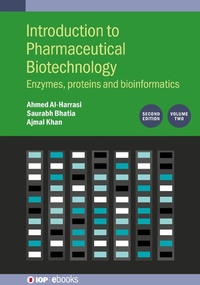
Introduction to Pharmaceutical Biotechnology, Volume 2 (Second Edition)
Description

Pharmaceutical biotechnology is a broad and growing field that can be defined as the science that covers all technologies required for the production, manufacturing and registration of biological drugs. Most therapeutic drugs in the current market are bioformulations, such as antibodies, nucleic acid products and vaccines. Such bioformulations are developed through several stages that include understanding the principles underlying health and disease; the fundamental molecular mechanisms governing the function of related biomolecules; synthesis and purification of the molecules; determining the product shelf life, stability, toxicity and immunogenicity, drug delivery systems, patenting; and clinical trials. The future of pharmaceuticals belongs to protein-based therapeutics and soon to be mRNA vaccines. Designing stable and effective therapeutic proteins requires knowledge of protein structure and the interactions that stabilise the structure necessary for function.
This book offers a detailed examination of biotransformation and enzymes, focusing on their crucial roles in biology and biotechnology. It is intended for students, researchers, and professionals who are interested in understanding the biochemical processes by which organisms metabolize various compounds and how enzymes facilitate these processes. The book primary aim is to provide a clear connection between theoretical concepts and their practical applications, showcasing biotransformation as an essential tool for developing sustainable solutions in pharmaceuticals, environmental management, and industrial practices. It comprehensively covers various biotransformation reactions, highlighting their importance in producing valuable products, detoxifying substances, and minimizing waste. Focusing on microbial biotransformation, the text explains how microorganisms are used or modified to carry out the transformation of organic compounds, improve production efficiencies, and tackle pollution. It places a special emphasis on modern techniques such as cell immobilization and genetic modification, which are employed to enhance the efficiency of biocatalysts in biotransformation processes. Designed as both an introductory resource and an in-depth reference, the book aims to spark further research and innovation in the field. It underscores the significance of biotransformation in advancing sustainable practices and contributing to a more sustainable future.
More details
Other editions
Additional editions
Persons
Ahmed Al-Harrasi is a professor of organic chemistry and the vice chancellor for graduate studies, research and external relations at the University of Nizwa. He obtained his BSc in Chemistry from SQU and his MSc and PhD in Organic Chemistry from Free University of Berlin as a DAAD-fellow. Then he received the Fulbright award in 2008 for postdoctoral research in Chemical Biology from Cornell University. He is a founder and chair of the Natural and Medical Sciences Research Center. He is a member of the Scientific Council of UNESCO. He was named on the list of top 2% Scientists for the last three years. He has authored over 800 scientific papers and more than 20 books and book chapters. He received the Order of Royal Commendation from His Majesty, The Sultan of Oman as an outstanding Omani individual for his remarkable contribution and active role in research.
Saurabh Bhatia is an Associate Professor within the Natural and Medical Sciences Research Centre at the University of Nizwa, Oman. He has published 79 referred journal articles and written 94 book chapters. Dr. Bhatia has also authored 10 books and is the Associate Editor on four international journals.
Ajmal Khan is currently working as a Associate Professor in Natural and Medical Sciences Research Centre at the University of Nizwa, Oman. Dr. Khan published more than 450 articles in international peer review journals with impact factor of more than 2000 and citation more than 9000. Besides this, he published two US patents, and 3 books and 13 books chapters. Dr. Khan is Associate Editor for four journals and in editorial board of three international journals.
Content
Preface
Acknowledgements
Author biographies
1 Introduction to enzymes and their applications
2 Technologies and procedures involved in enzyme production
3 Industrial enzymes and their applications
4 Immobilization of enzymes
5 Biosensors
6 Biotransformation and enzymes
7 Introduction to genomics
8 Basics of proteomics
9 Bioinformatics
10 Protein and enzyme engineering
