

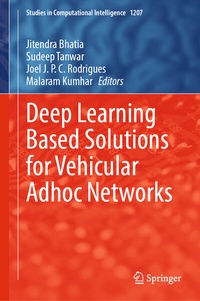
Deep Learning Based Solutions for Vehicular Adhoc Networks
Description

This book provides a holistic and comprehensive approach to deep learning for vehicular ad hoc networks (VANETs), covering various aspects such as applications, agency involvement, and potential ethical and legal issues. It begins with discussions on how the transportation system has been converted into Intelligent Transportation System (ITS). The use of VANETs is increasing in the development of ITS to enhance road safety, traffic efficiency, and driver comfort. However, the dynamic nature of vehicular environments and the high mobility of vehicles pose significant challenges to designing and implementing VANETs and ensuring reliable and efficient communication. Deep learning, a subset of machine learning, has the potential to revolutionize vehicular ad hoc networks (VANETs) to enable various applications such as traffic management, collision avoidance, and infotainment. DL has demonstrated great potential in addressing various challenges involved in VANETs by leveraging its ability to learn from vast data and make accurate predictions. It reviews the state-of-the-art DL-based approaches for various applications in VANETs, including routing, congestion control, autonomous driving, and security. In addition, this book provides a comprehensive analysis of these approaches' advantages and limitations and discusses their future research directions. The study in this book shows that DL-based techniques can significantly improve the performance and reliability of VANETs. Still, in-depth research is required to address the challenges of deploying these methods in real-world scenarios. Finally, the book discusses the potential of DL-based VANETs in supporting other emerging technologies, such as autonomous driving and smart cities. It explores the simulation/emulation tools for practical exposure to the vehicular ad hoc network.
More details
Other editions
Additional editions
Persons
Content
Overview of Vehicular Ad Hoc Networks.- Architecture and Protocols for data transmission in VANETs.- Applications and Challenges in VANETs.- Deep Learning Architectures for VANET.- Deep Learning for Security in VANET Secure Data Transmission in VANET.- Deep Learning for Resource Allocation in VANET.- Deep Learning for Traffic Prediction in VANET.- Traffic Prediction and modeling in Vehicular Ad Hoc Networks.- Traffic Data Collection and Processing in VANETs.- Deep Learning for Autonomous VANETs.- Implementation and Deployment of Deep Learning in Vehicular Ad Hoc Networks.- Deployment Strategies for Deep Learning in VANETs.- Energy Efficiency Deep Learning techniques in VANETs.- Case Studies and Real-World Deployment Examples.- Future Research Directions in Deep Learning for VANET.- Emerging Trends in VANETs.- Research Challenges and Open Issues in deploying deep learning models in VANETs.- Simulation/Emulation Platforms for Deep Learning in VANETs.- A framework to simulate VANETs.
