

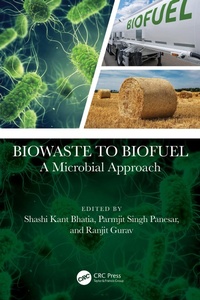
Biowaste to Biofuel
A Microbial Approach
Published on 6. October 2025
356 pages
978-1-040-43789-6 (ISBN)
Description

This book encompasses a wide range of topics related to biowaste to biofuels, covering agro-wastes, food waste, wastewater, CO2, and so forth. Each chapter provides an indepth examination of a specific biowaste to biofuel conversion technology discussing the underlying science, production processes, challenges, and potential applications. It presents practical insights into microbial biofuel production, including detailed explanations of fermentation processes, microbial pathways, conversion techniques, and technological advancements backed by case studies.
Includes theory and delves into practical applications of microbial biofuels
Reviews sustainability and environmental benefits with a focus on renewable energy
Explores how these fuels can help reduce greenhouse gas emissions and combat climate change
Discusses bioalcohol, biodiesel, biohydrogen, biomethane, and so forth
Provides real-world examples and case studies showcasing biofuel potential for a greener future
This book is aimed at graduate/master's students and researchers in bioenergy, fermentation, and chemical engineering.
Includes theory and delves into practical applications of microbial biofuels
Reviews sustainability and environmental benefits with a focus on renewable energy
Explores how these fuels can help reduce greenhouse gas emissions and combat climate change
Discusses bioalcohol, biodiesel, biohydrogen, biomethane, and so forth
Provides real-world examples and case studies showcasing biofuel potential for a greener future
This book is aimed at graduate/master's students and researchers in bioenergy, fermentation, and chemical engineering.
More details
Language
English
Place of publication
London
United Kingdom
Publishing group
Taylor & Francis Ltd
Target group
College/higher education
Illustrations
34 Tables, black and white; 44 Line drawings, black and white; 44 Illustrations, black and white
File size
15,12 MB
ISBN-13
978-1-040-43789-6 (9781040437896)
Copyright in bibliographic data and cover images is held by Nielsen Book Services Limited or by the publishers or by their respective licensors: all rights reserved.
Schweitzer Classification
Other editions
Additional editions
Book
10/2025
1st Edition
CRC Press
€208.40
Shipment within 10-20 days
Persons
Shashi Kant Bhatia is an Associate Professor in the Department of Biological Engineering, Konkuk University, Seoul, South Korea, and has more than ten years' experience in biowastes valorization into bioenergy, biochemicals, and biomaterials. He holds an MSc and a PhD in biotechnology from Himachal Pradesh University (India). Dr. Bhatia has worked as a Brain Pool Post-Doc Fellow at Konkuk University (2014-2016) and has contributed extensively to the industrial press and served as an editorial board member of the Sustainability and Energies Journal and associate editor of Frontier of Microbiology, Microbial Cell Factories, Bioprocess and Biosystem Engineering, Carbohydrate Technology and Applications, 3 Biotech, PLOS One, International Journal of Biomaterials, International Journal of Energy Research, and Marine Life Science and Technology. He is editor in chief of Biotechnology for Sustainable Materials Journal and serves as a reviewer for more than 100 peer-reviewed international journals. He has published more than 200 research and review articles on industrial biotechnology, bioenergy production, biomaterial, biotransformation, microbial fermentation, and enzyme technology in international scientific peer-reviewed journals and holds 15 international patents. He has also edited eight books on microbial biotechnology. With more than 15,000 citations with h-index 66 and i10 index 215 (as per Google Scholar), he is included in the top 2% scientist list of Stanford University. Dr. Bhatia has successfully supervised and completed three projects funded by the National Research Foundation of Korea ($600,000).
Parmjit Singh Panesar is working as Professor, Sant Longowal Institute of Engineering and Technology Longowal, Punjab, India. Prof. Panesar has also worked as Dean (Planning and Development), Dean (Research and Consultancy), and Head, Department of Food Engineering and Technology, SLIET Longowal, India. His research is focused in the area of Food Biotechnology especially bioprocessing of food industry by-products, food enzymes, prebiotics (lactulose, GOS), biopigments, etc. Prof. Panesar has more than 10,000 citations and h-index of 54 (as per Google scholar). In 2005, he has been awarded BOYSCAST (Better Opportunities for Young Scientists in Chosen Areas of Science and Technology) fellowship by Department of Science & Technology (DST), Government of India, to carry out advance research at Chembiotech labs, University of Birmingham Research Park, United Kingdom. Prof. Panesar has successfully completed nine research projects funded by Department of Biotechnology (DBT,) Council of Scientific & Industrial Research (CSIR), Ministry of Human Resource Development (MHRD), All India Council for Technical Education (AICTE), New Delhi, and two projects are in progress. He has published more than 210 international/national scientific papers, 50 book reviews in peer-reviewed journals, 50 chapters, and has authored/edited 18 books. He has guided 19 Ph.D. students, and 5 students are under progress. He is a member of the editorial advisory boards of national/international journals, including the International Journal of Biological Macromolecules, Journal of Food Science and Technology, and Carbohydrate Polymer Technologies and Applications. In recognition of his work, Prof. Panesar was elected as "Fellow 2018" by the Biotech Research Society of India (BRSI); "Fellow 2019" by the "National Academy of Dairy Science India (NADSI); "Fellow 2021" by the International Society for Energy, Environment, and Sustainability (ISEES); "Fellow 2021" by the Academy of Microbiological Sciences; and "Fellow 2022" by the Association of Food Scientists and Technologists, India. He was selected for the award of prestigious "INSA Teachers Award (2020)" by the Indian National Science Academy (INSA). Prof. Panesar has also been listed five times, consequently, in the most coveted list of "World Ranking of Top 2% Scientists" published by Stanford University, USA (2020, 2021, 2022, 2023, 2024). He has also visited several countries like the United Kingdom, United States, Canada, Switzerland, New Zealand, Australia, Germany, France, Singapore, Malaysia, China, Iran, Thailand, etc.
Ranjit Gurav is an Associate Professor at UPES Dehradun, India. He received his Ph.D. in biotechnology in 2013 and has since conducted extensive research for a decade in various countries, including the USA, South Korea, India, and China. Throughout his career, he has held roles such as Associate Professor, Research Professor, Assistant Professor, Postdoctoral Research Associate, and Young Scientist, contributing significantly to advancements in his field. His research primarily focuses on harnessing agriculture, forestry, food industry waste biomass, and by-products to produce bioelectricity, polyhydroxyalkanoates, biodiesel, exopolysaccharides, and biohydrogen. Dr. Gurav is highly skilled in implementing microbial, bioelectrochemical, hydrogel, biochar, and self-activated carbon-based technologies for the remediation of organic contaminants and heavy metals in water and soil. Using a microbial system, he has established a unique technology for converting poultry feather biomass into a growth stimulator, and chitin biomass into an antifungal agent. In addition, he developed green infrastructure to manage urban stormwater runoff through biologically active previous structures. Dr. Gurav has secured research funding totalling US$ 130,000 from organizations such as the NSF I-Corps of the United State America (USA), Faculty Innovation Accelerator Program (FIAP) of Texas State University USA, Department of Science and Technology-Science and Engineering Research Board (DST-SERB) India, and University of Petroleum and Energy Studies (UPES) Dehradun, India. He has 125+ Scopus-indexed international publications and holds 4 international patents. He has been listed among the top 2% of global scientists listed by Stanford University, USA, for the years 2022, 2023, and 2024. Dr. Gurav is deeply involved in the academic community, serving as an editor, associate editor, academic editor, topical editor, and editor for ten international journals, and reviewer for over 70 international journals. He holds life memberships with the BRSI and the Association of Microbiologists of India.
Parmjit Singh Panesar is working as Professor, Sant Longowal Institute of Engineering and Technology Longowal, Punjab, India. Prof. Panesar has also worked as Dean (Planning and Development), Dean (Research and Consultancy), and Head, Department of Food Engineering and Technology, SLIET Longowal, India. His research is focused in the area of Food Biotechnology especially bioprocessing of food industry by-products, food enzymes, prebiotics (lactulose, GOS), biopigments, etc. Prof. Panesar has more than 10,000 citations and h-index of 54 (as per Google scholar). In 2005, he has been awarded BOYSCAST (Better Opportunities for Young Scientists in Chosen Areas of Science and Technology) fellowship by Department of Science & Technology (DST), Government of India, to carry out advance research at Chembiotech labs, University of Birmingham Research Park, United Kingdom. Prof. Panesar has successfully completed nine research projects funded by Department of Biotechnology (DBT,) Council of Scientific & Industrial Research (CSIR), Ministry of Human Resource Development (MHRD), All India Council for Technical Education (AICTE), New Delhi, and two projects are in progress. He has published more than 210 international/national scientific papers, 50 book reviews in peer-reviewed journals, 50 chapters, and has authored/edited 18 books. He has guided 19 Ph.D. students, and 5 students are under progress. He is a member of the editorial advisory boards of national/international journals, including the International Journal of Biological Macromolecules, Journal of Food Science and Technology, and Carbohydrate Polymer Technologies and Applications. In recognition of his work, Prof. Panesar was elected as "Fellow 2018" by the Biotech Research Society of India (BRSI); "Fellow 2019" by the "National Academy of Dairy Science India (NADSI); "Fellow 2021" by the International Society for Energy, Environment, and Sustainability (ISEES); "Fellow 2021" by the Academy of Microbiological Sciences; and "Fellow 2022" by the Association of Food Scientists and Technologists, India. He was selected for the award of prestigious "INSA Teachers Award (2020)" by the Indian National Science Academy (INSA). Prof. Panesar has also been listed five times, consequently, in the most coveted list of "World Ranking of Top 2% Scientists" published by Stanford University, USA (2020, 2021, 2022, 2023, 2024). He has also visited several countries like the United Kingdom, United States, Canada, Switzerland, New Zealand, Australia, Germany, France, Singapore, Malaysia, China, Iran, Thailand, etc.
Ranjit Gurav is an Associate Professor at UPES Dehradun, India. He received his Ph.D. in biotechnology in 2013 and has since conducted extensive research for a decade in various countries, including the USA, South Korea, India, and China. Throughout his career, he has held roles such as Associate Professor, Research Professor, Assistant Professor, Postdoctoral Research Associate, and Young Scientist, contributing significantly to advancements in his field. His research primarily focuses on harnessing agriculture, forestry, food industry waste biomass, and by-products to produce bioelectricity, polyhydroxyalkanoates, biodiesel, exopolysaccharides, and biohydrogen. Dr. Gurav is highly skilled in implementing microbial, bioelectrochemical, hydrogel, biochar, and self-activated carbon-based technologies for the remediation of organic contaminants and heavy metals in water and soil. Using a microbial system, he has established a unique technology for converting poultry feather biomass into a growth stimulator, and chitin biomass into an antifungal agent. In addition, he developed green infrastructure to manage urban stormwater runoff through biologically active previous structures. Dr. Gurav has secured research funding totalling US$ 130,000 from organizations such as the NSF I-Corps of the United State America (USA), Faculty Innovation Accelerator Program (FIAP) of Texas State University USA, Department of Science and Technology-Science and Engineering Research Board (DST-SERB) India, and University of Petroleum and Energy Studies (UPES) Dehradun, India. He has 125+ Scopus-indexed international publications and holds 4 international patents. He has been listed among the top 2% of global scientists listed by Stanford University, USA, for the years 2022, 2023, and 2024. Dr. Gurav is deeply involved in the academic community, serving as an editor, associate editor, academic editor, topical editor, and editor for ten international journals, and reviewer for over 70 international journals. He holds life memberships with the BRSI and the Association of Microbiologists of India.
Content
1 Introduction to Biowaste to Biofuel: A Microbial Approach; 2 Biomass to Biofuel Conversion: Biomass Pretreatment Strategies for Microbial Feedstock; 3 Food Waste Upscaling to Biofuel by Microbial System; 4 Resource Recovery from Wastewater and Microbial Biofuel Production; 5 Carbon Capture and Biofuel: A Sustainable Synergy for a Greener World; 6 Microbial Enzymes Involved in Biofuel Production; 7 Advances in Immobilization Technologies for Biofuel Production; 8 Bioreactors Designs for Microbial Biofuel Production; 9 Renewable Energy Policies and Their Impact on Biofuel Development; 10 Commercialization of Microbial Biofuels around the World; 11 Life Cycle Assessment of Microbial Biofuel: Environmental and Economic Impacts; 12 Integration of Biofuel Production with Other Biorefinery Processes
