

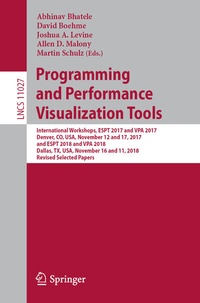
Programming and Performance Visualization Tools
International Workshops, ESPT 2017 and VPA 2017, Denver, CO, USA, November 12 and 17, 2017, and ESPT 2018 and VPA 2018, Dallas, TX, USA, November 16 and 11, 2018, Revised Selected Papers
Published on 24. April 2019
XIV, 285 pages
978-3-030-17872-7 (ISBN)
Description

This book contains the revised selected papers of 4 workshops held in conjunction with the International Conference on High Performance Computing, Networking, Storage and Analysis (SC) in November 2017 in Denver, CO, USA, and in November 2018 in Dallas, TX, USA: the 6th and 7th International Workshop on Extreme-Scale Programming Tools, ESPT 2017 and ESPT 2018, and the 4th and 5th International Workshop on Visual Performance Analysis, VPA 2017 and VPA 2018.
The 11 full papers of ESPT 2017 and ESPT 2018 and the 6 full papers of VPA 2017 and VPA 2018 were carefully reviewed and selected for inclusion in this book. The papers discuss the requirements for exascale-enabled tools as well as new approaches of applying visualization and visual analytic techniques to large-scale applications. Topics of interest include: programming tools; methodologies for performance engineering; tool technologies for extreme-scale challenges (e.g., scalability, resilience, power); tool support for accelerated architectures and large-scale multi-cores; tool infrastructures and environments; evolving/future application requirements for programming tools and technologies; application developer experiences with programming and performance tools; scalable displays of performance data; case studies demonstrating the use of performance visualization in practice; data models to enable scalable visualization; graph representation of unstructured performance data; presentation of high-dimensional data; visual correlations between multiple data sources; human-computer interfaces for exploring performance data; and multi-scale representations of performance data for visual exploration.
More details
Series
Language
English
Place of publication
Cham
Switzerland
Publishing group
Springer International Publishing
Product notice
Reflowable
Illustrations
XIV, 285 p. 166 illus., 105 illus. in color.
File size
36,34 MB
ISBN-13
978-3-030-17872-7 (9783030178727)
DOI
10.1007/978-3-030-17872-7
Schweitzer Classification
Other editions
Additional editions
Abhinav Bhatele | David Boehme | Joshua A. Levine
Programming and Performance Visualization Tools
International Workshops, ESPT 2017 and VPA 2017, Denver, CO, USA, November 12 and 17, 2017, and ESPT 2018 and VPA 2018, Dallas, TX, USA, November 16 and 11, 2018, Revised Selected Papers
Book
04/2019
Springer
€62.05
Shipment within 7-9 days
Content
- Intro
- Preface
- ESPT 2017
- Organizing Committee
- Program Committee
- ESPT 2018
- Organizing Committee
- Program Committee
- VPA 2017
- Workshop Chairs
- Steering Committee
- Program Committee
- VPA 2018
- Workshop Chairs
- Steering Committee
- Program Committee
- Contents
- ESPT 2017
- Enhancing PAPI with Low-Overhead rdpmc Reads
- 1 Introduction
- 2 Background
- 2.1 Performance Counter Hardware
- 2.2 Linux perf_event Interface
- 2.3 PAPI Library
- 2.4 Linux rdpmc Support
- 2.5 PAPI rdpmc Code
- 2.6 Linux rdpmc Bugs Found
- 3 Related Work
- 3.1 Lower-Level Interface Overhead
- 3.2 PAPI Overhead
- 3.3 Other Performance Counter Tools
- 4 Experimental Setup
- 5 Results
- 5.1 Outliers
- 5.2 Historical Comparison
- 6 Conclusion and Future Work
- References
- Generic Library Interception for Improved Performance Measurement and Insight
- 1 Introduction
- 2 Related Work
- 3 Methodology
- 3.1 Library Call Interception
- 3.2 Workflow
- 3.3 Implementation Details
- 4 Case Study
- 4.1 GROMACS
- 4.2 PERMON
- 5 Conclusions
- 6 Future Work
- References
- Improved Accuracy for Automated Communication Pattern Characterization Using Communication Graphs and Aggressive Search Space Pruning
- 1 Introduction
- 2 Characterizing Application Communication
- 2.1 Augmented Communication Graphs
- 2.2 Non-greedy Volume Attribution
- 2.3 Search Space Pruning
- 3 Implementation
- 4 Evaluation
- 4.1 Augmented Communication Graphs
- 4.2 Aggressive Pruning
- 5 Case Study: Xolotl
- 6 Related Work
- 7 Summary and Future Work
- References
- Moya-A JIT Compiler for HPC
- 1 Introduction
- 2 Motivation
- 2.1 Programmer Annotations
- 2.2 Compile-Time JIT-Aware Static Analysis
- 2.3 Dynamic JIT-Time Optimizations
- 3 Moya
- 4 Programmer Annotations
- 5 Compile-Time Analysis
- 5.1 Identification of Dynamic Constants
- 5.2 Mutability Analysis
- 5.3 Library Models
- 6 JIT - Time Optimizations
- 6.1 Function Argument Specialization
- 6.2 Dynamic Constant Propagation (DCP)
- 6.3 Invariant Load Detection
- 7 Results
- 7.1 Compile-Time Static Analysis
- 7.2 PlasComCM
- 7.3 NAS Parallel Benchmarks
- 8 Related Work
- 9 Future Work
- 10 Conclusion
- References
- Polyhedral Optimization of TensorFlow Computation Graphs
- 1 Introduction
- 2 Design
- 2.1 Overview
- 2.2 Subgraph Selection
- 2.3 Operator Code Generators
- 2.4 Subgraph Code Generator
- 2.5 R-Stream Optimization
- 2.6 TensorFlow Operator
- 2.7 Leveraging Broadcast
- 3 Experiments
- 4 Enabled Experiments/Work
- 5 Related Work
- 6 Conclusion
- References
- CAASCADE: A System for Static Analysis of HPC Software Application Portfolios
- 1 Introduction
- 2 Background and Related Work
- 3 Design and Methods
- 3.1 GNU Compiler Plugin Implementation
- 3.2 Database Infrastructure
- 4 Results
- 5 Conclusions and Future Work
- References
- Visual Comparison of Trace Files in Vampir
- 1 Introduction
- 2 Related Work
- 3 Methodology
- 3.1 Comparing Application Characteristics Using Charts
- 3.2 Aligning Traces Manually
- 3.3 Aligning Traces Automatically Using Predefined Markers
- 3.4 Aligning Traces Automatically Using Call Invocation Profiles
- 4 Case Study
- 4.1 LSMS - Comparing Performance Between Different Hardware
- 4.2 CloverLeaf - Comparing Performance Between Programming Models
- 4.3 Trinity RNA-Seq Assembler - Comparing Performance Between Different Process Numbers
- 5 Conclusions
- References
- ESPT 2018
- Understanding the Scalability of Molecular Simulation Using Empirical Performance Modeling
- 1 Introduction
- 2 ms2 Application
- 3 Methodology
- 3.1 Simulation Parameters
- 3.2 Benchmarking
- 3.3 Empirical Modeling
- 4 Experimental Setup
- 4.1 Parameter Values
- 4.2 Measurements Variability
- 5 Result Analysis
- 6 Related Work
- 7 Conclusion
- References
- Advanced Event-Sampling Support for PAPI
- 1 Introduction
- 1.1 Hardware Performance Counters
- 1.2 Advanced Sampling
- 1.3 Software Interfaces
- 2 Hardware Sampling Interfaces
- 2.1 Intel x86_64
- 2.2 AMD x86_64
- 2.3 Other Processors
- 3 Software Interface for Sampling
- 3.1 Linux perf_event Interface
- 3.2 PAPI Library Interface
- 4 Related Work
- 4.1 Existing Profiling Tools
- 4.2 NUMA Profiling
- 4.3 GPU Profiling
- 4.4 Other Tools with Sampling Interfaces
- 4.5 Other Proposed PAPI Sampling Interfaces
- 5 Proposed Advanced PAPI Sampling API
- 5.1 Abstracted Interface
- 5.2 Direct perf_event Interface
- 6 Preliminary Results
- 7 Conclusion and Future Work
- References
- ParLoT: Efficient Whole-Program Call Tracing for HPC Applications
- 1 Introduction
- 2 Background and Related Work
- 2.1 Binary Instrumentation
- 2.2 Efficient Tracing
- 3 Design of ParLoT
- 3.1 Tracing Operation
- 3.2 Incremental Compression
- 3.3 Compression Algorithm
- 3.4 PIN and Call-Stack Correction
- 4 Evaluation Methodology
- 4.1 Benchmarks and System
- 4.2 Metrics
- 4.3 Tracing Tools
- 5 Results
- 5.1 Tracing Overhead
- 5.2 Required Bandwidth
- 5.3 Compression Ratio
- 5.4 Overheads
- 5.5 Compression Impact
- 6 Discussion and Conclusion
- References
- Gotcha: An Function-Wrapping Interface for HPC Tools
- 1 Introduction
- 2 Background and Related Work
- 2.1 Background
- 2.2 Related Work
- 3 Gotcha Abstractions and Implementation
- 3.1 Gotcha Wrapping Abstraction
- 3.2 Multi-tool Support
- 3.3 Interface-Independent Wrapping
- 4 Use Cases
- 4.1 Caliper
- 4.2 Generic MPI Wrapper
- 5 Performance/Results
- 6 Future Work
- 7 Conclusions
- References
- VPA 2017
- Projecting Performance Data over Simulation Geometry Using SOSflow and ALPINE
- 1 Introduction
- 1.1 Research Contributions
- 2 Related Work
- 3 SOSflow
- 3.1 SOSflow Daemons
- 3.2 SOSflow Client Library
- 3.3 SOSflow Data
- 4 ALPINE Ascent
- 5 Experiments
- 5.1 Evaluation Platform
- 5.2 Experiment Setup
- 5.3 Overview of Processing Steps
- 5.4 Evaluation of Geometry Extraction
- 5.5 Evaluation of Overhead
- 6 Results
- 6.1 Geometry Extraction and Performance Data Projection
- 6.2 Overhead
- 7 Conclusion
- 7.1 Future Work
- References
- Visualizing, Measuring, and Tuning Adaptive MPI Parameters
- 1 Introduction
- 2 Visualizing AMPI with Projections
- 2.1 Implementation
- 2.2 Visualizations
- 3 Application Case Studies
- 3.1 LULESH
- 3.2 Particle-in-cell
- 4 Related Work
- 5 Conclusions
- References
- VPA 2018
- Visual Analytics Challenges in Analyzing Calling Context Trees
- 1 Introduction
- 2 HPC Domain Data
- 3 State of the Art
- 4 Data/Visual Analytics Operations on a CCT
- 5 Prototype of a Flow-Based Visualization Framework
- 5.1 Flow-Based Navigation
- 5.2 A First Flow Example
- 5.3 Alternative Function View
- 5.4 Data and Visualization Challenges
- 6 Conclusion
- References
- PaScal Viewer: A Tool for the Visualization of Parallel Scalability Trends
- 1 Introduction
- 2 The PaScal Viewer
- 2.1 The Color Diagrams
- 2.2 Input File Format
- 3 Case Studies
- 3.1 The Blackscholes Application
- 3.2 The Bodytrack Application
- 3.3 The Freqmine Application
- 4 Related Works
- 5 Conclusion and Future Works
- References
- Using Deep Learning for Automated Communication Pattern Characterization: Little Steps and Big Challenges
- 1 Introduction
- 2 Integrating Deep Learning into AChax
- 2.1 Training
- 2.2 Recognition and Parameterization
- 3 Early Experiments
- 4 Summary
- References
- Visualizing Multidimensional Health Status of Data Centers
- 1 Introduction
- 2 Existing Approaches
- 3 Visualization Components
- 3.1 HPC System Spatial Layout
- 3.2 Multidimensional Analysis of Health Status
- 4 Discussion and Future Work
- 5 Conclusion
- References
- Author Index
