

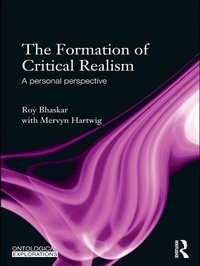
The Formation of Critical Realism
A Personal Perspective
Published on 25. January 2010
248 pages
978-1-134-05065-9 (ISBN)
Description

This series of interviews, conducted in the form of exchanges between Roy Bhaskar and Mervyn Hartwig, tells a riveting story of the formation and development of critical realism.
Three intersecting and interweaving narratives unfold in the course of this unfinished story: the personal narrative of Roy Bhaskar, born of an Indian father and English mother, a child of post-war Britain and Indian partition and independence; the intellectual narrative of the emergence and growth of critical realism; and a world-historical story, itself theorized by critical realism in its discussion of the development of modernity.
This book gives an invaluable account of the development of critical realism, and its consolidation as a leading philosophy of our times. It takes us through the major moments of its formation, the principal objections to and controversies within critical realism, the establishment of its institutions, and considers its limits and future development. Special features of the book include discussion of the genesis of critical realism, and the origins and nature of the so-called dialectical and spiritual turns.
The informal dialogical style of The Formation of Critical Realism makes it compelling reading and an invaluable source for students of critical realism as well as all those interested in the intellectual story of our times.
Three intersecting and interweaving narratives unfold in the course of this unfinished story: the personal narrative of Roy Bhaskar, born of an Indian father and English mother, a child of post-war Britain and Indian partition and independence; the intellectual narrative of the emergence and growth of critical realism; and a world-historical story, itself theorized by critical realism in its discussion of the development of modernity.
This book gives an invaluable account of the development of critical realism, and its consolidation as a leading philosophy of our times. It takes us through the major moments of its formation, the principal objections to and controversies within critical realism, the establishment of its institutions, and considers its limits and future development. Special features of the book include discussion of the genesis of critical realism, and the origins and nature of the so-called dialectical and spiritual turns.
The informal dialogical style of The Formation of Critical Realism makes it compelling reading and an invaluable source for students of critical realism as well as all those interested in the intellectual story of our times.
Reviews / Votes
'The Formation of Critical Realism is one of those big little books, only 237 pages short, but full of absorbing insights, ideas and reflections, to say nothing of providing the only comprehensive overview of the critical realist project available in print, to my knowledge. Comprised of interviews between Roy Bhaskar and Mervyn Hartwig, carried out between August 2007 and March 2008, the book recounts the story of the philosophical formation of critical realism, as told by its 'chief architect'. It takes critical realism philosophically through its main phases and levels of development, including original or basic critical realism, dialectical critical realism and the philosophy of metaReality.That such an overview of the development of critical realism is available in one volume is worth the price alone. But what makes this book particularly attractive is its promise of interweaving three unfolding and related narratives - the personal narrative of Bhaskar, a child of post-war Britain and Indian partition and independence, the intellectual narrative of the emergence and growth of critical realism, and a 'world-historical story' and discussion of the development of modernity.'
'...I found this book to be most inspiring in the sense that it revealed Bhaskar's (albeit fallible) commitment to 'walk the talk', his search for wholeness and 'unity of theory and practice', as first mentioned in the opening chapter. There are many examples of this throughout the book, including his early political activism, exploratory practice with psychoanalysis, meditation and other spiritual practices. Though the book sets out to discuss the formation of the philosophy of critical realism, I think it achieves much more than this. We see how critical realism is (or has the potential to be) a lived practice.'-Nick Wilson, King's College, London, in the Journal of Critical Realism vol 11 iss 2 p.247-254
More details
Series
Language
English
Place of publication
London
United Kingdom
Publishing group
Taylor & Francis Ltd
Target group
College/higher education
File size
1,84 MB
ISBN-13
978-1-134-05065-9 (9781134050659)
Copyright in bibliographic data and cover images is held by Nielsen Book Services Limited or by the publishers or by their respective licensors: all rights reserved.
Schweitzer Classification
Other editions
Additional editions
Book
01/2010
1st Edition
Routledge
€262.10
Shipment within 15-20 days
Book
01/2010
1st Edition
Routledge
€71.40
Shipment within 15-20 days
Persons
Roy Bhaskar is the originator of the philosophy of critical realism, and the author of many acclaimed and influential works including A Realist Theory of Science, The Possibility of Naturalism, Scientific Realism and Human Emancipation, Reclaiming Reality and Dialectic: The Pulse of Freedom. He is an editor of the recently published Critical Realism: Essential Readings and is currently chair of the Centre for Critical Realism.
Mervyn Hartwig is a leading commentator on critical realism, and the editor of and principal contributor to the recently published Dictionary of Critical Realism.
Mervyn Hartwig is a leading commentator on critical realism, and the editor of and principal contributor to the recently published Dictionary of Critical Realism.
Content
1 Childhood and adolescence: dialectic of alienation and wholeness (1944-1963) 2 Oxford days: carrying through the Copernican revolution in the philosophy of science (1963-1973) 3 Beyond empiricism and transcendental idealism: transcendental realism and the critique of classical modernism (1973-1975) 4 The critical realist embrace: critical naturalism (1975-1979) 5 'Prolegomenon to a natural history of the human species': explanatory critique (1979-1986) 6 The axiology of freedom: dialectical critical realism (1986-1994) 7 The spiritual turn: transcendental dialectical critical realism (1994-2000) 8 The philosophy of unity-in-difference: meta-Reality (2000-2002) 9 Where do we go from here?: applied critical realism and beyond (2002- )
