

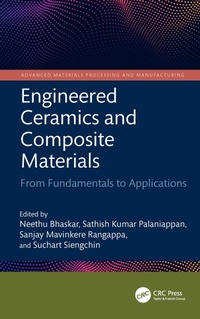
Engineered Ceramics and Composite Materials
From Fundamentals to Applications
Published on 23. February 2026
312 pages
978-1-040-85009-1 (ISBN)
Description

This book provides comprehensive insight into the diversity of ceramics and their applications in producing clean devices and their capability of being recycled into useful in-demand products. The emphasis is on the role of ceramic industries to build a circular economy by reusing and recycling the ceramic waste for environmental, financial, and social sustainability. It summarizes the energy and environmental benefits of ceramic materials and composites, covering its complete life cycle starting from synthesis to recycling and disposal.
Features
Focusses on the energy and environmental benefits and applications of ceramic materials with a coverage from their synthesis to recycle and disposal.
Discusses their suitability for photovoltaics and photo-electrocatalysis, membranes, sensors, and batteries.
Covers embedded circularity and life cycle thinking.
Provides relevant research results and case studies on various aspects of ceramics and composites with an emphasis on energy and environment.
Reviews bio-ceramics, wood ceramics, and nano-ceramics.
This book is aimed at researchers and graduate students in materials science, ceramics, and composites.
Features
Focusses on the energy and environmental benefits and applications of ceramic materials with a coverage from their synthesis to recycle and disposal.
Discusses their suitability for photovoltaics and photo-electrocatalysis, membranes, sensors, and batteries.
Covers embedded circularity and life cycle thinking.
Provides relevant research results and case studies on various aspects of ceramics and composites with an emphasis on energy and environment.
Reviews bio-ceramics, wood ceramics, and nano-ceramics.
This book is aimed at researchers and graduate students in materials science, ceramics, and composites.
More details
Series
Language
English
Place of publication
London
United Kingdom
Publishing group
Taylor & Francis Ltd
Target group
College/higher education
Professional and scholarly
Illustrations
15 Tables, black and white; 39 Line drawings, black and white; 6 Halftones, black and white; 45 Illustrations, black and white
File size
8,80 MB
ISBN-13
978-1-040-85009-1 (9781040850091)
Copyright in bibliographic data and cover images is held by Nielsen Book Services Limited or by the publishers or by their respective licensors: all rights reserved.
Schweitzer Classification
Other editions
Additional editions
Neethu Bhaskar | Sathish Kumar Palaniappan | Sanjay Mavinkere Rangappa
Engineered Ceramics and Composite Materials
From Fundamentals to Applications
Book
approx. 02/2026
1st Edition
CRC Press
€180.50
Not yet published
Persons
Neethu Bhaskar is a Scientist at the Kerala State Council for Science, Technology, and Environment, India. She holds a Ph.D. in Environmental Engineering from the Indian Institute of Technology Kharagpur. With expertise in microbial fuel cells, ceramic membrane synthesis, and clean energy technologies, she has published extensively, contributing several research papers and book chapters. She was awarded the Chief Minister's Nava Kerala Post-Doctoral Fellowship, a prestigious recognition by the Government of Kerala.
Sathish Kumar Palaniappan is a Research Scientist (Specialist 2) at King Mongkut's University of Technology North Bangkok, Thailand. He earned his Ph.D. in Mining Engineering from the Indian Institute of Technology Kharagpur and has extensive experience in polymer nanocomposites, biomaterials, tribology, and surface modifications. With over 64 research publications, 32 book chapters, and a granted Indian patent, he is an active contributor to the field of material sciences.
Sanjay Mavinkere Rangappa is an Associate Professor, Principal Research Scientist, and Advisor at King Mongkut's University of Technology North Bangkok, Thailand. He has authored over 180 high-quality journal articles, 60 book chapters, and edited 25 books. His research spans natural fiber composites, polymer composites, and advanced material technology. Recognized as one of Stanford University's Top 2% Most-Cited Scientists, he has received numerous accolades, including the Outstanding Young Researcher Award.
Suchart Siengchin is the Director of KMUTNB TechnoPark and Ex-President of King Mongkut's University of Technology North Bangkok, Thailand. A globally recognized expert in polymer processing and composite materials, he has authored over 350 peer-reviewed articles, 80 book chapters, and 30 books as an editor. He has been ranked among the world's top 2% scientists by Stanford University and has made significant contributions to material science research and education.
Sathish Kumar Palaniappan is a Research Scientist (Specialist 2) at King Mongkut's University of Technology North Bangkok, Thailand. He earned his Ph.D. in Mining Engineering from the Indian Institute of Technology Kharagpur and has extensive experience in polymer nanocomposites, biomaterials, tribology, and surface modifications. With over 64 research publications, 32 book chapters, and a granted Indian patent, he is an active contributor to the field of material sciences.
Sanjay Mavinkere Rangappa is an Associate Professor, Principal Research Scientist, and Advisor at King Mongkut's University of Technology North Bangkok, Thailand. He has authored over 180 high-quality journal articles, 60 book chapters, and edited 25 books. His research spans natural fiber composites, polymer composites, and advanced material technology. Recognized as one of Stanford University's Top 2% Most-Cited Scientists, he has received numerous accolades, including the Outstanding Young Researcher Award.
Suchart Siengchin is the Director of KMUTNB TechnoPark and Ex-President of King Mongkut's University of Technology North Bangkok, Thailand. A globally recognized expert in polymer processing and composite materials, he has authored over 350 peer-reviewed articles, 80 book chapters, and 30 books as an editor. He has been ranked among the world's top 2% scientists by Stanford University and has made significant contributions to material science research and education.
Content
1. Ceramics used in environmental engineering 2. Overview of dental ceramics vis-a-vis environment friendly approach 3. Nano-ceramics and their environmental applications 4.Ceramics from recycled materials and recycled ceramics 5. Advanced environmental barrier coating for ceramic matrix composites 6.Environmental impact assessment of ceramic-based products and its waste management 7. Advanced ceramic-ceramic-polymer composite electrolyte materials, composites and technologies for lithium-based electrochemical energy storage systems 8. Industrial applications of ceramic membranes: Energy and environmental prospects 9. Application of ceramics in sensors and batteries 10. Advances in photocatalytic ceramic materials for energy and environmental applications 11. Supplementary cementing materials: From waste to high-performance cement composites 12. Synergistic Advancements in Biopolymer-Ceramic Composites and Their Application
