

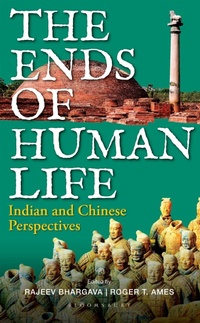
The Ends of Human Life
Indian and Chinese Perspectives
Published on 30. July 2025
300 pages
978-93-6131-123-9 (ISBN)
Description

This volume brings into dialogue key texts from early and late Vedic, Early Buddhist, Confucian, and Bhakti traditions, each addressing fundamental questions concerning the aims and conditions of human life. Through a close engagement with these diverse yet philosophically rich traditions, the essays in this collection examine six interrelated questions central to the human quest for meaning, fulfillment, and ethical orientation.
The first concerns the ends of human life: from material prosperity, aesthetic delight, and social recognition to moral rectitude, spiritual devotion, and contemplative knowledge. The volume probes how these ends are articulated, ordered, and interpreted within and across traditions. Are these ends discrete or interdependent? Can they coexist harmoniously, or are they marked by tension and hierarchy-perhaps culminating in a single, highest good?
A third area of inquiry relates to the practices and modes of life required to realize these ends-what virtues must be cultivated, and which vices eschewed? Fourth, the volume interrogates whether these ends are universally accessible or specific to particular social groups or stages of life. Fifth, it explores the implications of dependence, freedom, and social structure in the pursuit of these goods. Lastly, the volume considers the institutional and political arrangements best suited to enable or constrain the realization of diverse life ideals.
By drawing connections between classical sources and contemporary concerns, this interdisciplinary collection offers both a historically grounded and philosophically nuanced contribution to ongoing reflections on the good life.
The first concerns the ends of human life: from material prosperity, aesthetic delight, and social recognition to moral rectitude, spiritual devotion, and contemplative knowledge. The volume probes how these ends are articulated, ordered, and interpreted within and across traditions. Are these ends discrete or interdependent? Can they coexist harmoniously, or are they marked by tension and hierarchy-perhaps culminating in a single, highest good?
A third area of inquiry relates to the practices and modes of life required to realize these ends-what virtues must be cultivated, and which vices eschewed? Fourth, the volume interrogates whether these ends are universally accessible or specific to particular social groups or stages of life. Fifth, it explores the implications of dependence, freedom, and social structure in the pursuit of these goods. Lastly, the volume considers the institutional and political arrangements best suited to enable or constrain the realization of diverse life ideals.
By drawing connections between classical sources and contemporary concerns, this interdisciplinary collection offers both a historically grounded and philosophically nuanced contribution to ongoing reflections on the good life.
More details
Language
English
Place of publication
New Delhi
India
Target group
Professional and scholarly
File size
1,08 MB
ISBN-13
978-93-6131-123-9 (9789361311239)
Copyright in bibliographic data and cover images is held by Nielsen Book Services Limited or by the publishers or by their respective licensors: all rights reserved.
Schweitzer Classification
Persons
Rajeev Bhargava is currently an honorary fellow at the Centre for the Study of Developing Societies (Delhi) and the director of its Parekh Institute of Indian Thought.
Roger T. Ames is Humanities Chair Professor at Peking University in Beijing, China.
Roger T. Ames is Humanities Chair Professor at Peking University in Beijing, China.
Content
Acknowledgements
Introduction
Rajeev Bhargava
1 Fame, Ambition and Selflessness in Indian Moral Discourse
Patrick Olivelle
2 Confucian Way-Making (dao ?) and the Trivarga: A
Rationalizing of 'the Ends of Life' or the Aesthetic of
Exemplary Lives Lived?
Roger T. Ames
3 The Sequential Problem of the Eight Human Aims in the
Great Learning
Chenyang Li
4 The Fifth Puru?artha: Bhakti as The End of Life
Sudipta Kaviraj
5 Puru?arthas and the Art of Human Seeking
Rakesh Pandey
6 Dialogue and Dharma in the Mahabharata: The Case of
Draupadi¯'s Marriage
Brian Black
7 Dharma in Transition and a Disenchanted World: The
Mahabharata, Ni?kama Karman, and An?sa?sya
Kanad Sinha
8 Understanding Kama in an Early Upanishadic Dialogue
Ananya Vajpeyi
9 Riders in the Chariot: Self-cultivation as a Means for
Attaining Happiness, Heaven and Nirva?a in Early Buddhism
Jens Schlieter
10 The Great Good of Relationship and Its Troubles
David B. Wong
11 Unveiling of Consciousness - Kavya as a Vehicle of Puru?artha
Radhavallabh Tripathi
References
About the Editors and Contributors
Index
Introduction
Rajeev Bhargava
1 Fame, Ambition and Selflessness in Indian Moral Discourse
Patrick Olivelle
2 Confucian Way-Making (dao ?) and the Trivarga: A
Rationalizing of 'the Ends of Life' or the Aesthetic of
Exemplary Lives Lived?
Roger T. Ames
3 The Sequential Problem of the Eight Human Aims in the
Great Learning
Chenyang Li
4 The Fifth Puru?artha: Bhakti as The End of Life
Sudipta Kaviraj
5 Puru?arthas and the Art of Human Seeking
Rakesh Pandey
6 Dialogue and Dharma in the Mahabharata: The Case of
Draupadi¯'s Marriage
Brian Black
7 Dharma in Transition and a Disenchanted World: The
Mahabharata, Ni?kama Karman, and An?sa?sya
Kanad Sinha
8 Understanding Kama in an Early Upanishadic Dialogue
Ananya Vajpeyi
9 Riders in the Chariot: Self-cultivation as a Means for
Attaining Happiness, Heaven and Nirva?a in Early Buddhism
Jens Schlieter
10 The Great Good of Relationship and Its Troubles
David B. Wong
11 Unveiling of Consciousness - Kavya as a Vehicle of Puru?artha
Radhavallabh Tripathi
References
About the Editors and Contributors
Index
