

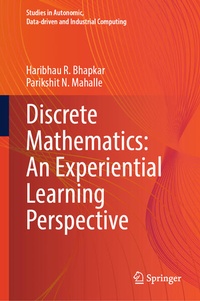
Discrete Mathematics: An Experiential Learning Perspective
Description

This book aims at presenting and exploring an experiential learning techniques for Discrete Mathematics along with the new paradigm shift of various educational policies across the globe. An experiential learning addresses the limitations of current pedagogy and learning techniques. The teaching of Discrete Mathematics traditionally leans heavily on theory. This book aims to bridge that gap by introducing an experiential dimension - learning by doing, reflecting, and connecting theory with practices/activities. To enhance conceptual understanding, the book adheres the " BEIMI " philosophy. The acronym " BEIMI " stands for Brainstorming Experiments/Activities (BE), Inferences (I) and Mathematical Insights (MI). Additionally, the case studies/ projects are given chapter wise. There is one separate chapter for every component of Discrete Mathematics which covers overview, fundamentals, working principles, case studies, and projects. This book is useful for academicians, researchers, students, professionals working in the various fields. It provides possible experiential, and multidisciplinary research directions including Mathematics, Science, Technology, Engineering, Arts, Management and other related fields.
More details
Other editions
Additional editions
Persons
Dr. Haribhau. R. Bhapkar is working as the Head and Associate Professor at the Department of Mathematics, Central University of Kashmir, Ganderbal, J &K. He is also the chairman, Board of Studies in Mathematics at the Central University of Kashmir. Dr. Bhapkar was graduated from the University of Pune, India, with first class with distinction. He received masters in Mathematics in 2000 and Ph.D. (Graph Theory) in 2016. He has 25 years of teaching and research experience at various levels. He has published 62+ research papers in National and International journals and conferences, mostly in the areas of graph coloring, graph isomorphism, mathematical modelling, COVID-19 and applications. He has authored/co-authored more than 130 Books/Book Chapters of Engineering Mathematics, COVID-19, Computer and general books published by Springer, Elsevier, CRC, Technical, and De Gruyter Publications. Additionally, he has filed/registered 53 copyrights and published/Granted 45 patents. Dr. Bhapkar has Multidisciplinary and Holistic Persona which is envisioned in various Educational Policies across the globe.
Dr. Parikshit N. Mahalle is a senior member IEEE and is a Professor and Dean- Academic Affairs at Vishwakarma Institute of Technology, Pune, India. Prior to this, he worked as a dean of Research and Development and head of the department of Artificial Intelligence and Data Science at Vishwakarma Institute of Information Technology, Pune, India and as a professor and head of the department of Computer Engineering at Sinhgad Institutes. He completed his Ph.D. from Aalborg University, Denmark, and completed his postdoctoral research at CMI, Copenhagen, Denmark. He has 24 years of teaching and research experience. His research interests are Machine Learning, Data Science, Algorithms, Internet of Things, Identity Management, and Security. He is guiding 8 Ph.D. students in the area of IoT and machine learning and six students have successfully defended their Ph.D. under his supervision from SPPU.
Content
1. Why Discrete Mathematics.- 2. Introduction.- 3. Sets.- 4. Relations.- 5. Functions.- 6. Logic and Proofs.- 7. Permutations and Combinations.- 8. Discrete Probabilities.
