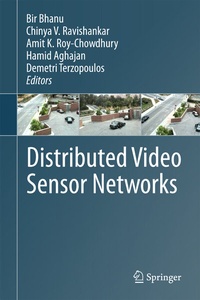
Distributed Video Sensor Networks
Description

Large-scale video networks are of increasing importance in a wide range of applications. However, the development of automated techniques for aggregating and interpreting information from multiple video streams in real-life scenarios is a challenging area of research.
Collecting the work of leading researchers from a broad range of disciplines, this timely text/reference offers an in-depth survey of the state of the art in distributed camera networks. The book addresses a broad spectrum of critical issues in this highly interdisciplinary field: current challenges and future directions; video processing and video understanding; simulation, graphics, cognition and video networks; wireless video sensor networks, communications and control; embedded cameras and real-time video analysis; applications of distributed video networks; and educational opportunities and curriculum-development.
Topics and features: presents an overview of research in areas of motion analysis, invariants, multiple cameras for detection, object tracking and recognition, and activities in video networks; provides real-world applications of distributed video networks, including force protection, wide area activities, port security, and recognition in night-time environments; describes the challenges in graphics and simulation, covering virtual vision, network security, human activities, cognitive architecture, and displays; examines issues of multimedia networks, registration, control of cameras (in simulations and real networks), localization and bounds on tracking; discusses system aspects of video networks, with chapters on providing testbed environments, data collection on activities, new integrated sensors for airborne sensors, face recognition, and building sentient spaces; investigates educational opportunities and curriculum development from the perspective of computer science and electrical engineering.
This unique text will be of great interest to researchers and graduate students of computer vision and pattern recognition, computer graphics and simulation, image processing and embedded systems, and communications, networks and controls. The large number of example applications will also appeal to application engineers.
More details
Other editions
Additional editions