

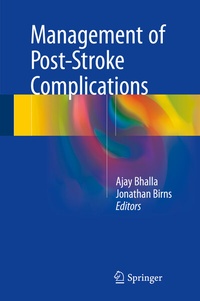
Management of Post-Stroke Complications
Description

This book highlights the underlying importance of post-stroke complications during recovery, allowing healthcare professionals managing stroke patients to understand their frequency and identify which patients are at risk of developing such complications. Complications are categorised into neurological and non-neurological, and the time-frame for these complications both in the short-term and long-term are discussed.
The common practices in managing post-stroke complications and the skills required in their prevention are described, as is the evidence base from clinical trials around their management. The book concludes with a discussion of new developments and research priorities for the future.
Management of Post-Stroke Complications is aimed at members of the multidisciplinary stroke team, stroke physicians, neurologists, general practitioners, stroke specialists in training, and medical students.
More details
Other editions
Additional editions
Persons
Dr Ajay Bhalla has been a Consultant Physician in Stroke, Geriatric and General Medicine at Guy's and St Thomas' Hospitals since 2009. His clinical work currently involves hyper-acute, acute and rehabilitative care for stroke patients as well as acute care for older patients both in hospital and community settings. He has lectured extensively both locally and nationally on stroke and is an accredited Royal College of Physicians Teacher. He currently co-supervises the Masters module in Gerontology at King's College, London where he is an Honorary Senior Lecturer. He is a principal investigator for a number of multi-centre stroke research studies and continues his research interest in the organisation of stroke services in the UK and across Europe.
Dr Jonathan Birns is a Consultant in Stroke Medicine, Geriatrics and General Medicine at Guy's and St Thomas' Hospital, Honorary Senior Lecturer at King's College London and Deputy Head of the London School of Medicine. His research interests have revolved around the relationship between blood pressure, cerebral haemodynamics and neuropsychological function in patients with cerebrovascular disease and he has published widely in the field. He has also successfully directed award-winning and pioneering educational and service developments projects and training programmes in stroke.
Content
Introduction.- Early Neurological Deterioration.- Post-Stroke Cardiac Complications.- Post-Stroke Seizures.- Infections After Stroke.- Venous Thromboembolism.- Swallowing and Nutritional Complications.- Urinary and Bowel Complications.- Positioning and Pressure Care.- Management of Spasticity.- Falls and Osteoporosis Post-Stroke.- Post-Stroke Cognitive Impairment.- Post-Stroke Pain.- Post-Stroke Fatigue: Common But Poorly Understood.- Mental Consequences Of Stroke.- Future Developments.
