

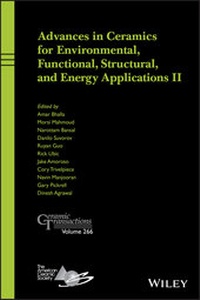
Advances in Ceramics for Environmental, Functional, Structural, and Energy Applications II
Description

Symposia topics included in this volume are:
* Advances in Dielectric Materials and Electronic Devices
* Innovative Processing and Synthesis of Ceramics, Glasses and Composites
* International Symposium on Ceramic Matrix Composites
* Materials for Nuclear Applications and Extreme Environments
* Nanotechnology for Energy, Environment, Electronics, Healthcare and Industry
* Processing and Performance of Materials Using Microwaves, Electric and Magnetic Fields, Ultrasound, Lasers, and Mechanical Work - Rustum Roy Symposium
* Additive Manufacturing of Composites and Complex Materials
* Eco-Friendly and Sustainable Ceramics
More details
Other editions
Additional editions

Content
Preface ix
Advances in Dielectric Materials and Electronic Devices
Effect of Atmosphere on Dielectric Properties of Calcium Copper Titanate Ceramics 3 Disna P. Samarakoon, Nirmal Govindaraju, and Raj N. Singh
Integrated Piezoelectric and Thermoelectric Sensing and Energy Conversion 15 Bryan Gamboa, Maximilian Estrada, Albert Djikeng, Daniel Nsek, Shuza Binzaid, Samer Dessouky, Amar S. Bhalla, and Ruyan Guo
Experimental and Numerical Evaluation of Stacked Piezoelectrics for Mechanical Energy Harvesting 23 Bryan Gamboa, Ruyan Guo, and Amar S. Bhalla
Temperature Dependent Measurements of Dielectric Properties for Sugary Carbonated Solutions Prepared in Various CO2 Pressure Conditions 31 Carlos Acosta, Amar Bhalla, and Ruyan Guo
Pyrolytic Graphite-Copper Thermocouple for Non-Invasive Direct Temperature Measurement 39 Abdul-Sommed Hadi, Jonathan Lann, Tyler Fricks, and Bryce E. Hill
Development of Ferroic and Multiferroic Nanomaterials for Drop-on-Demand Microfabrication 49 Brandon D. Young, Bryan Gamboa, Denise Alanis, Luiz Cotica, Amar Bhalla, and Ruyan Guo
Synthesis of High Curie Temperature La2Ti2O7 Piezoceramic by Mechanochemical Activation: A Preliminary Investigation 59 Kaustubh Ramesh Kambale, Ajit R. Kulkarni, Narayanan Venkataramani, Amruta Vairagade, and Sandeep Butee
Innovative Processing and Synthesis of Ceramics, Glasses and Composites
Morphological Transition and Evolution of Shapes in Glassy State; Barium Strontium Titanate Dielectric Capacitor Material 69 N. B. Singh, Ching Hua Su, Fow-Sen Choa, Brad Arnold, Lisa Kelly, K. D. Mandal, Narayan Singh, S. Pandey, and Christopher Cooper
International Symposium on Ceramic Matrix Composites
Advanced Environmental Barrier Coatings for SiC CMCs 83 Larry Fehrenbacher, David Kroliczek, Jeffrey Kutsch, Igor Vesnovsky, Erik Fehrenbacher, Anindya Ghoshal, Michael Walock, Muthyvel Murugan, and Andy Nieto
Materials for Nuclear Energy Applications
Density Functional Theory Modeling of Cation Diffusion in Bulk Tetragonal Zirconia 97 Yueh-Lin Lee, Yuhua Duan, Dane Morgan, Dan C. Sorescu, Harry Abernathy, and Gregory Hackett
Identifying a First Principles Descriptor for Tritium Diffusivities in Lithium Metal Oxides for Tritium Producing Burnable Absorber Rod Applications 111 Yueh-Lin Lee, Caroline Fedele, Hari P. Paudel, Dan C. Sorescu, Yuhua Duan
Optimizing Processing Conditions for Thorium Dioxide Using Spark Plasma Sintering 121 Anil Prasad, Linu Malakkal, Lukas Bichler, and Jerzy Szpunar
Nanotechnology for Energy, Environment, Electronics, Healthcare and Industry Applications
The Development and Characterization of Mechanically Exfoliated Graphite Based Counter Electrode for Natural Dye Sensitized Solar Cell (DSSC) 135 M.U. Manzoor, M.T.Z. Butt, M.S. Dar, M.H. Ashraf, T. Ahmad, and M. Kamran
Processing and Performance of Materials Using Microwaves, Electric and Magnetic Fields, Ultrasound, Lasers, and Mechanical Work -- Rustum Roy Symposium
The Effects of Microwave Radiation on the Digestion of Gibbsite by Sodium Hydroxide 143 Ben Dillinger, Carlos Suchicital, David Clark, Andrew Batchelor, Chris Dodds, and Sam Kingman
Effects of Pore Size and Heating Method on Drying Porous Fused Silica 157 Peter W. Loomis and David E. Clark
Microstructure and Microtexture of Induction Sintered Copper-based Powder Metal Parts 167 Daudi Waryoba
Interpreting Non-Thermal Microwave Effects on Materials Process Enhancements - A Straightforward Irreversible Thermodynamic Approach 181 Boon Wong
Biofilm Formation Behaviors Formed by E.Coli Under Weak Alternating Electromagnetic Fields 195 Hideyuki Kanematsu, Takaya Katsuragawa, Dana M. Barry, Keiya Yokoi, Senshin Umeki, Hidekazu Miura, Koji Suzuki, Akiko Ogawa, Nobumitsu Hirai, Takeshi Kougo, Daisuke Kuroda, and Stefan Zimmerman
Advances in Eco-Friendly and Sustainable Materials
Evaluation of Durability of Hydraulic Concrete with Colombian Aggregates: An Industrial Byproduct and a Mitigating Addition of The Reaction Alkali-Silica 213 Guilliana Agudelo, Carlos A. Palacio, and Henry A. Colorado
Mechanical and Physical Characterization of the Natural Fiber Luffa Cylindrica for Its Possible Use in Contact Sports Equipment: 1st Stage 225 Alejandro Restrepo Carmona, and Henry A. Colorado
Waste Tire Rubber in Calcium Phosphate Cement Blends 237 Carlos F. Revelo, and Henry A. Colorado
Fabrication by Additive Manufacturing of Clay with Electric Arc Furnace Steel Dust (EAF Dust) 249 Edisson Ordoñez and Henry A. Colorado
EFFECT OF ATMOSPHERE ON DIELECTRIC PROPERTIES OF CALCIUM COPPER TITANATE CERAMICS
Disna P. Samarakoon, Nirmal Govindaraju and Raj N. Singh
School of Materials Science & Engineering, Helmerich Advanced Technology Research Center, Oklahoma State University, Tulsa, OK 74106.
ABSTRACT:The stability and reproducibility of dielectric properties displayed by calcium copper titanate (CCTO) ceramics can be of concern when they are used as capacitor dielectrics and energy storage applications. Highly irreproducible dielectric properties were observed for samples tested in ambient conditions suggesting that ambient played an important role on the stability of dielectric properties. Consequently, the effects of various atmospheric conditions such as air, moisture, and inertness of the atmosphere on dielectric properties were studied on dense and phase pure CCTO samples prepared by powder processing and sintering. Stable and reproducible impedance data were successfully achieved by testing the samples in dry N2. Especially, low frequency dielectric properties were greatly enhanced in dry ambient than in humid air. This new approach of characterizing dielectric properties of CCTO can be used to eliminate hysteresis due to ambient atmosphere and produce stable and reproducible properties. These results will be presented and discussed.
INTRODUCTION
Solid CaCu3Ti4O12 (CCTO) is a perovskite type with a large dielectric constant (?´) of 104 -105 at room temperature (RT) that is capable of use in supercapacitors [1-3]. CCTO microstructure is electrically heterogeneous composed of semi-conducting grains and insulating boundaries (GBs) [4-6]. Origin of large-?´ in polycrystalline CCTO has therefore been widely attributed to barrier layer capacitance effect originated at GBs in [7, 9]. Despite the large-?´, value of dielectric loss (tan d) <0.05 over a wide frequency range is still not achieved for CCTO and hence prevent its capacitor applications [10, 11].
Synthesis of CCTO with reduced tan d while maintaining its large-?´ is a challenge because dielectric properties of CCTO are closely related to its synthesis conditions [12-20] and microstructure [16, 21, 22]. Even when prepared by the same preparation conditions or with small changes in the processing, a wide variations of tan d and ?´ values were reported for CCTO ceramics. This indicates that this material is still not well characterized to find out the reasons for large variations in its properties.
Our preliminary experiments showed that dielectric properties of CCTO are very sensitive to ambient air atmosphere where the samples were kept while measuring the AC impedance irrespective of the sintering temperatures. In order to reliably use the CCTO materials as capacitors, its surrounding atmosphere dependent dielectric properties are necessary to eliminate or decrease. However, to the best of our knowledge, electrical properties of CCTO ceramics has not been systematically investigated in a controlled atmosphere. This may have led to reported data in the published literature that cannot be fully rationalized.
In the light of these shortcomings, the current study investigated the effect of ambient atmosphere such as air, moisture, and inert conditions on the stability and reproducibility of the electrical properties displayed by CCTO ceramics and thereby eliminating inconsistent dielectric properties of measured samples. This work is a part of long term study on the dielectric properties of CCTO ceramics in both air and in a controlled environment to address these issues. Current experiments focused on synthetization of CCTO ceramics and characterization microstctures and its dielectric properties.
In the current experiments, the electrical properties such as complex impedance, ?´, tan d, and DC resistance of the CCTO sample S1070 (sintered for 5 h at 1070°C in air) are measured in both air and dry N2 atmospheres. Electrical properties are characterized using AC impedance spectroscopy while CCTO samples were kept in controlled ambient air and dry atmospheres as a function of frequency (from 1 Hz to 4 MHz) and temperatures from (23°C to 225°C).
We report highly irreproducible impedance spectra when the samples were kept in air at low temperatures. Interestingly, reproducible impedance spectra with a lowered tan d were seen by switching the atmosphere from air to dry N2. Data are analyzed and presented with a consideration for more evidence of temperature and frequency dependency of dielectric properties in both the testing atmospheres. The presence of moisture in air and its influence on dielectric loss is also highlighted for observed changes. This study may provide an understanding of the important roles of surrounding atmosphere and sample preparation conditions on the stability of electrical response of polycrystalline CCTO ceramics.
EXPERIMENTAL PROCEDURE
Pure CCTO powder was synthesized by solid-state reaction using stoichiometric ratio of the high-purity CaCO3 (VWR, 99.95%), CuO (VWR, 99.7%), and TiO2 (Sigma-Aldrich, Anatase 99.8%) raw materials. Calcination temperature of 850°C for 6 h in air was identified by thermogravimetric analysis (TGA, Netzsch STA 449 F1 Jupiter). Average particle size for all the calcined powders was measured as 500 nm using Malvern Zeta-sizer. Finely ground calcined powders were mixed with 0.5 weight % PVB and was uniaxially pressed at 165 MPa into 13 mm diameter and 2.5 mm thick pellets. Additional information on processing can be found elsewhere [23, 24]. Phases present in the calcined powders and sintered sample at 1070°C for 5 h (S1070) in air were identified using X-ray diffraction analysis (XRD, Bruker AXS D8 Discover). Scanning Electron Microscopy (SEM) was used to identify the microstructure of the S1070 whereas density was determined using Archimedes method.
Platinum electrodes were applied on to as-sintered pellets and were thermally cured at 600°C for 2 h. Complex impedance spectra (Z* = Z´-j Z´´, where Z´ and Z´´ are real and imaginary parts) were measured in the frequency range from 1 Hz to 4 MHz with 100 mV AC by an impedance analyzer (Solartron 1260A) and dielectric interface (Solartron 1296). Measurements were carried out at various heat/cool cycles between 23°C and 225°C while keeping the S1070 in both air and dry N2 atmospheres. Firstly, the complex impedance of as-prepared sample was measured in air atmosphere. Secondly, the measuring environment was shifted by dry N2 while keeping the ambient pressure of 0.02-0.04 MPa inside the tube furnace. The S1070 was thermally treated by heating up to 400°C in N2 and evacuating for 30 mins at this temperature and its complex impedance was measured in N2. Leads/instrument impedance was separately measured and was subtracted from the data before interpretation.
RESULTS
The relative density of the sample S1070 was 4.669 ± 0.042 g/cc (94% of the theoretical density - 5.049 g/cm3). Signs of secondary phase segregation were relatively negligible as observed by XRD for calcined CCTO powders or sintered ceramics in Fig. 1.
Fig. 1. XRD patterns of CCTO calcined powders at 850°C for 6 h and sintered ceramics at 1070°C for 5 h.
SEM in Fig. 2 is the polished surface of the S1070 shows a duplex nature microstructure. Some areas of S1070 microstructure shows no clear boundaries indicating an incomplete grain growth with large sized grains (<20 µm) while large number of smaller grains (~1 µm) segregated at the GBs.
Fig. 2. SEM micrograph of polished S1070 surface.
Impedance spectra of the S1070 at 23°C in both air and N2 are shown in Fig. 3 (a) and (b), respectively. As can be seen in Fig. 3 (a), in ambient air, there is an inconsistency of the total impedance measured at 23°C (near to RT) at low frequency. However, when the measuring environment was shifted from air to dry N2, irreproducibility was eliminated and stable impedance spectra could be seen.
Fig. 3. (a) Impedance spectra of the same S1070 measured at 23°C in both air and N2 atmospheres (b) is the corresponding high frequency data.
As shown in Fig. 3 (b), the arcs related to bulk resistance of S1070, which is implied by the non-zero intercepts at high frequency, are coincident with each other despite the surrounding measuring atmospheres. This suggests negligible impedance change in the bulk of CCTO due to measuring atmosphere. It is also evident that only the low frequency impedance arcs measured in air at 23°C are very sensitive to testing atmosphere. Therefore, GBs and/or electrode sample contact layers seem to play an important role in controlling the complex impedance of CCTO measured in ambient air. After treating in N2, when the samples were left in air atmosphere and re-measured in air in ambient conditions, impedance spectra were again returned to their un-predictable nature implying the instability when exposed to air atmosphere.
Impedance spectra were further explored at high...
