

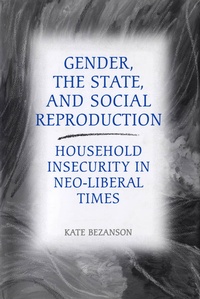
Gender, the State, and Social Reproduction
Household Insecurity in Neo-Liberal Times
1st Edition
Published on 2. November 2006
420 pages
978-1-4426-7520-9 (ISBN)
Description

Policies implemented in the mid to late 1990s in Ontario by Mike Harris's Conservative government have had undeniable repercussions for the population of that province. Kate Bezanson's Gender, the State, and Social Reproduction is the first study to consider the implications of those policies for gender relations - that is, how women and men, families, and households coped with these changes, and how division of labour and standards of living were affected. Bezanson also considers implications of neo-liberalism more generally, for the lives of people living under such regimes.
Beginning with an outline of the restructuring experiment which took place under the Conservative government between 1995 and 2000, Bezanson shows how this process dramatically altered the scope of the welfare state, labour market protections and conditions, and the capacity for people to manage and plan their own lives. She combines this detailed investigation of the changes introduced by Harris with data collected in in-depth interviews of selected Ontario households, in order to examine how neo-liberalism affects daily lives, particularly of low income people, and especially of women. Ultimately, Bezanson finds that the neo-liberal restructuring of Ontario in the 1990s consolidated a gender regime that was highly unsustainable for poor households, many of which were lead by women. A controversial and illuminating study, Gender, the State, and Social Reproduction crosses the disciplines of politics, history, gender studies, and sociology.
Beginning with an outline of the restructuring experiment which took place under the Conservative government between 1995 and 2000, Bezanson shows how this process dramatically altered the scope of the welfare state, labour market protections and conditions, and the capacity for people to manage and plan their own lives. She combines this detailed investigation of the changes introduced by Harris with data collected in in-depth interviews of selected Ontario households, in order to examine how neo-liberalism affects daily lives, particularly of low income people, and especially of women. Ultimately, Bezanson finds that the neo-liberal restructuring of Ontario in the 1990s consolidated a gender regime that was highly unsustainable for poor households, many of which were lead by women. A controversial and illuminating study, Gender, the State, and Social Reproduction crosses the disciplines of politics, history, gender studies, and sociology.
More details
Language
English
Place of publication
Toronto
Canada
Target group
College/higher education
Professional and scholarly
Edition type
Digital original
File size
12,16 MB
ISBN-13
978-1-4426-7520-9 (9781442675209)
Copyright in bibliographic data and cover images is held by Nielsen Book Services Limited or by the publishers or by their respective licensors: all rights reserved.
Schweitzer Classification
Other editions
Additional editions
Book
12/2006
University of Toronto Press
€82.00
Article not available at the moment
Person
Kate Bezanson is an assistant professor in the Department of Sociology at Brock University.
Content
List of Tables and Figures
Preface
1 The Neo-liberal Experiment in Ontario, 1995-2000
Conceptual Issues
Methodological Issues
Outline of the Book
2 Struggles over Social Reproduction in a Neo-liberal Era
The Dynamics of Social Reproduction
Mediating Social Reproduction
Towards a New Gender Order?
3 Legislative and Regulatory Changes in Ontario, 1995-2000
Neo-liberal Reorientations
Implementing the Neo-liberal Project in Ontario, 1995-2000
Escalating Tensions in Social Reproduction
4 Putting Together a Living in Ontario in the Late 1990s
Overview of Household Incomes, 1997-2000
Income from Labour Market Participation
Income from Government
Income from Other Sources
Putting It All Together
5 Interactive Effects of Social Policy Change on Households
Health Care
Education and Child Care
Social Assistance
Housing and Transportation
Multiple and Compounding Effects of Policy Change
6 Coping Strategies of Low-Income Households
Household Division of Labour and Resource Control
Coping Strategies
Putting Together a Living:
A Profile in Coping Coping Consequences
7 Rethinking Welfare State Retrenchment
Appendix A 1998 Low Income Cut-Offs (LICOs)
Appendix B Selection and Recruitment of Participants
Appendix C Detailed Household Structure
Appendix D Benchmark Questions
Appendix E Speaking Out Research Process
Appendix F List of Speaking Out Publications
Appendix G Profiles of Participant Households Who Received Social Assistance in the 1990s
Notes
References
Index
Preface
1 The Neo-liberal Experiment in Ontario, 1995-2000
Conceptual Issues
Methodological Issues
Outline of the Book
2 Struggles over Social Reproduction in a Neo-liberal Era
The Dynamics of Social Reproduction
Mediating Social Reproduction
Towards a New Gender Order?
3 Legislative and Regulatory Changes in Ontario, 1995-2000
Neo-liberal Reorientations
Implementing the Neo-liberal Project in Ontario, 1995-2000
Escalating Tensions in Social Reproduction
4 Putting Together a Living in Ontario in the Late 1990s
Overview of Household Incomes, 1997-2000
Income from Labour Market Participation
Income from Government
Income from Other Sources
Putting It All Together
5 Interactive Effects of Social Policy Change on Households
Health Care
Education and Child Care
Social Assistance
Housing and Transportation
Multiple and Compounding Effects of Policy Change
6 Coping Strategies of Low-Income Households
Household Division of Labour and Resource Control
Coping Strategies
Putting Together a Living:
A Profile in Coping Coping Consequences
7 Rethinking Welfare State Retrenchment
Appendix A 1998 Low Income Cut-Offs (LICOs)
Appendix B Selection and Recruitment of Participants
Appendix C Detailed Household Structure
Appendix D Benchmark Questions
Appendix E Speaking Out Research Process
Appendix F List of Speaking Out Publications
Appendix G Profiles of Participant Households Who Received Social Assistance in the 1990s
Notes
References
Index
