

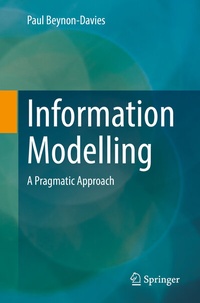
Information Modelling
Description

This textbook provides solid guidance on how to produce information models in practice. Information modeling has become increasingly relevant as an approach for understanding the active role that data plays within business and management and promoting the planning of business activities. The text promotes a practical approach to information modelling based around the analysis of communicative practice within delimited domains of organization.
The book chapters are designed to be read in sequence. The early chapters build an account of information modelling from the bedrock of a theory of information situations. Later chapters discuss a number of practical issues concerned with the application of this business analysis and design technique. The conclusion demonstrates a larger context for the application and importance of information modelling. Numerous in-text examples of the concepts of information modelling and their application are included throughout the text. A separate chapter is devoted to a range of exercises which the reader can use to test understanding and application of the technique. An appendix with solutions is also provided to support learning.
Overall, this textbook provides a step-by-step introduction to information modelling for use in undergraduate and postgraduate modules in information systems, computer science and even digitally focused modules within business and management. No prerequisite knowledge is assumed on the part of the reader. Students and practitioners are tutored in the development of information modelling from first principles. The book covers all the core principles of both entity-relationship diagramming and class diagramming - the two major approaches to information modelling.
More details
Other editions
Additional editions
Person
Paul Beynon-Davies is professor emeritus of organisational informatics at Cardiff Business School, Cardiff University. Before taking up an academic post, he had worked for several years in the informatics industry in the UK both in the public and private sectors. He has published widely having numerous books and peer-reviewed academic papers on topics relating to information systems, database systems, and business analysis and design.
