

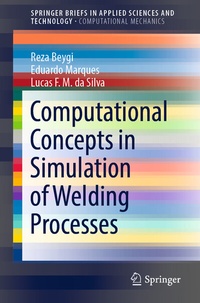
Computational Concepts in Simulation of Welding Processes
Description

This book introduces basic concepts related to computer-aided simulation of welding and prepares the reader to perform the simulation of welding by commercial simulation software. It focuses on conceptualizing the physics of welding, heat transfer, stress development and microstructure development in welding. This book helps the reader to implement these concepts in any commercial software to simulate the welding process according to their own requirement.
More details
Other editions
Additional editions
Persons
Eduardo A. S. Marques is a postdoctoral researcher at the Institute of Mechanical Engineering and Industrial Management (INEGI) and guest lecturer at the Department of
Mechanical Engineering of the Faculty of Engineering of the University of Porto (FEUP).
He obtained his PhD in the area of structural adhesive bonding for aerospace applications at FEUP in 2016 and now studies the effect of high strain rates, extreme temperature and high relative humidity on the behaviour of various materials and bonded structures.
Lucas F. M. da Silva is Full Professor in the Department of Mechanical Engineering at
the Faculty of Engineering of the University of Porto (FEUP) and editor-in-chief of the
Journal of Advanced Joining Processes. He leads the Advanced Joining Processes Unit (AJPU) of the Institute of Mechanical Engineering and Industrial Management (INEGI).
