

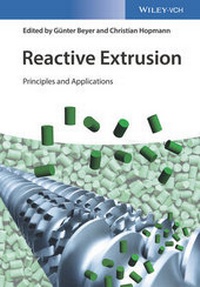
Reactive Extrusion
Description

As a result, readers will find here a compilation of potential applications for reactive extrusion to access new and cost-effective polymeric materials, while using existing compounding machines.
More details
Other editions
Additional editions
Persons
Professor Dr.-Ing. Christian Hopmann is Head of the Institute of Plastics Processing in Industry and the Skilled Crafts (Aachen, Germany) since 2011 and holds the Chair of Plastics Processing at the Faculty of Mechanical Engineering at RWTH Aachen University (Germany). Hopmann studied Mechanical Engineering at RWTH Aachen (Germany) and received his doctoral degree in 2000. From 2001 to 2004 he was Chief Engineer and Senior Vice Director of the Institute of Plastics Processing. In 2005, Hopmann started his industrial career at RKW AG Rheinische Kunststoffwerke (today: RKW SE), Europe's leading manufacturer of high quality polyethylene and polypropylene films, nonwovens and nets, being head of the Quality Management at RKW's site in Petersaurach (Germany). From 2006 to end of 2009 he was Head of Extrusion and thus responsible for the production of polyolefin films for hygiene, consumer packaging and industrial applications. From January 2010 to April 2011 he was Managing Director of RKW Sweden AB in Helsingborg (Sweden).
Content
2. The co-rotating twin screw extruder for reactive extrusion
3. Modelling of twin screw reactive extrusion: challenges and applications
4. Measurement and Modeling of Local Residence Time Distributions in a Twin Screw Extruder
5. In-process measurements for reactive extrusion monitoring and control
6. Exchange Reaction Mechanisms in the Reactive Extrusion of Condensation Polymers
7. In situ synthesis of inorganic and/or organic phases in thermoplastic polymers by reactive extrusion
8. Concept of (reactive) compatibilizer-tracer for emulsification curve build-up, compatibilizer selection and process optimization of immiscible (reactive) polymer blends
9. Nano-structuring of polymer blends by
an in-situ polymerization and in-situ compatibilization processes
10. Reactive Comb Compatibilizers for Immiscible Polymer Blends
11. Reactive compounding of highly filled flame retardant wire & cable compounds
12. Thermoplastic Vulcanizates (TPVs) by the Dynamic Vulcanization from Miscible or Highly Compatible Plastic/Rubber Blends
13. Reactive extrusion of polyamide 6 with integrated multiple melt degassing
14. Industrial production and use of grafted polyolefins
Chapter 1
Introduction to Reactive Extrusion
Christian Hopmann, Maximilian Adamy and Andreas Cohnen
RWTH Aachen University, Institute of Plastic Processing (IKV), Seffenter Weg 201, D-52074 Aachen, Germany
Engineering plastics have become indispensable to our daily lives. For several decades, the development of plastics technology to expand the scope of applications for plastics has been marked by "tailor-made" materials as well as by new processing techniques. Today, plastics are used in many applications ranging from plastics packaging and the automotive sector to medical products and they are increasingly substituting metal and ceramic. The success of this class of material is due to its characteristics such as good processability, low density, reasonable price, and especially its adjustable material properties.
The processing chain usually starts with the synthesis of the polymers, which is carried out by mostly petroleum-based monomers. In the field of polymer synthesis, a distinction is made between different polymerization reactions. These include, among others, mass polymerization, solution polymerization, and polymerization in gas phase [10]. Mass polymerization, which takes place in the melt, achieves high throughputs and high purities. However, the reaction rate, which is typically quite slow, results in the sedimentation of polymer chains with high molecular weight. Solution polymerization enables a higher homogeneity of the molecular weight distribution in the mixture because of the use of solvents. However, the solvent has to be removed by an energy-intensive process following polymerization. In addition, the presence of the solvent may produce undesirable side reactions. During gas phase polymerization, the monomers are transferred into a fluid state by an inert gas flow prior to polymerization [10].
Polymerization can be carried out in three different ways: batchwise, semi-continuous, and continuous. The choice of the reaction process influences both the material properties, such as viscosity or achievable molecular weight and the reaction kinetics and the resulting heat dissipation. Although polymerization in a batchwise process allows the production of small amounts of special polymers the batchwise process is less suitable for the mass production of a polymer due to the restricted achievable viscosity. Semi-continuous processes are often used for polycondensate reactions, when either low molecular weight fractions have to be removed to shift the chemical equilibrium or when additives have to be added. The continuous process is characterized by high throughputs with simultaneously good heat dissipation. The process used influences the residence time as well as the residence time distribution. Typical reactors are the stirring tank reactor, stirred tank reactors in series, and the tube reactor [8].
After the synthesis, the properties of polymers frequently do not meet the requirements for the production of component parts. Therefore, the material properties are specifically adjusted by adding fillers and additives. This takes place in a separate processing step that follows polymer synthesis. Mostly, a co-rotating and closely intermeshing twin-screw extruder is used for this compounding task, in which the polymers are melted and mixed with additives and functional fillers [12]. The additives and fillers can be mixed dispersively and distributively into the melt to achieve homogeneous material properties. The processing during compounding as well as the material composition influence the material properties. The produced material is usually formed as granules, and goes through further processes such as injection molding or extrusion [12]. Alternatively, direct compounding of sheets or profiles is also possible. This saves energy, since the material does not have to be melted again. In addition, the material experiences a lower thermal stress, which enhances the material properties.
To summarize, the supply chain of plastics processing usually consists of three steps: polymerization, compounding, and further processing. In industrial applications, these three steps are separated in time and space, as each process step is usually performed by a different company with clearly defined areas of responsibilities. At the beginning of the supply chain, the production of polymers is already characterized by inflexibility, as the chemical reactors are generally designed for the production of large amounts of polymers. A typical stirring tank reactor can handle a volume of up to 50 m3 [10]. Furthermore, many reactor types are not designed for the handling and mixing of high-viscosity liquids. In such cases, the synthesis of polymers takes place in the presence of a solution, suspension, or emulsion. The removal of the processing aids is complex and reduces the economic efficiency. Therefore, the continuous processing of specialty polymers for specific applications in small amounts ensures efficiency. The raw material manufacturers cannot react rapidly and flexibly to the changing market demands. Thus, it is not possible to satisfy individual customer requirements for small volumes. Therefore, raw material manufacturers produce only few variations in large quantities. This restriction at the beginning of the process chain hinders use in plastics applications that demand more specific characteristics profiles than are currently available. A higher flexibility during polymer synthesis could therefore create a wider range of scope of plastics applications.
In this context, reactive extrusion offers a more flexible alternative to polymerization in the presence of a solution, suspension, or emulsion and subsequent compounding. In reactive extrusion, the co-rotating, intermeshing twin-screw extruder that is traditionally used to melt, homogenize, and pump polymers through dies for compounding, is used for the synthesis of polymers. The extruder, which conveys the reactant oligomer or monomer in solid, liquid, or molten state represents a horizontal chemical reactor. As such, reactive extrusion includes the backward integration of the polymer synthesis into the compounding process. In principle, all reaction types of polymer synthesis can be realized in the twin-screw extruder, as long as the reaction rate is adapted to the residence time and distribution of the material in the processing machine [4, 7]. The residence time depends on the throughput, the length of the extruder, and the screw design and speeds. An increase of the residence time is possible within certain limits by linking two extruders to a cascade or by using low throughputs and screw speeds. However, this leads to a production that is not economically viable due to low capacity utilization [17].
One advantage of reactive extrusion is the absence of solvents as a reaction medium, as melts with different viscosities can be processed in a twin-screw extruder [7]. The absence of solvents in a conventional reactor technology causes additional issues regarding the removal of excessive heat, as polymer melts show a low thermal conductivity. In comparison, the reactive extrusion enables efficient heat removal due to the large reactor surface in relation to the reactor volume. The use of twin-screw extruders results in a high flexibility, as twin-screw extruders possess segmented barrels, which enable individual heating and cooling of single segments [7, 12]. In addition, the material is heated by the shear energy of the tightly intermeshing screw elements during conveyance and mixing. The introduced shear heating and the external heating provides the required heat for chemical reactions. The screws of a twin-screw extruder also consist of several segments. The geometry of the screw elements may differ depending on the depth between screw flights, the flight thickness, and the direction and degree of flight pitch [7]. Furthermore, mixing elements can be included for different mixing effects. Therefore, both dispersive and distributive mixing are possible. The design of the screw is key for the resulting mixing effect and the shear energy input.
A typical reactive extrusion process involves the following procedure: The reactants are fed through the main hopper into the twin-screw extruder, where the reactants are heated up to start the chemical reaction. The temperature profile, the use of activators and catalysts, and the residence time of the material in the extruder determine the reaction speed and the reaction progress. Consequently, the throughput, the length of the extruder, and the screw speed limit the degree of polymerization. Otherwise, the polymerization can be stopped specifically by the deactivation of reactive end groups to achieve a low viscosity. The addition of solid, liquid, or gaseous reactants is possible at almost any position at the extruder. For example, heat-sensitive additives can be added at the end of the extruder to minimize the residence time, or an inert gas can be added at the extruder feet to protect the process from degradation by atmospheric oxygen. Low molecular components, reaction byproducts and moisture can be removed by vacuum degassing during the reactive extrusion process. The degassing capability is dependent on the residence time, the melt temperature (which influences the viscosity), the diffusion rate, the attainable vacuum, the number of the degassing zones, and the renewal rates of the surface [11]. In addition, the adding of fillers and additives during the reactive extrusion is possible. The excellent mixing effect of the twin-screw extruder enables a homogenous incorporation of fillers. At the end of the extruder the melt is pressed through a die to either form strings that are pelletized, or to extrude directly sheets,...
