

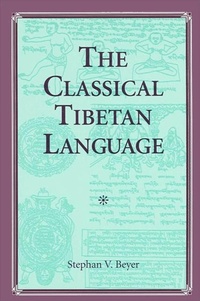
The Classical Tibetan Language
Description

Among Asian languages, Tibetan is second only to Chinese in the depth of its historical record, with texts dating back as far as the eighth and ninth centuries, written in an alphabetic script that preserves the contemporaneous phonological features of the language.
The Classical Tibetan Language is the first comprehensive description of the Tibetan language and is distinctive in that it treats the classical Tibetan language on its own terms rather than by means of descriptive categories appropriate to other languages, as has traditionally been the case. Beyer presents the language as a medium of literary expression with great range, power, subtlety, and humor, not as an abstract object. He also deals comprehensively with a wide variety of linguistic phenomena as they are actually encountered in the classical texts, with numerous examples of idioms, common locutions, translation devices, neologisms, and dialectal variations.
More details
Other editions
Additional editions
Person
Stephan V. Beyer has a Ph.D. in Buddhist Studies and is author of The Cult of Tara: Magic and Rituals in Tibet and The Buddhist Experience. He is currently an attorney and partner at Sidley and Austin in Chicago.
Content
- Intro
- The Classical Tibetan Language
- Contents
- Foreword
- Preface
- Introduction
- 2. Transliteration
- 3. Tibetan in Context
- 4. The Writing System
- 5. Sounds
- 6. Syllables
- 7. Words
- 8. Inflections
- 9. Phrases
- 10. Simple Propositions
- 11. Complex Propositions
- 12. Sentences
- 13. Beyond the Sentence
- Bibliography
- Index
- A
- B
- C
- D
- E
- F
- G
- H
- I
- J
