

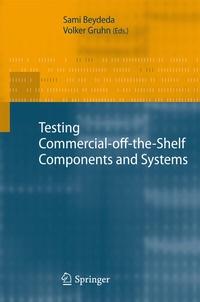
Testing Commercial-off-the-Shelf Components and Systems
Description

Industrial development of software systems needs to be guided by recognized engineering principles. Commercial-off-the-shelf (COTS) components enable the systematic and cost-effective reuse of prefabricated tested parts, a characteristic approach of mature engineering disciplines. This reuse necessitates a thorough test of these components to make sure that each works as specified in a real context.
Beydeda and Gruhn invited leading researchers in the area of component testing to contribute to this monograph, which covers all related aspects from testing components in a context-independent manner through testing components in the context of a specific system to testing complete systems built from different components. The authors take the viewpoints of both component developers and component users, and their contributions encompass functional requirements such as correctness and functionality compliance as well as non-functional requirements like performance and robustness.
Overall this monograph offers researchers, graduate students and advanced professionals a unique and comprehensive overview of the state of the art in testing COTS components and COTS-based systems.
More details
Other editions
Additional editions
Persons
Sami Beydeda is a research associate at the computer science department of the University of Leipzig, Germany. His research interests include quality assurance of software components and component-based systems. Sami Beydeda has written his PhD on "The Self-Testing COTS Components (STECC) Method" and has published several articles on testing in component-based development. He was responsible for several software development project in industry, in the financial sector in particular, and for research projects at the Universities of Dortmund and Leipzig. Sami Beydeda is a program committee member of COMPSAC 2004, Workshop on Quality Assurance and Testing of Web-Based Applications 2004, AICCSA 2005.
Volker Gruhn is a full professor at the computer science department of the University of Leipzig, Germany. His research interests are component-based development, software processes for distributed systems, architecture of electronic commerce applications and workflow management. He has been chief technical officer of a German software house called LION from 1992 to 1996. In this position he was responsible for a software development department of 150 people. Volker Gruhn was a PC member of major software engineering conferences (ESEC95, ESEC97, ICSE2004) and several software process workshops and conferences. He was program chair of the 6th European Workshop on Software Process Technology and the 8th European Software Engineering Conference. Volker Gruhn has already organized a workshop at ICSE, the Engineering Distributed Objects Workshop during ICSE 99. In 1997 Volker Gruhn co-founded adesso AG, a German software house specialized in component-based software development. adesso AG currently has 170 employees.
