

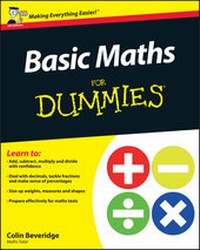
Basic Maths For Dummies, UK Edition
Description

More details
Other editions
Additional editions
Person
Content
Introduction
Hi! I'm Colin, and I want to change the world.
I live in a world where, when I say 'I'm a maths tutor,' people say to me 'Oh, maths . . . I was never any good at that,' or 'I haven't used maths since I left school.'
I live in a world where I have to bite my tongue rather than say 'I don't mind that you think maths is hard, but I am saddened that you're proud of this,' or 'Are you sure about that? I bet you used maths six times before breakfast this morning.'
I want to live in a world where everyone is okay at maths. Not a world full of Einsteins, not a world full of geeks - just a world where having a solid level of maths is as natural to everyone as having a solid level of reading and talking.
This book is part of my vision - and I'm delighted that you've picked it up. You've taken the first step to being a bigger part of my ideal world, and I want to do everything I can to help you become as good at maths as you want to be.
I want to show you that maths makes sense, most of the time, and that you use maths countless times a day, often when you don't even realise it. I want to show you that after you break problems down into smaller steps, those problems are so much more doable. I want to help you stop feeling stupid or afraid or troubled by maths. I know you aren't stupid: you just haven't got the hang of maths yet.
Most of all, I want to hear how you get on. The best way to catch me is on twitter (@icecolbeveridge) - I can't promise I'll get back to you straight away, but I promise I'll read and reply if I possibly can.
About This Book
In this book, I try to help you understand not only how to do the maths you need, but why you do the maths in a certain way. I show you maths isn't some mystical language of squiggles but instead is a concise and efficient way to communicate. One of the nice things about maths is that it changes very little from country to country. I studied maths in France for a year and was surprised that most of the words, even in the ridiculously advanced maths they thought I could do, were either basic French vocab or very similar to the English words. The sums were exactly the same. (I still couldn't do them, but that's a different story.)
Now, I'm pretty good at maths. I've been a full-time maths tutor since 2008. Before that I worked on a NASA project in the USA. I have an equation named after me. I know my stuff.
But - and this is a big 'but' - I know that being a good mathematician isn't the same as being a good maths teacher. I'm lucky to have worked with enough people at the stage you are now - smart and interested, but needing help to understand - that I can break down maths into smaller, simpler parts that I hope you'll understand.
Among other things, I cover the following in this book:
Keeping calm instead of stressing about maths.
Solving regular arithmetic problems - adding and taking away, multiplying and dividing.
Rounding off and estimating your answers.
Dealing with decimals, fractions, percentages and ratios.
Messing about with measures of time, money, weight and temperature.
Understanding shapes - how you measure them and how you move them around.
Grappling with graphs - both reading and drawing.
Summing up statistics, including averages and probabilities.
How could that not be fun?
This book is based on the UK Adult Numeracy Core Curriculum, from Entry Level 3 through to Level 2. Whether or not a Level 2 numeracy qualification is equivalent to an A-C pass at GCSE is a murky area I don't want to muddy further, but I reckon they're roughly the same level in difficulty, although the numeracy curriculum covers slightly fewer topics.
So, that means this book may help you do pretty well at GCSE level but won't cover all of the topics involved - particularly algebra, which this book barely touches. If you read this book cover to cover and understand everything, you should ace any UK Adult Numeracy test thrown at you. Although I've based this book on the core curriculum, I sometimes dip into topics in a little more detail than needed. I also cover a few areas from a slightly earlier level in the curriculum if I reckon you may find the particular subject hard.
Whether you're studying for a numeracy qualification or a GCSE, or just want to brush up on your basic maths skills, this book has what you need. Best of all, the book follows the For Dummies format. Divided into easy-to-follow parts, the book serves as both your reference and your troubleshooting guide.
Conventions Used in This Book
I keep the conventions to a minimum in this book. Here are the ones I use:
I use italics for emphasis or to highlight new words or phrases.
Boldfaced text indicates key words in bulleted lists or the key steps of action lists.
Monotype font is used for internet and email addresses.
What You're Not to Read
This book is designed to be an easy-access reference guide to basic maths. I cover each subject in its entirety in individual chapters, and the information doesn't depend on what comes before or after. This means you can jump around the book to the subjects you want to focus on and skip those you feel comfortable with already or just aren't interested in.
If you feel like you're starting from scratch, I strongly recommend you peruse the whole book to get a solid idea of all that's involved. If you already have a decent maths background, you probably want to focus on the areas you find are relatively weak for you - but you may also find some of the insights in other areas help to shore up your maths skills.
No matter what your background, you can skip paragraphs marked with the Technical Stuff icon without giving up an understanding of the primary subject. Also, sidebars supplement the primary text - you can skip them without missing the main point.
Foolish Assumptions
Making assumptions is always a risky business, but knowing where I'm coming from may put you at ease. So, in writing this book, I assume that:
You know how to count and are familiar with the symbols for the numbers.
You understand the idea of money and changing a banknote for an equivalent value of coins.
You know what some basic shapes look like.
You're prepared to think fairly hard about maths and want either to pass a numeracy qualification or to simply brush up on your maths skills.
How This Book Is Organised
Like all For Dummies books, Basic Maths For Dummies is a reference and each topic is allotted its own part in the book. Within each part are individual chapters relating specifically to the topic in question.
Part I: Whole Numbers: The Building Blocks of Maths
If you want to be good at maths - and I presume you do, otherwise you'd have picked up a different book - being able to do three things really well is helpful:
Stay calm: Maths can be hard enough when your mind isn't complaining about how impossible it is and trying to sabotage your efforts. I give you tips on how to keep that under control and set yourself up for success.
Do sums on paper: As a mathematician, I think this is the least important of the three for being good at maths. Unfortunately, the people who write exams disagree with me, so I walk you carefully through methods for adding, taking away, multiplying and dividing, and I try to show you why the sums work.
Work out rough answers: Being able to give a ballpark answer quickly is far more important to me than being able to work out a huge long-division sum. I show you how to work out a rough answer without giving yourself a headache.
Part II: Parts of the Whole
Stand back, everybody - I'm going to use the F-word. A word some people would like to see banned from books in public libraries and never have to hear on the TV. That's right, I'm talking about fractions. Gasp! I can't believe he wrote that!
I'm here to tell you that there's nothing dirty about fractions, even improper ones. There's a lot of misinformation out there about fractions, and some teachers find talking about fractions very difficult without getting embarrassed. But don't worry - in Part II I try to answer all of your questions about fractions in a frank and easy-to-understand manner. I also cover their close friends, decimals, percentages, ratios and proportion, which are all versions of the same thing.
I also...
