

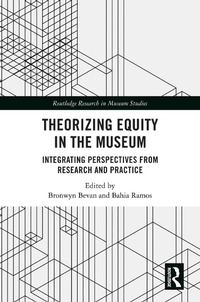
Theorizing Equity in the Museum
Integrating Perspectives from Research and Practice
1st Edition
Published on 30. August 2021
184 pages
978-1-000-42779-0 (ISBN)
Description

Theorizing Equity in the Museum integrates the perspectives of learning researchers and museum practitioners to shed light on the deep-seated structures that must be accounted for if the field is to move past aspirations and rhetoric and towards more inclusive practices.
Written during a time when museums around the world were being forced to reckon with their institutional practices of exclusion; their histories of colonization, both cultural and intellectual; and, for many, their tenuous business models, the chapters leverage a range of theoretical perspectives to explore lived experiences of working in the museum towards changing the museum. Theories of spatial justice, critical pedagogy, culturally relevant pedagogy, critical race theory, and others are used to consider how the museum's dominant cultural structures and norms collide with museum professionals' aspirations for inclusive practices. The chapters present a mix of empirical research and reflections, which collectively operate to theorize the museum as a potential force for enriching, empowering, and transforming an inclusive public's relationship with some of our most powerful ideas and aspirations. But first they must change, from the inside out.
Grounded in practice and practical problems, Theorizing Equity in the Museum demonstrates how theory can be used as a practical tool for change. As a result the book will be of interest to academics and students engaged in the study of museums, education, learning and culture, as well as to museum practitioners with an interest in equity and inclusion.
Written during a time when museums around the world were being forced to reckon with their institutional practices of exclusion; their histories of colonization, both cultural and intellectual; and, for many, their tenuous business models, the chapters leverage a range of theoretical perspectives to explore lived experiences of working in the museum towards changing the museum. Theories of spatial justice, critical pedagogy, culturally relevant pedagogy, critical race theory, and others are used to consider how the museum's dominant cultural structures and norms collide with museum professionals' aspirations for inclusive practices. The chapters present a mix of empirical research and reflections, which collectively operate to theorize the museum as a potential force for enriching, empowering, and transforming an inclusive public's relationship with some of our most powerful ideas and aspirations. But first they must change, from the inside out.
Grounded in practice and practical problems, Theorizing Equity in the Museum demonstrates how theory can be used as a practical tool for change. As a result the book will be of interest to academics and students engaged in the study of museums, education, learning and culture, as well as to museum practitioners with an interest in equity and inclusion.
More details
Series
Edition
1. Auflage
Language
English
Place of publication
London
United Kingdom
Publishing group
Taylor & Francis Ltd
Target group
Professional and scholarly
College/higher education
Illustrations
5 Line drawings, black and white; 7 Halftones, black and white; 12 Illustrations, black and white
ISBN-13
978-1-000-42779-0 (9781000427790)
Copyright in bibliographic data and cover images is held by Nielsen Book Services Limited or by the publishers or by their respective licensors: all rights reserved.
Schweitzer Classification
Other editions
Additional editions
Bronwyn Bevan | Bahia Ramos
Theorizing Equity in the Museum
Integrating Perspectives from Research and Practice
Book
05/2023
1st Edition
Routledge
€62.90
Shipment within 10-20 days
Bronwyn Bevan | Bahia Ramos
Theorizing Equity in the Museum
Integrating Perspectives from Research and Practice
Book
08/2021
1st Edition
Routledge
€206.00
Shipment within 15-20 days
Persons
Bronwyn Bevan, PhD, worked at the Exploratorium in San Francisco for almost 25 years, starting as a project coordinator for a program working with teachers, developing collaborations with universities and CBOs, and ultimately overseeing research and serving as a member of the senior management team. Her research examines how learning can be organized to empower individuals and communities.
Bahia Ramos is director of arts at the Wallace Foundation. She leads the team responsible for the strategy and implementation of the foundation's work in areas including building audiences for the arts and promoting arts education for young people. Before arriving at Wallace, Ramos served as program director of the arts for the Knight Foundation. In that role, she built national partnerships and initiatives with organizations such as ArtPlace and Sundance, and worked on the local level to bring arts experiences to diverse audiences and neighborhoods.
Bahia Ramos is director of arts at the Wallace Foundation. She leads the team responsible for the strategy and implementation of the foundation's work in areas including building audiences for the arts and promoting arts education for young people. Before arriving at Wallace, Ramos served as program director of the arts for the Knight Foundation. In that role, she built national partnerships and initiatives with organizations such as ArtPlace and Sundance, and worked on the local level to bring arts experiences to diverse audiences and neighborhoods.
Content
List of Figures; List of Contributors; Preface; Chapter 1 Spatial Justice Theory: Working Towards Justice: Reclaiming our Science Center; Chapter 2 Critical Pedagogy and Critical Theory: Museum Education and Critical Pedagogy: Re-imagining Power in the Art Museum; Chapter 3 Feminism, Intersectionality, and Decolonization Theories: "The Price We Have to Be Willing to Pay is Ourselves": Discussing Illusions of Inclusion in Science Centers and Museums; Chapter 4 Theories of Identity in Communities of Practice: Centering Equity and Access: An Examination of a Natural History Museum's Mentored Research Youth Program; Chapter 5 Foucauldian Discourses of Power: Discourses of Dissent: How Competing Agendas Prevent or Enable Sustainable Change Taking Place within Twenty-First Century Art Museums; Chapter 6 Culturally Responsive Pedagogy and Feminist Theory: Female-Responsive Exhibit Design: Explorations of a Research-Practice Partnership; Chapter 7 Theories of Rightful Presence in Socio-Cultural Contexts: Vicious Cycles: Museums Marginalize the Museum Educators They Hire to Engage Marginalized Communities; Chapter 8 Social Models of Disability and Museum Research: Inclusion and Accessibility in Science Museums: Voices from Brazil Chapter 9 Embodied Theory and Lived Experience: Museums are Burning: Dare We Engage a Liberatory Imagination in Practice and Research?; Index
