

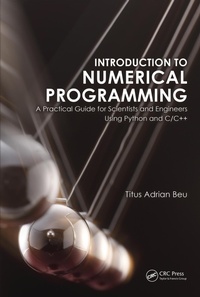
Introduction to Numerical Programming
A Practical Guide for Scientists and Engineers Using Python and C/C++
1st Edition
Published on 3. September 2014
674 pages
978-1-4665-6968-3 (ISBN)
Description

Makes Numerical Programming More Accessible to a Wider AudienceBearing in mind the evolution of modern programming, most specifically emergent programming languages that reflect modern practice, Numerical Programming: A Practical Guide for Scientists and Engineers Using Python and C/C++ utilizes the author's many years of practical research and tea
Reviews / Votes
"This book is written for advanced undergraduate and graduate students in natural sciences and engineering for a one- or two-semester course. The material presented includes many topics treated in a numerical analysis course and contains a lot of coding examples in Phyton, and C/C++. ... The value of the book lies in the presentation of the programming and a program example on almost every second page."-Gudula Ruenger, Zentralblatt MATH, 1308
"In a relatively crowded field of numerical programming books, this is the only one to include both Python and C code examples. ... a good reference for a one- or two-semester course for advanced undergraduate students or for graduate students in science or engineering."
-Optics & Photonics News, 2015
"Working through this book you will become an expert in numerical techniques ... . Your journey will be a real pleasure since the book focuses on thorough explanations, hands-on code examples, and graphical representations."
-Professor Dr. Alexander K. Hartmann, Institute for Physics, University of Oldenburg
"... by taking simple mathematical examples and translating them into what the computer actually does, this textbook provides us with a good picture of what is achieved in a numerical simulation. A basic necessity for whoever wants to address more complex coding and algorithms!"
-Professor Michel Mareschal, Department of Physics, Universite Libre de Bruxelles
"This is a useful book, both as a text and as a reference for computational physics students and instructors. Right from the first chapter about errors it provides an invaluable resource for aspects that are often not sufficiently emphasised, despite their importance for reliable calculations. I strongly recommend it for everyone's bookshelf."
-Professor Joan Adler, Technion, Israel Institute of Technology
"... a comprehensive introduction to classical numerical methods for advanced-level undergraduate students in the physical sciences, engineering, and applied mathematics. The book is novel in teaching both numerics and the art of programming, via clear and simple codes in Python and C/++. ... I will recommend it to my students."
-Professor Mike Wheatland, The University of Sydney
"This book is unique in providing an introduction to [numerical methods, programming languages, and graphics]. Each topic is clearly explained and can be practiced using ready-made computer programs."
-Professor R.I. Campeanu, York University, Toronto "This book is written for advanced undergraduate and graduate students in natural sciences and engineering for a one- or two-semester course. The material presented includes many topics treated in a numerical analysis course and contains a lot of coding examples in Phyton, and C/C++. ... The value of the book lies in the presentation of the programming and a program example on almost every second page."
-Gudula Ruenger, Zentralblatt MATH, 1308
"In a relatively crowded field of numerical programming books, this is the only one to include both Python and C code examples. ... a good reference for a one- or two-semester course for advanced undergraduate students or for graduate students in science or engineering."
-Optics & Photonics News, 2015
"Working through this book you will become an expert in numerical techniques ... . Your journey will be a real pleasure since the book focuses on thorough explanations, hands-on code examples, and graphical representations."
-Professor Dr. Alexander K. Hartmann, Institute for Physics, University of Oldenburg
"... by taking simple mathematical examples and translating them into what the computer actually does, this textbook provides us with a good picture of what is achieved in a numerical simulation. A basic necessity for whoever wants to address more complex coding and algorithms!"
-Professor Michel Mareschal, Department of Physics, Universite Libre de Bruxelles
"This is a useful book, both as a text and as a reference for computational physics students and instructors. Right from the first chapter about errors it provides an invaluable resource for aspects that are often not sufficiently emphasised, despite their importance for reliable calculations. I strongly recommend it for everyone's bookshelf."
-Professor Joan Adler, Technion, Israel Institute of Technology
"... a comprehensive introduction to classical numerical methods for advanced-level undergraduate students in the physical sciences, engineering, and applied mathematics. The book is novel in teaching both numerics and the art of programming, via clear and simple codes in Python and C/++. ... I will recommend it to my students."
-Professor Mike Wheatland, The University of Sydney
"This book is unique in providing an introduction to [numerical methods, programming languages, and graphics]. Each topic is clearly explained and can be practiced using ready-made computer programs."
-Professor R.I. Campeanu, York University, Toronto
More details
Series
Edition
1. Auflage
Language
English
Place of publication
Baton Rouge
United States
Publishing group
Taylor & Francis Inc
Target group
College/higher education
This text serves advanced undergraduate and graduate level students in physical sciences and engineering, as well as researchers and professionals in various disciplines of science and engineering who employ computational tools in their study and work.
Illustrations
124 s/w Abbildungen, 8 s/w Tabellen
124 b/w images and 8 tables
ISBN-13
978-1-4665-6968-3 (9781466569683)
Copyright in bibliographic data and cover images is held by Nielsen Book Services Limited or by the publishers or by their respective licensors: all rights reserved.
Schweitzer Classification
Other editions
Additional editions
Titus A. Beu
Introduction to Numerical Programming
A Practical Guide for Scientists and Engineers Using Python and C/C++
Book
07/2017
1st Edition
CRC Press
€297.40
Shipment within 10-20 days
Titus A. Beu
Introduction to Numerical Programming
A Practical Guide for Scientists and Engineers Using Python and C/C++
Book
09/2014
1st Edition
CRC Press
€145.00
Shipment within 15-20 days
Person
Titus Adrian Beu, professor of theoretical and computational physics at the University "Babes-Bolyai" from Cluj-Napoca, Romania, has been active in the broader field of computational physics for more than 30 years. His research topics have evolved from Tokamak plasma and nuclear reactor calculations in the 1980s, collision theory and molecular cluster spectroscopy in the 1990s, to fullerenes and nanofluidics simulations in recent years. Development of ample computer codes has been at the core of all research projects the author has conducted. In parallel, he has lectured on general programming techniques and advanced numerical methods, general simulation methods, and advanced molecular dynamics.
Content
Approximate Numbers. Basic Programming Techniques. Elements of Scientific Graphics. Sorting and Indexing. Evaluation of Functions. Algebraic and Transcendental Equations. Systems of Linear Equations. Eigenvalue Problems. Modeling of Tabulated Functions. Integration of Functions. Monte Carlo Method. Ordinary Differential Equations. Partial Differential Equations. Appendices. Index.
