

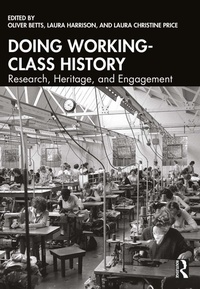
Doing Working-Class History
Research, Heritage, and Engagement
1st Edition
Published on 4. November 2024
346 pages
978-1-040-18389-2 (ISBN)
Description

Economic and political uncertainty has brought the language of class - especially discussion of the working class - to a broad audience across scholarship and social debate. This introductory volume shows how the history of the working class has, is, and can be researched, written, and represented.
The book is structured in three parts: perspective, context, and application. Each offers an introduction to both classic historiography and new ideas and methodologies. With chapters covering a span of the years c.1750-present, the book focuses on three essential questions:
What is working-class history and what should it become?
What can a focus on working-class history reveal?
What are the possibilities of this research in the university classroom, the heritage world, and beyond?
Doing Working-Class History will appeal to students and scholars of working-class history, whether relative newcomers to the field or veteran researchers interested in new approaches and material. It will also be of interest to local and family historians, museum and heritage professionals, and general readers.
The book is structured in three parts: perspective, context, and application. Each offers an introduction to both classic historiography and new ideas and methodologies. With chapters covering a span of the years c.1750-present, the book focuses on three essential questions:
What is working-class history and what should it become?
What can a focus on working-class history reveal?
What are the possibilities of this research in the university classroom, the heritage world, and beyond?
Doing Working-Class History will appeal to students and scholars of working-class history, whether relative newcomers to the field or veteran researchers interested in new approaches and material. It will also be of interest to local and family historians, museum and heritage professionals, and general readers.
More details
Edition
1. Auflage
Language
English
Place of publication
London
United Kingdom
Publishing group
Taylor & Francis Ltd
Target group
College/higher education
Illustrations
7 Tables, black and white
ISBN-13
978-1-040-18389-2 (9781040183892)
Copyright in bibliographic data and cover images is held by Nielsen Book Services Limited or by the publishers or by their respective licensors: all rights reserved.
Schweitzer Classification
Other editions
Additional editions
Oliver Betts | Laura Harrison | Laura Christine Price
Doing Working-Class History
Research, Heritage, and Engagement
Book
11/2024
1st Edition
Routledge
€59.20
Shipment within 10-20 days
Oliver Betts | Laura Harrison | Laura Christine Price
Doing Working-Class History
Research, Heritage, and Engagement
Book
11/2024
1st Edition
Routledge
€197.00
Shipment within 15-20 days
Persons
Oliver Betts is Research Lead at the National Railway Museum in York. He specialises in the history of technology and class, exploring how working-class worlds across the Anglophone world were reshaped by technologies. He has published on workers, communities, and industry in history and museums.
Laura Harrison is an Associate Professor of Modern History at the University of the West of England. She specialises in histories of youth and youth culture and is the author of Dangerous Amusements: Leisure, the Young Working Class, and Urban Space in Britain, c.1870-1939 (2022).
Laura Christine Price is a historian, teacher, and writer. Her PhD thesis, completed at the University of York, explored wool textile workers' relationships to trade unionism. She is an independent researcher and teaches at a secondary school in West Yorkshire.
Laura Harrison is an Associate Professor of Modern History at the University of the West of England. She specialises in histories of youth and youth culture and is the author of Dangerous Amusements: Leisure, the Young Working Class, and Urban Space in Britain, c.1870-1939 (2022).
Laura Christine Price is a historian, teacher, and writer. Her PhD thesis, completed at the University of York, explored wool textile workers' relationships to trade unionism. She is an independent researcher and teaches at a secondary school in West Yorkshire.
Content
Introduction: A time for working-class histories Part 1: Working-class history in perspective 1. Disability in working class history 2. Parasites unite: Sensory history, the possibilities of transgression, and the perceptual manifesto of the proletariat 3. 'What are those ones with the hammers?': Teaching working class history in secondary schools 4. 'Everyone has a tale to tell': Family history, family historians and working-class histories 5. Museums and Heritage Sites as sources for working-class history 6. Reading against the grain: Non-Plebian Sources in working-class history 7. Accessible bibliography Part 2: Working-class history in context 8. The Daily Citizen: Class v consumerism in the early Labour press 9. Gender politics of class: Exploring the connections and collaboration between the Irish labour movement and the Irish Women's Franchise League in Dublin, 1908-1916 10. Bootstraps and bras: Maidenform, the International Ladies' Garment Workers Union, and the creation of a new export-led economy in Puerto Rico 11. Patriotism and the English working class, c. 1902-1929 12. Medical care for working-class children in the late eighteenth and early nineteenth century 13. 'I have told her that it was neglected, and asked her why': Working-class women and discourses of 'bad motherhood' in England and Wales, 1870-1939 14. Unorganised Workers: Wool textile workers and class identities in twentieth-century Yorkshire 15. 'Where the Brass Band is Beloved', Brass Bands and working-class cultural identity: Inventing a musical metonym in the Southern Pennines, c.1840-1914 16. Street life: The leisure spaces and places of working-class youth in Britain, c. 1870-1960 17. Coal miners in the industrialization and deindustrialization of France and Germany: A comparative synthesis of the Nord/Pas-de-Calais and the Ruhr Part 3: Working-class history in application 18. Representations of working-class lives at criminal justice heritage sites 19. How broadside ballads followed us into this century 20. 'We tell our own stories:' Bussing Out, a creative installation about working-class children in Bradford 21. 'The Past We Inherit, the Future We Build': The praxis of working-class history
