

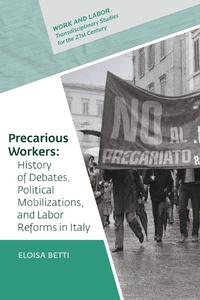
Precarious Workers
History of Debates, Political Mobilization, and Labor Reforms in Italy
Published on 20. December 2022
268 pages
978-963-386-438-8 (ISBN)
Description

The recent vast upsurge in social science scholarship on job precarity has generally little to say about earlier forms of this phenomenon. Eloisa Betti's monograph convincingly demonstrates on the example of Italy that even in the post-war phase of Keynesian stability and welfare state, precarious labor was an underlying feature of economic development. She examines how in this short period exceptional politics of labor stability prevailed. The volume then presents the processes whereby labor precarity regained momentum- under the name of flexibility- in the post-Fordist phase from the early 1980s, taking on new forms in the Craxi and Berlusconi eras.
Multiple actors are addressed in the analysis. The book gives voice to intellectuals, scholars, politicians and trade unionists as they have framed the concept and debates on precarious work from the 1950s onwards. Views of labor law experts, politicians and public servants are investigated in regard to labor regulations. Positions of the very precarians are explored, ranging from rural women, industrial homeworkers and blue-collar workers to physicians, university researchers and trainees, unveiling the emergence of anti-precarity social movements. The continuous role of women's associations and feminist groups in opposing labor precarity since the 1950s is prominently exposed.
Multiple actors are addressed in the analysis. The book gives voice to intellectuals, scholars, politicians and trade unionists as they have framed the concept and debates on precarious work from the 1950s onwards. Views of labor law experts, politicians and public servants are investigated in regard to labor regulations. Positions of the very precarians are explored, ranging from rural women, industrial homeworkers and blue-collar workers to physicians, university researchers and trainees, unveiling the emergence of anti-precarity social movements. The continuous role of women's associations and feminist groups in opposing labor precarity since the 1950s is prominently exposed.
More details
Series
Language
English
Place of publication
Budapest
Hungary
Target group
Professional and scholarly
File size
3,46 MB
ISBN-13
978-963-386-438-8 (9789633864388)
Copyright in bibliographic data and cover images is held by Nielsen Book Services Limited or by the publishers or by their respective licensors: all rights reserved.
Schweitzer Classification
Other editions
Additional editions
Eloisa Betti
Precarious Workers
History of Debates, Political Mobilization, and Labor Reforms in Italy
Book
12/2022
Central European University Press
€132.50
Available (delivery time upon request)
Content
Acknowledgments and Note to the English Edition
Introduction
I. Labor precarity as a historical phenomenon
II. Historicizing precarious work in the Italian Republic
III. Precarious workers: A readers' guide
Chapter 1. The Other Face of the Boom: The Discovery of Precarity
1.1. The invention of precarity: Paolo Sylos Labini's contribution
1.1.1 The inquiry into Sicily
1.1.2 The Fuà-Sylos Labini proposal for economic planning
1.1.3 The reception of Sylos Labini between Rome and Geneva
1.2 Precarity thy name is woman: genesis of a debate
1.2.1 The CGIL's female trade-unionists
1.2.2 The Union of Italian Women
1.2.3 Communist Women
1.2.4 The National Commission for Women Workers
1.3 Against precarity: the fight for "job stability"
1.3.1 Invisible precarity: industrial homeworkers
1.3.2 Precarity in the field: The dream of being employees
1.3.3 Against bogus seasonal work: Food workers
1.3.4 For a secure annual wage: Construction workers
1.3.5 Precarity on the ward: The hospital doctors' dispute
Chapter 2. The Construction of Stable Work Between Parliament and Labor Law
2.1 The parliamentary inquiry into workers' conditions in Italy
2.1.1 A political alliance for the improvement of the working classes' conditions
2.1.2 "Precarity" in the parliamentary inquiry documents
2.1.3 The parliamentary inquiry and the new labor law
2.2 Legislation on "particular labor relationships" during the boom years
2.2.1 Home-based industrial work
2.2.2 Sub-contracted work
2.2.3 The fixed-term contract
2.3 New regulations on dismissals in the nineteen-sixties
2.3.1 Dismissal for marriage
2.3.2 Individual dismissals
Chapter 3. Stability or Precarity: The Two Faces of the Long Seventies
3.1 The achievement of stability
3.1.1 The Statute of Workers' Rights and Article 18
3.1.2 The new home-based industrial work law
3.2 In the shadow of the crisis: Industrial restructuring and precarity
3.2.1 Precarious work in the studies of the seventies
3.2.2 The decentralization of production and precarity: The metalworking and textile- industries
3.3 Intellectual precarity and intellectual elaboration on precarity
3.3.1 Precarity and the woman question
3.3.2 Precarity and the 1977 movement
3.3.3 Intellectual precarity between schools and universities
Chapter 4. The Myth of Flexibility during the Roaring Eighties
4.1 The flexibility paradigm in economic-sociological thinking
4.1.1 Flexibility and precarity in the international debate
4.1.2 The myth of flexibility and the eclipse of precarity in the Italian debate
4.2 Labor policies and legislative changes in the shade of flexibility
4.2.1 Flexibility in the Parliament: The Craxi government's.
Introduction
I. Labor precarity as a historical phenomenon
II. Historicizing precarious work in the Italian Republic
III. Precarious workers: A readers' guide
Chapter 1. The Other Face of the Boom: The Discovery of Precarity
1.1. The invention of precarity: Paolo Sylos Labini's contribution
1.1.1 The inquiry into Sicily
1.1.2 The Fuà-Sylos Labini proposal for economic planning
1.1.3 The reception of Sylos Labini between Rome and Geneva
1.2 Precarity thy name is woman: genesis of a debate
1.2.1 The CGIL's female trade-unionists
1.2.2 The Union of Italian Women
1.2.3 Communist Women
1.2.4 The National Commission for Women Workers
1.3 Against precarity: the fight for "job stability"
1.3.1 Invisible precarity: industrial homeworkers
1.3.2 Precarity in the field: The dream of being employees
1.3.3 Against bogus seasonal work: Food workers
1.3.4 For a secure annual wage: Construction workers
1.3.5 Precarity on the ward: The hospital doctors' dispute
Chapter 2. The Construction of Stable Work Between Parliament and Labor Law
2.1 The parliamentary inquiry into workers' conditions in Italy
2.1.1 A political alliance for the improvement of the working classes' conditions
2.1.2 "Precarity" in the parliamentary inquiry documents
2.1.3 The parliamentary inquiry and the new labor law
2.2 Legislation on "particular labor relationships" during the boom years
2.2.1 Home-based industrial work
2.2.2 Sub-contracted work
2.2.3 The fixed-term contract
2.3 New regulations on dismissals in the nineteen-sixties
2.3.1 Dismissal for marriage
2.3.2 Individual dismissals
Chapter 3. Stability or Precarity: The Two Faces of the Long Seventies
3.1 The achievement of stability
3.1.1 The Statute of Workers' Rights and Article 18
3.1.2 The new home-based industrial work law
3.2 In the shadow of the crisis: Industrial restructuring and precarity
3.2.1 Precarious work in the studies of the seventies
3.2.2 The decentralization of production and precarity: The metalworking and textile- industries
3.3 Intellectual precarity and intellectual elaboration on precarity
3.3.1 Precarity and the woman question
3.3.2 Precarity and the 1977 movement
3.3.3 Intellectual precarity between schools and universities
Chapter 4. The Myth of Flexibility during the Roaring Eighties
4.1 The flexibility paradigm in economic-sociological thinking
4.1.1 Flexibility and precarity in the international debate
4.1.2 The myth of flexibility and the eclipse of precarity in the Italian debate
4.2 Labor policies and legislative changes in the shade of flexibility
4.2.1 Flexibility in the Parliament: The Craxi government's.
