

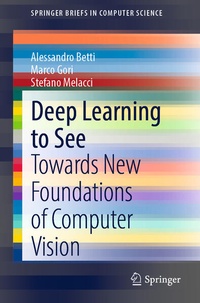
Deep Learning to See
Description

The remarkable progress in computer vision over the last few years is, by and large, attributed to deep learning, fueled by the availability of huge sets of labeled data, and paired with the explosive growth of the GPU paradigm. While subscribing to this view, this work criticizes the supposed scientific progress in the field, and proposes the investigation of vision within the framework of information-based laws of nature.
This work poses fundamental questions about vision that remain far from understood, leading the reader on a journey populated by novel challenges resonating with the foundations of machine learning. The central thesis proposed is that for a deeper understanding of visual computational processes, it is necessary to look beyond the applications of general purpose machine learning algorithms, and focus instead on appropriate learning theories that take into account the spatiotemporal nature of the visual signal.
Serving to inspire and stimulate critical reflection and discussion, yet requiring no prior advanced technical knowledge, the text can naturally be paired with classic textbooks on computer vision to better frame the current state of the art, open problems, and novel potential solutions. As such, it will be of great benefit to graduate and advanced undergraduate students in computer science, computational neuroscience, physics, and other related disciplines.
More details
Other editions
Additional editions
Persons
Marco Gori received the Ph.D. degree in 1990 from Università di Bologna, Italy, working partly at the School of Computer Science (McGill University, Montreal). In 1992, he became an Associate Professor of Computer Science at Università di Firenze and, in November 1995, he is currently leading the Siena Artificial Intelligence Lab (SAILAB).
Professor Gori is primarily interested in machine learning with applications to pattern recognition, Web mining, game playing, and bioinformatics. He has recently published the monograph "Machine Learning: A constraint-based approach," (MK, 560 pp., 2018), which contains a unified view of his approach. His pioneering role in neural networks has been emerging especially from the recent interest in Graph Neural Networks, that he contributed to introduce in the seminal paper "Graph Neural Networks," IEEE-TNN, 2009.
Professor Gori has been the chair of the Italian Chapter of the IEEE Computational Intelligence Society and the President of the Italian Association for Artificial Intelligence. He is a Fellow of IEEE, a Fellow of EurAI, and a Fellow of IAPR. He was one the first people involved in the European project on Artificial Intelligence CLAIRE, and he is currently a Fellow of Machine Learning association ELLIS. He is in the scientific committee of ICAR-CNR and is the President of the Scientific Committee of FBK-ICT. Dr. Gori is currently holding an international 3IA Chair at the Université Côte d'Azur.
Alessandro Betti received the M.S. degree in Theoretical Physics in 2016 from the University of Pisa, Italy, and the PhD degree in Computer Science (Smart Computing) in 2020, awarded jointly from the Universities of Florence, Pisa, and Siena. He is currently a postdoctoral researcher of the Department of Information Engineering and Mathematics, University of Siena. His main research interests are in machine learning, specifically the formulation of a class of learning problems that possess a natural temporal embedding using the formalism of Calculus of Variations (with applications to online learning, continuous learning from video streams, and computer vision).
Stefano Melacci is an Associate Professor at the Department of Information Engineering and Mathematics, University of Siena (Siena, Italy), where he received his PhD (2010) and the M.S. Degree (cum Laude) in Computer Engineering. He worked as a Researcher in the Academy and in the Industry (QuestIT S.r.l., Italy), and he has been a Visiting Scientist at the Ohio State University, Columbus (OH), USA. His profile is strongly characterized by research activity in the field of Machine Learning and, more generally, in Artificial Intelligence. Recently, he focussed on the problem of Continuous Learning from Video Streams, studying the role of motion and attention. He contributed to the unifying framework of Learning from Constraints that allows classic learning models to integrate symbolic knowledge representations. Prof. Melacci serves as Associate Editor of the IEEE Transactions on Neural Networks and Learning Systems, and he is an active reviewer for several journals and conferences in the field of Machine Learning.