

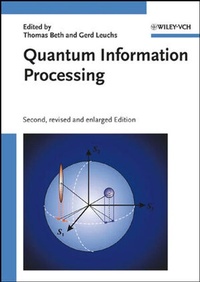
Quantum Information Processing
2nd Edition
Published on 6. March 2006
XXII, 449 pages
978-3-527-60608-5 (ISBN)
Description

Quantum processing and communication is emerging as a challenging technique at the beginning of the new millennium. This is an up-to-date insight into the current research of quantum superposition, entanglement, and the quantum measurement process - the key ingredients of quantum information processing. The authors further address quantum protocols and algorithms. Complementary to similar programmes in other countries and at the European level, the German Research Foundation (DFG) realized a focused research program on quantum information. The contributions - written by leading experts - bring together the latest results in quantum information as well as addressing all the relevant questions.
Reviews / Votes
"This collection representing state-of-the-art research in a number of important directions, with a nice balance between theory and experiment, is a worthy contribution to the literature. Researchers and graduate students working in any aspect of quantum information science would find this collection a very useful and readable summary of the work." (Lloyd C. L. Hollenberg, Centre for Quantum Computer Technology, Melbourne, about the first edition)"This revised edition provides up-to-date insights into the current research of quantum superposition, entanglement, and the quantum measurement process..."
IEEE Computer Magazine
More details
Other editions
Additional editions
Thomas Beth | Gerd Leuchs
Quantum Information Processing
Book
03/2005
2nd Edition
Wiley-VCH
€275.00
Article exhausted; check different version
Persons
Thomas Beth studied mathematics, physics and medicine. He received his Ph.D. in 1978 and his Postdoctoral Lecturer Qualification (Dr.-Ing. habil.) in informatics in 1984. From a position as Professor of computer science at the University of London he was apppointed to a chair of informatics at the University of Karlsruhe. He also is the director of the European Institute for System Security (E.I.S.S.). In the past decade he has built up a research center for quantum information at the Institute for Algorithms and Cognitive Systems (IAKS). Professor Thomas Beth passed away in 2005.
Gerd Leuchs studied physics and mathematics at the University of Cologne and received his Ph.D. in 1978. After two research visits at the University of Colorado, Boulder, he headed the German Gravitational Wave Detection Group from 1985 to 1989. He then went on to be the technical director of Nanomach AG in Switzerland for four years. Since 1994 he holds the chair for optics at the Friedrich-Alexander-University of Erlangen-Nuremberg, Germany. His fields of research span the range from modern aspects of classical optics to quantum optics and quantum information.
Gerd Leuchs studied physics and mathematics at the University of Cologne and received his Ph.D. in 1978. After two research visits at the University of Colorado, Boulder, he headed the German Gravitational Wave Detection Group from 1985 to 1989. He then went on to be the technical director of Nanomach AG in Switzerland for four years. Since 1994 he holds the chair for optics at the Friedrich-Alexander-University of Erlangen-Nuremberg, Germany. His fields of research span the range from modern aspects of classical optics to quantum optics and quantum information.
Content
Algorithms for quantum systems - quantum algorithms
Quantum information processing and error correction with jump codes
Computational model for the one-way quantum computer: Concepts and summary
Simulation tool development related to a combinatorial quantum automaton based on trapped ions
Increasing the size of NMR quantum computers
On lossless quantum data compression with a classical helper
Entanglement properties of composite quantum systems
Non-classical Gaussian states in noisy environments
Quantum estimation with finite resources
Size scaling of decoherence rates
Reduced collective description of spin-ensembles
Quantum Gates and Algorithms on Molecular Vibrations - NEW
Decoherence in resonantly driven bistable systems
Entanglement and decoherence in cavity QED with a trapped ion
Quantum information processing with ions deterministically coupled to an optical cavity
Strongly coupled atom-cavity systems
A relaxation-free verification of the quantum zeno paradox on an individual atom
Spin resonance with trapped ions: experiments and new concepts
Controlled single neutral atoms as qubits
Towards quantum logic with cold atoms in a CO2 -laser optical lattice
Quantum information processing with atoms in optical micro-structures
Quantum information processing with neutral atoms on atom chips
Fabrication and measurement of aluminum and niobium based single-electron transistors and charge qubits
Quantum Dynamics of Vortices and Vortex Qubits - NEW
Quantum dot circuits for quantum computation
Multiphoton entanglement
A quantum optical XOR gate
Conditional Linear Optical Networks - NEW
A quantum optical XOR gate
Quantum structure of fiber solitons and quantum communication
Quantum information processing and error correction with jump codes
Computational model for the one-way quantum computer: Concepts and summary
Simulation tool development related to a combinatorial quantum automaton based on trapped ions
Increasing the size of NMR quantum computers
On lossless quantum data compression with a classical helper
Entanglement properties of composite quantum systems
Non-classical Gaussian states in noisy environments
Quantum estimation with finite resources
Size scaling of decoherence rates
Reduced collective description of spin-ensembles
Quantum Gates and Algorithms on Molecular Vibrations - NEW
Decoherence in resonantly driven bistable systems
Entanglement and decoherence in cavity QED with a trapped ion
Quantum information processing with ions deterministically coupled to an optical cavity
Strongly coupled atom-cavity systems
A relaxation-free verification of the quantum zeno paradox on an individual atom
Spin resonance with trapped ions: experiments and new concepts
Controlled single neutral atoms as qubits
Towards quantum logic with cold atoms in a CO2 -laser optical lattice
Quantum information processing with atoms in optical micro-structures
Quantum information processing with neutral atoms on atom chips
Fabrication and measurement of aluminum and niobium based single-electron transistors and charge qubits
Quantum Dynamics of Vortices and Vortex Qubits - NEW
Quantum dot circuits for quantum computation
Multiphoton entanglement
A quantum optical XOR gate
Conditional Linear Optical Networks - NEW
A quantum optical XOR gate
Quantum structure of fiber solitons and quantum communication
