

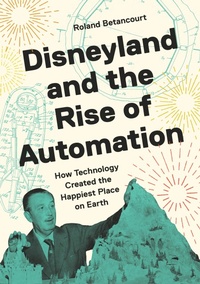
Disneyland and the Rise of Automation
Description

A history of the engineering marvels behind one of America's most innovative and beloved entertainment experiences When Disneyland opened to the public in 1955, it demystified the hidden world of factory automation through its extraordinary new attractions. In this fascinating book, Roland Betancourt tells the story of how the visionary engineers and designers at Disney transformed the technologies of the postwar assembly line into an entertainment experience unlike anything the world had ever seen. Disneyland and the Rise of Automation traces the origins and evolution of these technical innovations during the theme park's first three decades in operation, exploring how engineers reimagined the systems and machines of industrial manufacturing and the military. The magnetic tape used to test ballistic missiles was repurposed to animate the talking macaws in the Enchanted Tiki Room. Programmable Logic Controllers, widely used on automotive assembly lines, brought to life the spectacular rides of the Matterhorn Bobsleds and Space Mountain. Betancourt shows how these and other attractions helped to allay fears about automation and job displacement in 1950s America. Along the way, he situates Disneyland's remarkable creations within a broader history of the technologies that increasingly order and construct the world around us, from the Fordist factory to artificial intelligence. Essential reading for anyone interested in engineering, corporate histories, or popular culture, Disneyland and the Rise of Automation invites us to consider how technology and the logic of automation become integrated into our lives through entertainment.
More details
Other editions
Additional editions
Person
Content
- Cover
- Contents
- Preface: Making Magic
- Introduction: Walt Disney at the River Rouge
- I. Automation
- 1. The Amusement Park Is a Factory: 1918, Coney Island
- 2. What Is Automation?: 1952-70, Challenge of Automation
- 3. Feedback Control: 1952, Automation for the Masses
- 4. This Is Automation!: 1955, General Electric's This Is Automation
- 5. Operations Research: 1953, Planning and Engineering Disneyland
- 6. Closing the Loop: 1955 Onward, Guest Feedback and Automatic Control
- II. Systems of Control
- 7. Relays: 1955, Rocket to the Moon and Circarama
- 8. Tracks and Sensors: 1955, Fantasyland Dark Rides
- 9. The Block System: 1950, Walt Disney and the Railroad
- 10. Industrialization and Automation: 1955, Peter Pan Flight
- III. Feedback
- 11. The Rise of the Modern Roller Coaster: 1959, Matterhorn Bobsleds
- 12. Self-Regulating Control: 1959, Safety Control System of the Matterhorn
- 13. The Assembly Line, Remade: 1964, Ford's Magic Skyway at the World's Fair
- 14. Automation for Mass Transportation: 1964-67, From the Magic Skyway to the PeopleMover
- 15. The Mass Handling of People: 1967, Goodyear PeopleMover
- 16. Eliminating Blocks, Controlling Vision: 1967, The Omnimover
- IV. Computerization
- 17. The Computer: 1969, Programmable Logic Controller
- 18. Representing Computerization: 1977, Space Mountain
- 19. Beauty in the Breakdown: 1978, Matterhorn Bobsleds
- 20. Fred, the Computer Made Audible: 1979, Big Thunder Mountain Railroad
- 21. The Ascendancy of the PLC: 1982, Matterhorn Bobsleds
- V. Animation
- 22. Space-Age Animation: 1963, Audio-Animatronics
- 23. Animating the Inanimate: 1955, Movement in the Postwar Period
- 24. Magnetic Tape: 1945-55, From Spoil of War to Symbol of Automation
- 25. Guided Missiles and Automation: 1962, Controlling the Audio-Animatronic
- 26. Eliminating the Human Element: Labor, Automation, and the Human
- Conclusion: Automationland
- Acknowledgments
- Notes
- Bibliography
- Index
- Photo Credits
