

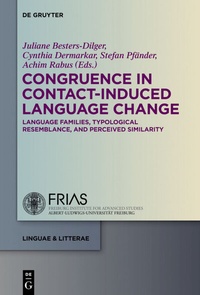
Congruence in Contact-Induced Language Change
Language Families, Typological Resemblance, and Perceived Similarity
1st Edition
Published on 22. August 2014
VIII, 410 pages
978-3-11-037301-1 (ISBN)
Description

Modern contact linguistics has primarily focused on contact between languages that are genetically unrelated and structurally distant. This compendium of articles looks instead at the effects of pre-existing structural congruency between the affected languages at the time of their initial contact, using the Romance and Slavic languages as examples. In contact of this kind, both genetic and typological similarities play a part.
More details
Series
Language
English
Place of publication
Berlin/Boston
Germany
Target group
Professional and scholarly
US School Grade: College Graduate Student
Edition type
Digital original
Illustrations
15 s/w Tabellen
15 b/w tbl.
File size
2,28 MB
ISBN-13
978-3-11-037301-1 (9783110373011)
Schweitzer Classification
Other editions
Additional editions
Juliane Besters-Dilger | Cynthia Dermarkar | Stefan Pfänder
Congruence in Contact-Induced Language Change
Language Families, Typological Resemblance, and Perceived Similarity
E-Book
01/2014
1st Edition
De Gruyter
€149.95
Available for download
Juliane Besters-Dilger | Cynthia Dermarkar | Stefan Pfänder
Congruence in Contact-Induced Language Change
Language Families, Typological Resemblance, and Perceived Similarity
Book
01/2014
1st Edition
De Gruyter
€149.95
Shipment within 7-9 days
Persons
J. Besters-Dilger, C. Dermarkar, St. Pfänder, and A. Rabus, University of Freiburg, Germany.
Content
1 - Introduction [Seite 9]
2 - Part 1: Contact-induced change between closely related languages [Seite 21]
2.1 - Convergence in the Baltic-Slavic contact zone: Triangulation approach [Seite 23]
2.2 - Convergence and congruence due to contact between the South Slavic languages [Seite 51]
2.3 - The case of Czech-Slovak language contact and contact-induced phenomena [Seite 69]
2.4 - Belarusian and Russian in the Mixed Speech of Belarus [Seite 101]
2.5 - Lingua Franca in the Western Mediterranean: between myth and reality [Seite 130]
2.6 - Intimate family reunions: code-copying between Turkic relatives [Seite 145]
3 - Part 2: Contact-induced changes in scenarios with looser family ties [Seite 155]
3.1 - Language contact in a multilingual setting: The attractive force of Italo-romance dialects on Italian in Montreal [Seite 157]
3.2 - Balkan Slavic and Balkan Romance: from congruence to convergence [Seite 176]
3.3 - The convergence of Czech and German between the years 900 and 1500 [Seite 192]
4 - Part 3: Typological congruence and perceived similarity [Seite 207]
4.1 - Contact-induced language change and typological congruence [Seite 209]
4.2 - Similarity effects in language contact: Taking the speakers' perceptions of congruence seriously [Seite 227]
4.3 - Doing copying: Why typology doesn't matter to language speakers [Seite 247]
4.4 - South Siberian Turkic languages in linguistic contact: Altay-kizi nominalizer constructions as a test case [Seite 266]
4.5 - French meets Arabic in Cairo: discourse markers as gestures [Seite 283]
4.6 - Language mixing and language fusion: when bilingual talk becomes monolingual [Seite 302]
5 - Part 4: "Doing being family": language families and language ideologies [Seite 343]
5.1 - Siblings in contact: the interaction of Church Slavonic and Russian [Seite 345]
5.2 - Transparency of morphological structures as a feature of language contact among closely related languages: Examples from Bulgarian and Czech contact with Russian [Seite 360]
5.3 - Avoiding typological affinity: "negative borrowing" as a strategy of Corsican norm finding [Seite 376]
5.4 - Sociolinguistic and areal factors promoting or inhibiting convergence within language families [Seite 398]
2 - Part 1: Contact-induced change between closely related languages [Seite 21]
2.1 - Convergence in the Baltic-Slavic contact zone: Triangulation approach [Seite 23]
2.2 - Convergence and congruence due to contact between the South Slavic languages [Seite 51]
2.3 - The case of Czech-Slovak language contact and contact-induced phenomena [Seite 69]
2.4 - Belarusian and Russian in the Mixed Speech of Belarus [Seite 101]
2.5 - Lingua Franca in the Western Mediterranean: between myth and reality [Seite 130]
2.6 - Intimate family reunions: code-copying between Turkic relatives [Seite 145]
3 - Part 2: Contact-induced changes in scenarios with looser family ties [Seite 155]
3.1 - Language contact in a multilingual setting: The attractive force of Italo-romance dialects on Italian in Montreal [Seite 157]
3.2 - Balkan Slavic and Balkan Romance: from congruence to convergence [Seite 176]
3.3 - The convergence of Czech and German between the years 900 and 1500 [Seite 192]
4 - Part 3: Typological congruence and perceived similarity [Seite 207]
4.1 - Contact-induced language change and typological congruence [Seite 209]
4.2 - Similarity effects in language contact: Taking the speakers' perceptions of congruence seriously [Seite 227]
4.3 - Doing copying: Why typology doesn't matter to language speakers [Seite 247]
4.4 - South Siberian Turkic languages in linguistic contact: Altay-kizi nominalizer constructions as a test case [Seite 266]
4.5 - French meets Arabic in Cairo: discourse markers as gestures [Seite 283]
4.6 - Language mixing and language fusion: when bilingual talk becomes monolingual [Seite 302]
5 - Part 4: "Doing being family": language families and language ideologies [Seite 343]
5.1 - Siblings in contact: the interaction of Church Slavonic and Russian [Seite 345]
5.2 - Transparency of morphological structures as a feature of language contact among closely related languages: Examples from Bulgarian and Czech contact with Russian [Seite 360]
5.3 - Avoiding typological affinity: "negative borrowing" as a strategy of Corsican norm finding [Seite 376]
5.4 - Sociolinguistic and areal factors promoting or inhibiting convergence within language families [Seite 398]
