

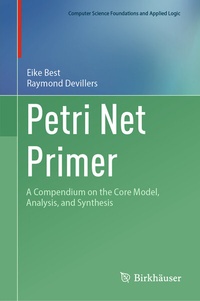
Petri Net Primer
Description

Petri nets model concurrent and distributed systems where active components communicate through the production and absorption of various kinds of resources.
Although the dynamic properties of such systems may be very complex, they may sometimes be connected to the static structure of a Petri net. Many properties are decidable, but their complexity may be huge. It is often opportune to restrict oneself to classes of systems, to partial algorithms, and to similar but simpler properties. Instead of analysing a given system, it is also possible to search for a system satisfying some desired properties by construction.This comprehensive textbook/reference presents and discusses these issues in-depth in the context of one of the most fundamental Petri net models, called place/transition nets. The presentation is fortified by means of many examples and worked exercises.
Among topics addressed : In which order may actions may be generated and scheduled? What states and configurations may be reached in a concurrent system? Which interesting classes of systems can be analysed relatively efficiently? Is it possible to synthesise a system of some class from its behaviour? How can systems be represented algebraically, compositionally, and concisely?
This unique text, based on introductory as well as on advanced courses on distributed systems, will serve as an invaluable guide for students and (future) researchers interested in theoretical-as well as in practical-aspects of Petri nets and related system models.
Eike Best has been a full professor (now retired) affiliated to Carl von Ossietzky Universität Oldenburg, Germany. Raymond Devillers has been a full professor (now retired) affiliated to Université Libre de Bruxelles, Belgium. The authors have a long record as collaborators in the fields of Petri nets and the semantics of concurrency.
Reviews / Votes
"The book describes Petri nets, the computation-friendly models. It prepares readers for the theory side of Petri nets. The basics, properties, and major application of program verification are discussed. Its textbook format consists of the gradual unfolding of the theory of Petri nets, with exercises at the end of each chapter. Undergraduate/graduate-level semester courses can use it as a textbook." (Maulik A. Dave, Computing Reviews, January 6, 2025)
More details
Other editions
Additional editions
Persons
Eike Best
Born in 1951 in Germany, graduated in Informatik in 1974 at the Technische Hochschule Karlsruhe. He has joined projects led by Peter Lauer and Brian Randell at the University of Newcastle upon Tyne (1975-1981) where he started to cooperate with Raymond Devillers. He earned his PhD in 1982 at Newcastle and a Habilitation degree at the University of Bonn in 1988 while working at Carl Adam Petri's Institute. He has taught a range of computer science courses as a professor in Paderborn, Hildesheim, and Oldenburg (from 1996), and he has a research and project leadership record, with an emphasis on semantics and Petri nets.
Raymond Devillers
Born in 1945 in Belgium, graduated in Mathematics and Physics, he got a PhD Thesis in 1974 on the use of games for deadlock prevention at the University of Brussels. During a postdoctorate stay in Newcastle upon Tyne, he met Eike Best, start of a long-lasting cooperation. After a job at the Computer Center of the ULB, he started a professorial career at the same university, where he taught many different courses in practical and theoretical computer sciences. He conducted many researches, in particular about the analysis and synthesis of Petri nets, before and after his retirement in 2010.
Content
Preface.- 1 First Steps in Petri Nets.- 2 Languages of Petri Nets.- 3 Reachability and Coverability.- 4 Linear-algebraic Structure of Petri Nets.- 5 Graph-theoretical Structure of Petri Nets.- 6 More Structure Theory.- 7 Program Verification Using Traps.- 8 Fairness, Simulations, and Inhibitor Arcs.- 9 Unfoldings and Reachability Checking.- 10 Petri Net Computers.- 11 Synthesis of Petri Nets from Labelled Transition Systems.- 12 Persistent Transition Systems and Choice-free Petri Nets.- 13 Divide-and-Conquer Methods for Synthesis.- 14 Marked Graph Synthesis.- 15 Bounded Choice-free Net Synthesis.- 16 Model Checking Safe, Strongly Persistent Petri Nets.- 17 Semilinearity.- 18 Decidability of the reachability problem.- 19 The Box Algebra 1/2: Refinement and Recursion.- 20 The Box Algebra 2/2: Iteration and Data.- 21 High-level Petri Nets.- Biblyography.- Index
