

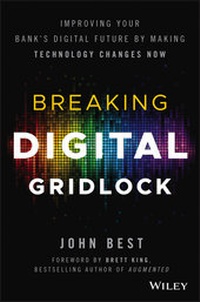
Breaking Digital Gridlock
Description

Breaking Digital Gridlock empowers credit unions and community banks to make the shift to digital--even without a seven-figure consulting budget. From leadership, to technology, to security, and more, this book provides effective, real-world strategies for taking the leap without tearing your organization apart. With an emphasis on maintaining the culture, services, and features you have carefully crafted for your customers over the years, these strategies allow you to make your organization more resistant to digital disruption by adopting key technologies at key points in their evolution. Expert advice grounded in practicality shows how FinTech partnerships and strategic technology acquisition can foster new growth with minimal disruption, and how project management can be restructured to most effectively implement any digital solution and how to implement and leverage analytics. Specific implementation advice coupled with expert approaches offer the ability to modernize in an efficient, organized, financially-sound manner.
The companion website features a digital readiness assessment that helps clarify the breadth and scope of the change, and serves as a progress check every step of the way. Access to digital assets helps smooth the path to implementation, and a reader forum facilitates the exchange of ideas, experiences, and advice.
* Identify revolutionary versus evolutionary technology opportunities
* Empower employee innovation, and stop managing all risk out of good ideas
* Understand blockchain, machine learning, cloud computing, and other technologies
* Forge strategic partnerships that will drive growth and success amidst technological upheaval
It is widely accepted that digital is the future of banking, but knowing is not the same as doing. If your organization has been riding the fence for too long amidst uncertainty and budget constraints, Breaking Digital Gridlock provides the solutions, strategies, and knowledge you need to begin moving forward.
More details
Other editions
Additional editions
Content
- Intro
- Title Page
- Table of Contents
- Foreword
- Preface
- What Is Digital Gridlock?
- Riskphobia
- Acknowledgments
- Introduction
- Five Myths about Going Digital
- John's Story
- Note
- PART I: Processes
- CHAPTER 1: How to Improve Internal Processes
- Regulatory Gridlock
- Flawed Bank Processes
- Continual Improvement
- Project Management
- When to Use Agile versus Waterfall
- In-house Staff and Outside Vendors
- Process Management
- Team Organization: Centers of Excellence
- Cultural Considerations
- PART II: Technology
- CHAPTER 2: Tech Evolution versus Tech Revolution
- Evolutionary Technology
- Evolution in Banking
- True Revolution
- The Financial Revolution
- CHAPTER 3: The Cloud
- The Financial Cloud
- What Are You Afraid Of?
- Types of Cloud Services
- Major Players in the Cloud
- Capital One in the Cloud
- Strategies for Moving to the Cloud
- Note
- CHAPTER 4: Artificial Intelligence
- Computers Will Be Trainable
- Machine Learning: Familiar Names
- Artificial Intelligence versus Intelligent Augmentation
- The AI Threat
- Notes
- CHAPTER 5: Application Programming Interface (API)
- Why Create an API?
- Getting Started
- The Second Step
- The Third Step
- CHAPTER 6: Blockchain and Cryptocurrency
- Bitcoin: A Brief History
- Decentralization
- Security
- How to Use a Distributed Ledger
- PART III: Security
- CHAPTER 7: Sovereign Identity
- Trust Frameworks
- Encryption and Data Security
- Sovereign Identity in Practice
- Weaknesses in the Current Identity System
- An Opportunity for Financial Institutions
- Note
- CHAPTER 8: The Hacker Threat
- The Artificial Intelligence Threat
- Planning for the Worst
- Operation Ababil
- DDoS Attacks
- Be Afraid When Things Are Down. Be Very Afraid When Things Are Going Well
- Security as a Process of Innovation
- The Equifax Breach
- Scenario Planning
- Notes
- PART IV: People
- CHAPTER 9: The Digital Change Is for Everyone
- Human Resources
- Facilities
- Accounting: Software Depreciating
- CHAPTER 10: Who Can Break Gridlock?
- Common Symptoms of People Problems
- Human Solutions
- Data Is Money
- PART V: Culture
- CHAPTER 11: Culture and Innovation
- Where Does Culture Start?
- Culture Breakdowns
- Culture and Talent
- Steps to an Innovative Culture
- Achievement versus Alignment
- Notes
- CHAPTER 12: Culture and Technology
- A Tale of Two Cultures
- Having It Your Way-BYOP
- PART VI: Strategy
- CHAPTER 13: The Long View
- The Problem: Banking and Financial Competitors
- Threats: The -tions
- The Reality of Change
- Changing Features or Services
- How Solutions Can Fail
- Note
- CHAPTER 14: Digital Governance
- Review Proposed Products and Integration
- Data Governance
- CHAPTER 15: Using Data Analytics
- Look Ahead
- Credit Card Usage
- Usage Monitoring
- Digital "Why" 101
- Digital Marketing
- CHAPTER 16: Big Data and the Zombie Apocalypse
- Apocalyptic Risk
- Staffing in an Apocalypse
- Creating Value
- Digital Insight and Intuition
- Types of Analytics
- Note
- Conclusion
- Cultural Issues
- People Strategy
- Process Changes
- Technology
- Security
- About the Companion Website
- Index
- End User License Agreement
Introduction
Five Myths about Going Digital
Before an organization can break its digital gridlock, it is necessary to dispel the myths that prevent it from moving forward. In the past 20 years I have visited hundreds of credit unions and spoken to hundreds of executives and board members. Based on this experience, I have identified the top five myths that prevent that bank executives, board members, and staff from believing in digital. The first step in moving forward with digital transformation is to realize the truth.
Myth 1: We Are Too Small for Digital
This is my favorite myth, and it's the easiest one to dispel. In terms of digital transformation, being small is actually a huge advantage. If you don't believe me, consider this for a moment: Why did the Titanic sink? Most people believe it is because the ship hit an iceberg.
Nope, I say. The Titanic's crew saw the iceberg and may have had just enough time to correct their course.1 I argue that the real reason the Titanic sank is because it couldn't turn in time. It's hard to turn a large ship, and large organizations face the same difficulties. The more people, branches, and assets an organization has, the longer it takes to retrain, revamp, and retool the people, places, and things required to support digital transformation. Smaller institutions have the advantage because they are more nimble. In fact, the biggest challenge for the smaller institution is not turning too quickly and throwing people overboard.
Myth 2: Our Customers Are Too Old
Another classic myth: People are too old for technology. I hope someone tells my mom, who is 71 and the queen of social media, that she's too old for tech. I am not saying that there isn't some truth to this myth, but we shouldn't paint every elderly person with the same brush. Seniornet.org shows that since 2012, seniors have steadily been flocking to Facebook. It actually makes perfect sense. Seniors have time, they enjoy seeing pictures of their grandkids, and they really enjoy connecting with their old friends. Facebook is the perfect tool for this type of interaction.
I was recently on a flight and I watched a senior citizen break out her iPad, log in to in-flight Wi-Fi, and start checking her email and her Facebook account. Meanwhile, the 30-something woman next to me asked me for help to get her laptop on the Wi-Fi system. If you have ever tried to connect to an airline's in-flight Wi-Fi system, you know it isn't always a cakewalk, but the senior citizen made it look easy. Simple fact: Not all seniors are techno-phobes.
Myth 3: Our Board Won't Get on Board
I often do board sessions with CEOs to help everyone understand what is going on in the tech space. I am always excited to meet members of the board and executive leadership. In the case of credit unions, the board is made up of volunteers that usually represent each of the employee segments that credit unions serve.
Behold, I have discovered digital!
What I have discovered from these sessions is that board members are passionate about their institutions and, when they are presented with facts and figures regarding the digital shift, they easily get on board. Of course, sometimes I see gridlock at the board level or meet obstructionist board members. In most cases, these people aren't opposed to adopting new technology; they just want to see data to support the move. This is something that many institutions cannot provide, in large part because they haven't done their research.
Myth 4: Digital Is Too Expensive
This is an easy myth to dispel. The truth is that not going digital will be more expensive than doing it. Consider that most mid-sized institutions are woefully behind in implementing analytics. Their lack of analytics is driving up their costs, while the bigger financial institutions are finding more efficient and effective ways to market products, provide services, and determine where and when to deliver their services. Analytics is a game changer for the industry. A key differentiator for financial institutions will be their ability to use data to become prescriptive for customers. Those without analytics will fall further and further behind. Having analytics is like discovering fire. Suddenly, you don't have to be afraid of the dark; the fire will illuminate your path.
Myth 5: Digital Leads to Layoffs and Branch Closures
I am not a proponent of closing branches, but I am proponent of changing how the branch network functions. I am also a proponent of proportionate spending between digital and physical branches that is commensurate with the number of customers each channel serves and the profit they provide. No matter what, closing all of your branches isn't good idea. New branching will consist of more sales and fewer transactional services. Take, for instance, Financial Partners Credit Union, which just recently renovated all of its branches by adding personal teller machines. I interviewed the CEO, who said that they closed no branches and the Full time employee (FTE) is the same, but the credit union's production is higher. This is an important concept: it is the responsibility of the leadership to plan for transition. This is often overlooked as organizations transition to digital processes. If the displacement is known ahead of time, then people can be retrained to provide even more value to the business.
The other reality is that if you don't look at digital, you may be forced to lay off parts of your workforce due to marketplace pressure. At least with digital transformation there is room for a thoughtful transition as it relates to your employees.
John's Story
I would like to introduce myself before we get in to the deep, dark places that digital transformation will inevitably take us to. I grew up as a military brat, and a lazy one at that. I spent most of my life traveling around the world with my father, usually coming up with Tom Sawyer-like ways to get out of work. When I was nine years old, my dad retired from the army and we moved to Stuttgart, Germany. This is where I did most of my growing up. My dad was some sort of engineer who worked with computers on a military base. I attended American schools on base and, when I was 11, I built an ASCII emulator for the school science fair. It was a breadboard with dip switches that represented binary positions, and when you flipped them in the right order you could make a letter appear on the digital screen. I got an ASCII Char 70 (otherwise known as a capital F) for a grade on that project. The teacher said my dad helped me too much. I guess she didn't believe I could solder wires or understand binary. I was especially discouraged because my dad was away for work much of the time, so he wasn't able to help me very much. I drowned my sorrows by spending hours on his VIC-20 typing in programs from a magazine called Compute.
Yes, there was a time when, if you wanted to play a game, you had to spend hours typing code in line by line and save your work to a cassette tape. As we all know, this wouldn't work today, because computer games are millions and millions of lines of code. My dad eventually upgraded our home computer to a Commodore-64 and floppy disks, and at that point I started programming my own games. Since I was in Germany during the 1980s, I didn't get out much because it wasn't always safe to wander around by yourself, so I had tons of time to play with computers and my dad's electronics. I would dismantle Atari games, Sony personal stereos (apparently, Sony disapproves of calling them Walkmen), and basically anything electronic I could I get my hands on. I didn't know it, but I was preparing for my future.
Fast forward to 1996: I was a year married to my amazing wife and had my second child on the way. I was trying to make a living as a teacher or quasi teacher in the Hillsborough County School System in Florida. Some forward-thinking schools had decided to bring in technology specialists to teach the kids during the school day, and I was lucky enough to have gotten one of these jobs. It was the best job I ever had. I loved hanging out with the kids because they didn't live by any preconceived notions about what could or couldn't be done. This fit right in with my own philosophy that nothing is impossible. As a matter of fact, this was a family philosophy. If you ever said to my dad, "That's impossible," he would quickly respond, "Nothing's impossible." To these kids, anything was possible because their spirit hadn't been broken by life yet, and I would feed off their energy daily. As much as I loved this job, I couldn't stay because I needed to make more money to support our second child. I decided to leverage my natural computer skills and I applied for a job at the information technology department at Suncoast Schools Federal Credit Union (as it was known then). I was a member of Suncoast long before I became an employee, thanks to my job in the school system, and as a result, I knew a little bit about the credit union.
I successfully landed the job of technology monkey boy. (Honestly, I don't even remember my title, but I was happy to have the job.) I was hired by Kevin Johnson, who at the time was one of two people working in the IT department. Today he is the CEO of the credit union and, I am proud to say, still a...
