

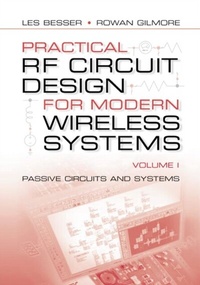
Practical RF Circuit Design for Modern Wireless Systems, Volume I
Passive Circuits and Systems
1st Edition
Published on 1. January 2002
576 pages
978-1-58053-675-2 (ISBN)
Description

Unlike the many theoretical resources and courses on the subject, this unique book (the first of a two volume set) takes a highly practical approach to RF circuit design, offering a complete understanding of the fundamental concepts you need to know and use for your work in this industry. The book lays the ground work for efficient RF circuit design in a step-by-step approach, by defining important principles and parameters and progressively introducing critical analytical tools. It helps you distinguish between RF and low frequency circuits, and offers a detailed look at a typical RF system. This is a tested and insightful book that contains answers to most of the questions practical engineers are asking. The first volume reviews various computer-aided simulation, synthesis, and optimization techniques used in modern RF and microwave design, and discusses the practical use of the graphical design tools, such as the Smith Chart. Other key topics include passive component modeling, impedance matching, and lumped and distributed filters. Moreover, the authors present an introduction to high-speed circuit design considerations faced by the digital designer at high clock speeds. The book makes extensive use of state-or-the-art CAD programs to illustrate the concepts and theory, and is lavishly illustrated with examples. This text is guaranteed to provide even the most experienced RF designer with fresh, intuitive insight into circuit operation, and will be as useful at universities as a course text on practical RF circuit design, as it will in industry as a training refresher.
More details
Other editions
Additional editions
Les Besser | Rowan Gilmore
Practical RF Circuit Design for Modern Wireless Systems: Passive Circuits and Systems Vol I
Book
08/2003
Artech House Publishers
€152.50
Shipment within 10-20 days
Content
- Practical RF Circuit Design for Modern Wireless Systems Volume I Passive Circuits and Systems
- Contents vii
- Preface xv
- Acknowledgments xix
- Chapter 1 Introduction 1
- 1.1 Defining RF 1
- 1.2 Circuits and systems 3
- 1.3 Wireless 5
- 1.4 Conclusion 6
- Reference 7
- Chapter 2 RF circuit fundamentals 9
- 2.1 Introduction 9
- 2.2 The decibel scale 9
- 2.3 Complex number review 15
- 2.4 Normalization 17
- 2.5 R-L-C voltage-current relationships 18
- 2.6 Complex impedance and admittance systems 20
- 2.7 Unloaded and loaded Q definitions 22
- 2.8 Complex series impedance of RF components 23
- 2.9 Complex parallel admittance of RF components 24
- 2.10 Series and parallel L-C resonant circuits 27
- 2.11 Series and parallel conversions of lumped R-L-C networks 30
- 2.12 One-port and multiport networks 33
- 2.13 Importance of power transfer when cascading system components 35
- 2.14 Importance of impedance matching 36
- 2.15 RF components and related issues 37
- 2.16 Lumped elements versus transmission lines 40
- 2.17 Circuit parameters using wave relations 59
- 2.18 Impedance transformation and matching 65
- 2.19 Single-ended versus differential circuits 66
- 2.20 Time domain versus frequency domain 73
- 2.21 Summary 78
- References 79
- Selected bibliography 80
- Chapter 3 The radio as typical RF system 81
- 3.1 Receiver architecture 81
- 3.2 Receiver characterization 94
- 3.3 Analysis of a CDMA receiver handset 125
- Problems 144
- References 146
- Chapter 4 The Smith chart and S-parameters 147
- 4.1 Introduction 147
- 4.2 The Smith chart: a polar plot of reflection coefficient 148
- 4.3 The admittance Smith chart 154
- 4.4 Circuit manipulations using series and parallel components 159
- 4.5 The immitance (Z-Y) Smith chart 160
- 4.6 Constant Q curves on the Smith chart 169
- 4.7 Negative reactive elements 170
- 4.8 Negative resistance and the extended Smith chart 171
- 4.9 Transmission line manipulations on the Smith chart 172
- 4.10 Matrix descriptions of networks 180
- 4.11 The scattering (S) matrix 183
- 4.12 The network analyzer 185
- 4.13 S-parameter measurements 188
- 4.14 Two-port gain expressions in terms of S-parameters 193
- 4.15 Cascading two-ports with S-parameters 200
- 4.16 Multiport S-parameters 205
- 4.17 Generalized two-port S-parameters 206
- 4.18 Mixed-mode S-parameters 209
- 4.19 Summary 217
- References 218
- Selected Bibliography 219
- Plates
- Chapter 5 Impedance matching techniques 221
- 5.1 The impedance match 222
- 5.2 Transmission zero definitions 225
- 5.3 Impedance matching into complex termination 232
- 5.4 Impedance matching with uneven resistive terminations 236
- 5.5 The Q matching technique with L-C sections 239
- 5.6 Impedance matching of complex terminations 247
- 5.7 Multisection impedance matching to increase bandwidth 254
- 5.8 Multisection impedance matching to decrease bandwidth 260
- 5.9 Impedance matching with transmission line components 264
- 5.10 Impedance matching with transmission lines on the Smith chart 267
- 5.11 Impedance matching of balanced circuits 272
- 5.12 Answers to illustrative exercise of Section 5.2.1 (circuit 4) 274
- 5.13 Summary 276
- References 276
- Selected bibliography 276
- Chapter 6 CAE/CAD of linear RF/MW circuits 277
- 6.1 Introduction 277
- 6.2 Historical review 279
- 6.3 Analysis versus synthesis and optimization 281
- 6.4 Circuit simulation techniques 282
- 6.5 Impedance mapping 284
- 6.6 Component tuning 286
- 6.7 Circuit optimization 286
- 6.8 Statistical design techniques 298
- 6.9 Circuit synthesis 314
- 6.10 Electromagnetic field simulation 321
- 6.11 CAD program descriptions 327
- 6.12 Summary 334
- References 334
- Chapter 7 Passive component models 337
- 7.1 Introduction 337
- 7.2 Resistance, self-inductance, and stray capacitance of conductors 339
- 7.3 Frequency response of physical resistors 346
- 7.4 Modeling physical inductors 350
- 7.5 Ferrite beads 362
- 7.6 Physical capacitor models 364
- 7.7 Via hole models 372
- 7.8 Planar transmission lines for RF/MW applications 377
- 7.9 Dielectric board materials 387
- 7.10 Transformers 389
- 7.11 Crystal resonators and models 395
- 7.12 Surface acoustic wave resonators 403
- 7.13 Dielectric resonators 405
- 7.14 Component measurements and modeling 408
- 7.15 Summary 410
- References 411
- Chapter 8 Filters and resonant circuits 415
- 8.1 Introduction 415
- 8.2 Filter specifications 417
- 8.3 Various filter types 421
- 8.4 Low-frequency versus RF/MW filters 423
- 8.5 Comparison of filter responses 441
- 8.6 Multiplexer filters 442
- 8.7 Filter design outline 444
- 8.8 Transmission line (distributed-element) filters 457
- 8.9 Network transformations 460
- 8.10 L-C resonant circuits in filter design 475
- 8.11 Other forms of resonators 484
- 8.12 Summary 489
- References 490
- Selected bibilography 491
- Chapter 9 Similarities and differences of RF and high-speed digital designs 493
- 9.1 Historical perspective of analog RF and digital designs 493
- 9.2 Time-domain and voltage-current parameters (transition times, delays, skew, and signal levels) 496
- 9.3 Crosstalk versus coupling 500
- 9.4 R-L-C models for digital applications 503
- 9.5 Parasitics of passive interconnects, loading, vias, and losses 509
- 9.6 Frequency-domain versus time-domain considerations 513
- 9.7 Measurement and simulation considerations 516
- References 520
- Appendix 523
- About the Authors 527
- Index 529
