

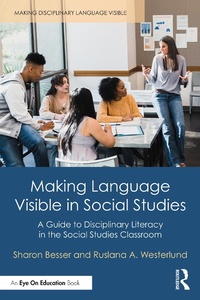
Making Language Visible in Social Studies
A Guide to Disciplinary Literacy in the Social Studies Classroom
1st Edition
Published on 13. February 2024
222 pages
978-1-003-85005-2 (ISBN)
Description

As the first book in the Making Disciplinary Language Visible series, this practical toolkit helps teachers promote disciplinary literacy development for Multilingual learners and their peers in the 5-12 social studies classroom. Using systemic functional linguistics (SFL) and the SFL-informed genre pedagogy, the Teaching and Learning Cycle for Disciplinary Genres, the book shows teachers how to teach content using language as a meaning-making resource. Besser and Westerlund provide clear guidance on understanding how language is used in the discipline and provide practical tools to empower teachers to teach language in the service of social studies disciplinary genres.
Chapters feature authentic vignettes to illustrate problems of practice, annotated social studies texts, practical curriculum design tools, exercises for readers to develop knowledge about language, and sample scripts for practical application.
Chapters feature authentic vignettes to illustrate problems of practice, annotated social studies texts, practical curriculum design tools, exercises for readers to develop knowledge about language, and sample scripts for practical application.
Reviews / Votes
"Sharon Besser and Ruslana Westerlund's Making Language Visible in Social Studies is a must-read resource for anyone who is passionate about teaching for equity through social studies. Their practical, empowering, and language-based disciplinary literacy approach provides teachers with a unique and effective path to maximally improve their students' disciplinary expertise in social studies."Dr. Andres Ramirez, Associate Professor in the Department of Curriculum and Instruction at Florida Atlantic University
"Making Language Visible in Social Studies offers teachers of social studies the essential 'behind the scenes' support to integrate attention to the language and content of social science. The authors address both the 'what' of key disciplinary texts for learning and the 'how' of pedagogic practice, including authentic texts and practical activities to engage and support literacy for learning in social science."
Sally Humphrey, Senior Lecturer, School of Education, Australian Catholic University
"This book is a much-needed collection for teachers and teacher educators in need of resources to develop their knowledge base about how language is used in social studies. With practical concepts, ideas, and tools, this book will empower teachers to teach language in the context of social studies disciplinary genres. Chapters illustrate problems of practice with annotated social studies texts showing language features and functions that can be used in curriculum design and practical applications for both content and language teachers."
Luciana C. de Oliveira, Ph.D., Professor and Associate Dean for Academic Affairs and Graduate Studies, School of Education, Virginia Commonwealth University
"Social Studies teachers are literacy teachers. This book clearly shows what these teachers need to know about language and how to teach it in the context of social studies classes for the benefit of students' acquisition of knowledge and ability to function as literate individuals."
Maria Estela Brisk, Boston College, Emeritus Professor
More details
Series
Edition
1. Auflage
Language
English
Place of publication
London
United Kingdom
Publishing group
Taylor & Francis Ebooks
Target group
College/higher education
Professional and scholarly
Product notice
Reflowable
Illustrations
54 Tables, black and white; 17 Line drawings, black and white; 8 Halftones, black and white; 25 Illustrations, black and white
ISBN-13
978-1-003-85005-2 (9781003850052)
Copyright in bibliographic data and cover images is held by Nielsen Book Services Limited or by the publishers or by their respective licensors: all rights reserved.
Schweitzer Classification
Other editions
Additional editions
Sharon Besser | Ruslana Westerlund
Making Language Visible in Social Studies
A Guide to Disciplinary Literacy in the Social Studies Classroom
Book
02/2024
1st Edition
Routledge
€45.90
Shipment within 10-20 days
Sharon Besser | Ruslana Westerlund
Making Language Visible in Social Studies
A Guide to Disciplinary Literacy in the Social Studies Classroom
Book
02/2024
1st Edition
Routledge
€206.20
Shipment within 10-20 days
Persons
Sharon Besser is a teacher educator, curriculum writer, and researcher who looks at problems in education through the lens of Systemic Functional Linguistics. She has over 25 years of experience locally and internationally in support of Multilingual learners.
Ruslana Westerlund is an educational consultant, author, keynote speaker, and researcher of disciplinary literacy through Systemic Functional Linguistics with more than 25 years of experience in the field of Multilingual learner education.
Ruslana Westerlund is an educational consultant, author, keynote speaker, and researcher of disciplinary literacy through Systemic Functional Linguistics with more than 25 years of experience in the field of Multilingual learner education.
Content
Chapter 1
What does it mean to make language visible in Social Studies and why do we need to do it?
Chapter 2
What is the nature of language in Social Studies explanations?
What do we mean by explain?
Chapter 3
What is the nature of language of arguments in Social Studies? What do we mean by argue?
Chapter 4
How to make Language visible using the Teaching and Learning Cycle for Disciplinary Genres
Chapter 5
A language-based approach to disciplinary reading
What does it mean to make language visible in Social Studies and why do we need to do it?
Chapter 2
What is the nature of language in Social Studies explanations?
What do we mean by explain?
Chapter 3
What is the nature of language of arguments in Social Studies? What do we mean by argue?
Chapter 4
How to make Language visible using the Teaching and Learning Cycle for Disciplinary Genres
Chapter 5
A language-based approach to disciplinary reading
