

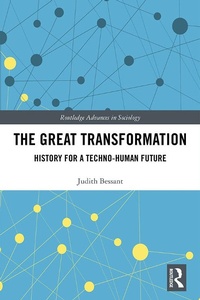
The Great Transformation
History for a Techno-Human Future
1st Edition
Published on 17. April 2018
262 pages
978-1-317-28630-1 (ISBN)
Description

While artificial intelligence (AI), robots, bio-technologies and digital media are transforming work, culture, and social life, there is little understanding of or agreement about the scope and significance of this change. This new interpretation of the 'great transformation' uses history and evolutionary theory to highlight the momentous shift in human consciousness taking place. Only by learning from recent crises and rejecting technological determinism will governments and communities redesign social arrangements that ensure we all benefit from the new and emerging technologies.
The book documents the transformations under way in financial markets, entertainment, and medicine, affecting all aspects of work and social life. It draws on historical sociology and co-evolutionary theory arguing that the radical evolution of human consciousness and social life now under way is comparable with, if not greater than, the agrarian revolution (10000 BCE), the explosion of science, philosophy, and religion in the Axial Age (600 BCE), and the recent Industrial Revolution. Turning to recent major socio-economic crisis, and asking what can be learnt from them, the answer is we cannot afford this time around to repeat the failures of elites and theoretical systems such as economics to attend appropriately to radical change. We need to think beyond the constraints of determinist and reductionist explanations and embrace the idea of deep freedom.
This book will appeal to educators, social scientists, policy-makers, business leaders, and students. It concludes with social design principles that can inform deliberative processes and new social arrangements that ensure everyone benefits from the affordances of the new and emerging technologies.
The book documents the transformations under way in financial markets, entertainment, and medicine, affecting all aspects of work and social life. It draws on historical sociology and co-evolutionary theory arguing that the radical evolution of human consciousness and social life now under way is comparable with, if not greater than, the agrarian revolution (10000 BCE), the explosion of science, philosophy, and religion in the Axial Age (600 BCE), and the recent Industrial Revolution. Turning to recent major socio-economic crisis, and asking what can be learnt from them, the answer is we cannot afford this time around to repeat the failures of elites and theoretical systems such as economics to attend appropriately to radical change. We need to think beyond the constraints of determinist and reductionist explanations and embrace the idea of deep freedom.
This book will appeal to educators, social scientists, policy-makers, business leaders, and students. It concludes with social design principles that can inform deliberative processes and new social arrangements that ensure everyone benefits from the affordances of the new and emerging technologies.
Reviews / Votes
"Judith Bessant addresses a crucially important question for our time: might the turbulent period we live in be re-conceived as a second Axial Age, driven by technological change? As the question itself implies, this requires an open-minded and fearless exploration of ideas from many disciplines. And the author delivers, with a stimulating synthesis. If we are going to understand what is happening to our species as we try to cope with artificial intelligence, we need more of this kind of broad scholarship."- Merlin Donald, Professor Emeritus, Department of Psychology, Queen's University, Canada
"The Great Transformation ambitiously weaves together much-needed historical, sociological, scientific, and philosophical insights into our present techno-social condition, and how we might wisely steer its trajectory toward a better future. Pushing beyond simplistic utopian and dystopian metaphors, and rejecting tired and fatalistic theories of technological determinism, Bessant identifies new practices and principles of social thinking, learning, and designing that can help us rescue the endangered promise of technology for human flourishing."
- Shannon Vallor, William J. Rewak S.J. Professor of Philosophy at Santa Clara University, USA, and author of Technology and the Virtues: A Philosophical Guide to a Future Worth Wanting
"Bessant puts the high-tech revolution of today in perspective of the great technological revolutions of human history. But because society and technology co-evolve, this look into the future highlights the freedom we can exercise to ensure everyone benefits."
- Randall Collins, Professor Emeritus, Department of Sociology, University of Pennsylvania, USA, and co-author of Does Capitalism Have a Future?
More details
Series
Edition
1. Auflage
Language
English
Place of publication
London
United Kingdom
Publishing group
Taylor & Francis Ltd
Target group
College/higher education
Illustrations
2 s/w Abbildungen, 2 s/w Tabellen
2 Tables, black and white
File size
1,93 MB
ISBN-13
978-1-317-28630-1 (9781317286301)
Copyright in bibliographic data and cover images is held by Nielsen Book Services Limited or by the publishers or by their respective licensors: all rights reserved.
Schweitzer Classification
Other editions
Additional editions
Book
12/2019
1st Edition
Routledge
€68.90
Shipment within 15-20 days
Book
04/2018
1st Edition
Routledge
€206.50
Shipment within 10-20 days
Person
Judith Bessant is a Professor at RMIT University, Melbourne, and Adjunct Professor at the School of Justice, Queensland University of Technology, Brisbane. She is widely published and her research interests include policy, sociology, politics, youth studies, media-technology studies, and history. She has also worked as an advisor for governments and non-government organizations. In 2017 she was awarded an Order of Australia (AM) for her 'significant service to education as a social scientist, advocate and academic specializing in youth studies research'.
Content
Introduction 1. Freedom and Determinism: Alpha Go, AI Financial Trading and Japan's Mika Diva 2. What is Happening? : The First Axial Age 3. Changing Our Minds: The Techno-Axial Age 4. Crisis and Learning from the past: Three economic crises, 1890-2008 5. Recursivity in Times of Crisis: A Heuristic 6. Data is the New Oil: Leadership and Political Rhetoric in the Techno-Axial Age 7. What experts say about Artificial Intelligence 8. Social design for the new Techno-Axial Age Conclusion
