

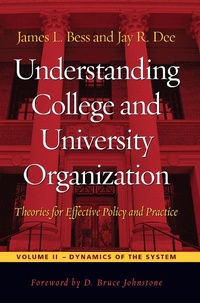
Understanding College and University Organization
Theories for Effective Policy and Practice: Volume II - Dynamics of the System
1st Edition
Published on 3. July 2023
506 pages
978-1-000-97360-0 (ISBN)
Description

Now available in paperback, this two-volume work is intended to help readers develop powerful new ways of thinking about organizational principles, and apply them to policy-making and management in colleges and universities. The book is written with two audiences in mind: administrative and faculty leaders in institutions of higher learning, and students (both doctoral and Master's degree) studying to become upper-level administrators, leaders, and policy makers in higher education. It systematically presents a range of theories that can be applied to many of the difficult management situations that college and university leaders encounter. It provides them with the theoretical background to knowledgeably evaluate the many new ideas that emerge in the current literature, and in workshops and conferences. The purpose is to help leaders develop their own effective management style and approaches, and feel confident that their actions are informed by appropriate theory and knowledge of the latest research in the field. Without theory, organizational leaders are forced to treat each problem that they encounter as unique-as if it were a first-time occurrence. While leaders may have some experience with a particular issue, their solutions are usually not informed by the accumulated wisdom of others who have already encountered and resolved similar situations. The authors approach the theory of the organization and administration of colleges and universities from three quite different perspectives, or paradigms, each relying on different assumptions about the "reality" of organizational life in colleges and universities. The positivist paradigm-primarily an omnibus systems theory-integrates the chapters into a comprehensive, yet easily accessible whole. Social constructionism, the second paradigm, is introduced in each chapter to illuminate the difficulty of seeking and finding meaningful consensus on problems and policies, while also addressing important ethical issues that tend to be overlooked in leadership thought and action. The third paradigm, postmodernism, draws attention to difficulties of logic and communication under the constraints of strictly linear thinking that "authorities" at all levels attempt to impose on organizations. This "multiple paradigm" approach enables readers to become more cognizant of their own assumptions, how they may differ from those of others in their organization, and how those differences may both create difficulties in resolving problems and expand the range of alternatives considered in organizational decision making. The book offers readers the tools to balance the real-world needs to succeed in today's challenging and competitive environment with the social and ethical aspirations of all its stakeholders and society at large. The authors' aim is to elucidate how administration can be made more efficient and effective through rational decision-making while also respecting humanistic values. This approach highlights a range of phenomena that require attention if the institution is ultimately to be considered successful. Also available: Volume 1: The State of the System Two volume set
Reviews / Votes
"Quite simply a tour de force. Not only have the authors written by far the broadest and deepest theoretical analysis of college and university organization I've seen, but they have clearly organized a complex topic, and written it engagingly. This will be seen as a landmark work in the field. It should be required reading for all who claim to understand higher education institutions and the behavior that goes on inside and around them."David W. Leslie, Chancellor Professor of Education, The College of William and Mary
"This work provided our graduate students (both Master's and doctoral) with the best introduction to organizational theory and its implications for higher education leadership/management that I have ever seen. It very effectively uses the three paradigms to provide students with a framework for making sense of the voluminous literature generated in the social sciences and business on organization theory. By the end of the course, the students were in an excellent position to place current literature within a framework and relate it to the "big picture" and what they already knew. It provided them with the conceptual lenses to navigate this convoluted intellectual terrain. This work is a treasure!"
Martin J. Finkelstein, College of Education and Human Services, Seton Hall University
"This semester, I assigned Understanding College and University Organization as a required text in my master's-level Organization and Administration of Student Services course. Not only did the text exceed my expectations, but I was amazed by how the students embraced the book's theoretical perspectives. Following each class session, students would comment on how much they enjoyed reading the book, especially the cases at the beginning of each chapter. They noted that the cases were relevant to their work experience in student affairs and that the authors used common sense language to describe complex concepts in meaningful ways. The authors' approach makes it easy to apply these concepts in group discussions and class presentations, and in "real-time" activities in the students' workplaces or internship sites. Therefore, I highly recommend this textbook to master's level instructors who seek to foster critical thinking about theory and practice."
Cheryl J. Daly, director, College Student Personnel master's program, Western Carolina University
"An extraordinarily comprehensive treatment of the uses of theory to understand and manage organizations of academic life....recommended for every student of American higher education."
Theodore J. Marchese, Senior Consultant, Academic Search Consultation Service, and formerly Vice President of the American Association for Higher Education
"Anyone caring to become immersed in the nature of organizational theory, liberally illustrated by realistic cases, will better understand from these volumes what has happened-not only to a particular college or university at a point in time - but to the public's and politician's not always favorable perceptions of, and behaviors toward, higher education. I predict that many years will pass before these two volumes are surpassed."
From the Foreword by D. Bruce Johnstone, former Chancellor of the State University of New York system
More details
Edition
1. Auflage
Language
English
Place of publication
London
United Kingdom
Publishing group
Taylor & Francis Ltd
Target group
College/higher education
ISBN-13
978-1-000-97360-0 (9781000973600)
Copyright in bibliographic data and cover images is held by Nielsen Book Services Limited or by the publishers or by their respective licensors: all rights reserved.
Schweitzer Classification
Other editions
Additional editions
James L. Bess | Jay R. Dee
Understanding College and University Organization
Theories for Effective Policy and Practice: Volume II - Dynamics of the System
Book
02/2012
1st Edition
Stylus Publishing
€67.03
Shipment within 3-4 weeks
James L. Bess | Jay R. Dee
Understanding College and University Organization
Theories for Effective Policy and Practice: Volume II - Dynamics of the System
Book
10/2007
Routledge
€139.64
Article exhausted; check different version
Persons
James L. Bess is President of James L. Bess & Associates and Professor Emeritus at New York University, where he taught from 1980-2000. He is the author or editor of eight books and over fifty articles and book chapters. Jay R. Dee is Associate Professor of Higher Education, Graduate College of Education, University of Massachusetts, Boston. D. Bruce Johnstone is Distinguished Service Professor of Higher and Comparative Education at the State University of New York at Buffalo. He is director of the International Comparative Higher Education Finance and Accessibility Project. Dr. Johnstone has held posts of vice president for administration at the University of Pennsylvania, president of the State University College of Buffalo, and chancellor of the State University of New York system.
Content
Each begins with a preview of its key points and includes a case drawn from recent situations experienced by practitioners. The cases provide concrete experiential "data" against which the theories in each can be tested, validated, and compared with situations that readers encounter at their home institutions. Questions are provided about each case to stimulate reflection on and discussion of the multiple issues raised. Each includes an extensive bibliography on the topic. Volume II. Dynamics of the System Volume II deals with the more dynamic conditions of organizations-conditions that arise less predictably and that often challenge the status quo. It addresses the management of conflict, power and politics in higher education, types and stages of organizational decision-making, managerial and individuals' styles and roles in decision-making, organizational learning, strategy, accountability and assessments of effectiveness, change and the complexities and challenges associated with organization-wide change, and finally, approaches to leadership. While this volume refers to and utilizes concepts and theories introduced in Volume One, it can be read and understood independently. TABLE OF CONTENTS Problem-to-Theory Application Table Foreword by D. Bruce Johnstone About the Authors Acknowledgements Preface 1. Overview 2. Conflict in Organizations 3. Power and Politics in Higher Education Organizations 4. Organizational Decision Making 5. Individual Decision Making 6. Organizational Learning 7. Organizational Strategy 8. Organizational Goals, Effectiveness, and Efficiency 9. Organizational Change in Higher Education 10. Leadership 11. The End and the Beginning. Fresh Thoughts About Organizational Theory and Higher Education SUBJECT INDEX AUTHOR INDEX
