

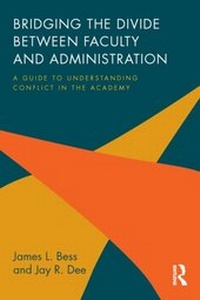
Bridging the Divide between Faculty and Administration
A Guide to Understanding Conflict in the Academy
1st Edition
Published on 20. June 2014
206 pages
978-1-135-01734-7 (ISBN)
Description

Conflicts between faculty and administration have become particularly virulent and disruptive in recent years, as institutions have struggled to adapt to intensifying pressures for efficiency and accountability. Analyzing common sources of conflict and challenges on campus that impede attempts to address these conflicts, Bridging the Divide between Faculty and Administration provides a theory-driven and research-based approach for authentic discourse between faculty and administration. This important resource presents a wealth of strategies for improving communication in colleges and universities, ultimately enhancing organizational effectiveness and institutional performance.
Special Features:
End-of-chapter "Implications for Practice" provide practical tips and advice for faculty and administrators to use in their own contexts.
Analysis of actual conflicts based on extensive interviews with administrators and faculty across a variety of college and university settings.
Exploration of creative ways for faculty and administrators to work across differences in their belief systems and to address the underlying sources of conflict.
Special Features:
End-of-chapter "Implications for Practice" provide practical tips and advice for faculty and administrators to use in their own contexts.
Analysis of actual conflicts based on extensive interviews with administrators and faculty across a variety of college and university settings.
Exploration of creative ways for faculty and administrators to work across differences in their belief systems and to address the underlying sources of conflict.
Reviews / Votes
"Bess and Dee have written a thoughtful and thought provoking book to help us think and rethink how we come together as a community. They encourage us to readjust our perspectives, examine our language, and think about what we say, how we say it, and to whom we communicate. This book takes the perspective that supporting administrators and faculty, through understanding and meaning making, can move them toward collaboration and happier endings."-From the foreword by Mari Koerner, Dean of Mary Lou Fulton Teachers College, Arizona State University
"In Bridging the Divide between Faculty and Administration, Bess and Dee bring their encyclopedic knowledge of organization theory to an examination of academic governance and decision-making in contemporary higher education. Bess and Dee's contribution-and it is not a small one-is to reframe the problem of governance in ways that deter us from taking many of the knee-jerk, but largely ineffective, paths, and focus our attention on what the real, underlying sources of our differences are. In doing so, they challenge both faculty and administrators to move beyond our comfort zones. Their book should be an indispensable resource to both administrative and faculty leaders seeking to move their institutions forward in difficult times as well as a resource for training prospective leaders."
-Martin J. Finkelstein, Professor of Higher Education, Seton Hall University
More details
Language
English
Place of publication
London
United Kingdom
Publishing group
Taylor & Francis Ltd
Target group
Professional and scholarly
Illustrations
15 s/w Tabellen
15 Tables, black and white
File size
1,20 MB
ISBN-13
978-1-135-01734-7 (9781135017347)
Copyright in bibliographic data and cover images is held by Nielsen Book Services Limited or by the publishers or by their respective licensors: all rights reserved.
Schweitzer Classification
Other editions
Additional editions
James L. Bess | Jay R. Dee
Bridging the Divide between Faculty and Administration
A Guide to Understanding Conflict in the Academy
Book
06/2014
1st Edition
Routledge
€261.80
Shipment within 15-20 days
James L. Bess | Jay R. Dee
Bridging the Divide between Faculty and Administration
A Guide to Understanding Conflict in the Academy
Book
06/2014
1st Edition
Routledge
€63.00
Shipment within 15-20 days
Persons
James L. Bess is Professor Emeritus at New York University, USA.
Jay R. Dee is Associate Professor of Higher Education and Director of the Higher Education Doctoral Program at the University of Massachusetts, Boston, USA.
Jay R. Dee is Associate Professor of Higher Education and Director of the Higher Education Doctoral Program at the University of Massachusetts, Boston, USA.
Content
Foreword
Acknowledgments
Preface
Chapter One: Perennial Conflicts between Faculty and Administration
Chapter Two: Paradigm Differences as the Underlying Sources of Conflict between Faculty and Administrators
Chapter Three: Communication and Conflict in the Academy
Chapter Four: Faculty-Administration Conflict and Institutional Effectiveness
Chapter Five: When Time is of the Essence: The Temporal Dimensions of Conflict in the Academy
Chapter Six: Enhancing Communication and Collaboration between Faculty and Administration
Chapter Seven: Summary and Conclusions: Toward Improved Understanding, Cooperation, and Effectiveness
References
Acknowledgments
Preface
Chapter One: Perennial Conflicts between Faculty and Administration
Chapter Two: Paradigm Differences as the Underlying Sources of Conflict between Faculty and Administrators
Chapter Three: Communication and Conflict in the Academy
Chapter Four: Faculty-Administration Conflict and Institutional Effectiveness
Chapter Five: When Time is of the Essence: The Temporal Dimensions of Conflict in the Academy
Chapter Six: Enhancing Communication and Collaboration between Faculty and Administration
Chapter Seven: Summary and Conclusions: Toward Improved Understanding, Cooperation, and Effectiveness
References
