

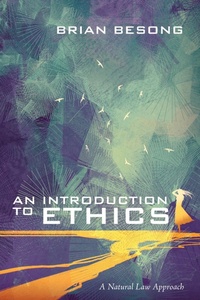
An Introduction to Ethics
A Natural Law Approach
Published on 1. January 2018
248 pages
978-1-4982-9890-2 (ISBN)
Description

It is natural for us to wonder what should I do, and why? And although a combination of common sense and upbringing aids us in answering our questions, it is also natural for us to seek answers that are grounded in something deeper and more enduring than our personal dispositions and those of our parents. We seek a genuinely good life and the practical wisdom necessary to arrive at happiness.
In this Introduction to Ethics, Brian Besong presents a comprehensive and contemporary introduction to the practical wisdom handed down to us by Aristotle, St. Thomas Aquinas, and many others--a position now commonly called "natural law." Written as a beginner's guide, the book systematically explores a range of moral issues including moral knowledge, happiness, right and wrong action, and virtues, to name a few. Introduction to Ethics explains in a lively way how natural law provides principled and persuasive answers to our most fundamental moral questions.
More details
Other editions
Additional editions
Book
01/2018
Wipf & Stock Publishers
€29.40
Shipment within 15-20 days
Book
01/2018
Wipf & Stock Publishers
€47.00
Shipment within 15-20 days
Person
Brian Besong is an Assistant Professor of Philosophy at Ohio Dominican University.
Content
- Intro
- Title Page
- Preface
- Introduction
- Chapter 1: Foundational Issues
- 1.1 Who cares?
- 1.2 Says Who?
- 1.3 Prove It
- 1.4 *A Word about Moral Knowledge
- Chapter Comprehension Questions
- Chapter 2: The Pursuit of Happiness
- 2.1 Characterizing Motivation
- 2.2 Initial Criteria and False Leads
- 2.3 Aristotle's Picture of Happiness
- 2.4 Aquinas's Picture of Happiness
- 2.5 Common Aims and Moral Goodness
- Chapter Comprehension Questions
- Chapter 3: Good and Evil
- 3.1 Natural Appetites and Happiness
- 3.2 Moral Goodness
- Chapter Comprehension Questions
- Chapter 4: Moral Responsibility
- 4.1 Excuses, Excuses: The Scope of Moral Evaluation
- 4.2 Intentionality and Moral Responsibility
- 4.3 Freedom and Moral Responsibility
- 4.4 Knowledge and Moral Responsibility
- 4.5 Applications
- Chapter Comprehension Questions
- Chapter 5: Rights and Duties
- 5.1 The Moral Imperative
- 5.2 A Collective Pursuit of Happiness
- 5.3 Connections between Rights and Duties
- 5.4 The Hierarchy of Duties and Rights
- Chapter Comprehension Questions
- Chapter 6: Virtue and Vice
- 6.1 Habits
- 6.2 Virtues and Vices
- 6.3 Prudence
- 6.4 Justice
- 6.5 Temperance
- 6.6 Fortitude
- Chapter Comprehension Questions
- Appendix 1: How to Read Philosophy
- Appendix 2: Objections to Natural Law
- Bibliography
