

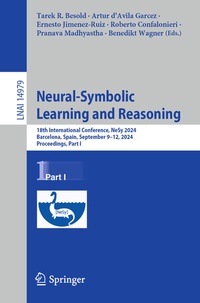
Neural-Symbolic Learning and Reasoning
Description

This book constitutes the refereed proceedings of the 18th International Conference on Neural-Symbolic Learning and Reasoning, NeSy 2024, held in Barcelona, Spain during September 9-12th, 2024.
The 30 full papers and 18 short papers were carefully reviewed and selected from 89 submissions, which presented the latest and ongoing research work on neurosymbolic AI. Neurosymbolic AI aims to build rich computational models and systems by combining neural and symbolic learning and reasoning paradigms. This combination hopes to form synergies among their strengths while overcoming their
complementary weaknesses.
More details
Other editions
Additional editions
Content
.- Context Helps: Integrating context information with videos in a graph-based HAR framework.
.- Assessing Logical Reasoning Capabilities of Encoder-Only Transformer Models.
.- Variable Assignment Invariant Neural Networks for Learning Logic Programs.
.- ViPro: Enabling and Controlling Video Prediction for Complex Dynamical Scenarios using Procedural Knowledge.
.- The Role of Foundation Models in Neuro-Symbolic Learning and Reasoning.
.- A semantic loss for ontology classification.
.- On the use of Neurosymbolic AI for Defending against Cyber Attacks.
.- Bayesian Inverse Graphics for Few-Shot Concept Learning.
.- Simple and Effective Transfer Learning for Neuro-Symbolic Integration.
.- Ethical Reward Machines.
.- Embed2Rule - Scalable Neuro-Symbolic Learning via Latent Space Weak-Labelling.
.- ULLER: A Unified Language for Learning and Reasoning.
.- Disentangling Visual Priors: Unsupervised Learning of Scene Interpretations with Compositional Autoencoder.
.- Probing LLMs for logical reasoning.
.- Enhancing Machine Learning Predictions through Knowledge Graph Embeddings.
.- Terminating Differentiable Tree Experts.
.- Valid Text-to-SQL Generation with Unification-based DeepStochLog.
.- Enhancing Geometric Ontology Embeddings for EL++ with Negative Sampling and Deductive Closure Filtering.
.- Lattice-preserving ALC ontology embeddings.
.- Towards Learning Abductive Reasoning using VSA Distributed Representations.
.- Learning to Solve Abstract Reasoning Problems with Neurosymbolic Program Synthesis and Task Generation.
.- Leveraging Neurosymbolic AI for Slice Discovery.
