

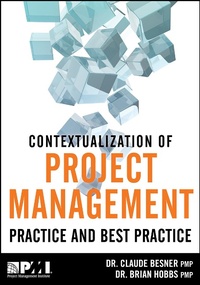
Contextualization of Project Management Practice and Best Practice
Published on 1. July 2012
298 pages
978-1-62825-010-7 (ISBN)
Description

Contextualization of Project Management Practice and Best Practice contributes to a better understanding of project management practice by investigating the use and usefulness of project management practices, tools, and techniques. The study examines practice variations among organizational, project management, and project contexts and performance. The use of project management practices, tools, and techniques is seen here as an indicator of the realities of practice. A clear understanding of the state of professional practice is particularly important to future development in the field of project management. Directly observing what project practitioners do and how they put into action their knowledge and competencies is a means to understand their practice.
More details
Other editions
Additional editions
Claude Besner | Brian Hobbs
Contextualization of Project Management Practice and Best Practice
Book
07/2012
Project Management Institute
€63.27
Article exhausted; check different version
Content
- Cover
- Title Page
- Copyright Page
- Table of Contents
- Executive Summary
- Acknowledgements
- 1. Introduction
- 1.1. Research Objectives and Questions
- 1.2. General Strategy to Accomplish the Goals
- 1.3. Organization of the Monograph
- 2. Project Management Practice
- 2.1. Introduction
- 2.2. Researching the Value of Project Management Practice
- 2.3. The Literature on Project Management Practices, Tools and Techniques
- 2.3.1. Research with a Narrow Perspective on Project Management Practice
- 2.3.2. Research with a Wide Perspective on Project Management Practice
- 2.4. Project Management Software
- 2.5. Concluding Remarks
- 3. Methodology
- 3.1. Design of the Web-Based Questionnaire
- 3.2. Soliciting Practitioners in Three Phases
- 3.3. Presentation of the Questionnaire and Differences between Phases
- 3.4. Statistical Analysis and Presentation of Results
- 3.5. The Sample Sizes for Different Analyses
- 3.6. Methodological Note
- 3.7. Presentation of the Results
- Methodological Aspects
- 3.7.1. Chapter 4: Description of Contextual Variables and the Performance Measure: Methodological Aspects
- 3.7.2. Chapter 5: Generic Project Management Practice: Methodological Aspects
- 3.7.3. Chapter 6: Contextual Variation in Project Management Practice: Methodological Aspects
- 3.7.4. Chapter 7: Best Practices: Methodological Aspects
- 3.7.5. The Index of Toolsets and Tools
- Methodological Aspects
- 4. Description of the Contextual Variables and the Performance Measure
- 4.1. Respondent Demographics
- 4.2. Contextual Variables
- 4.3. Organizational Context
- 4.3.1. Maturity
- 4.3.2. Organizational Support for use of Tools or Techniques
- 4.3.3. Availability of Competent Personnel
- 4.3.4. Rate of Project Success
- 4.3.5. Public or Private Sector
- 4.3.6. Number of Employees
- 4.3.7. Number of Project Managers
- 4.4. Project Management Context
- 4.4.1. Organizational Structure
- 4.4.2. Participation in Different Phases
- 4.4.3. Project is Part of a Program or Independent
- 4.5. Project Characteristics
- 4.5.1. Project Types
- 4.5.2. Project Budget
- 4.5.3. Project Duration
- 4.5.4. Internal or External Project Customers
- 4.5.5. Local, Regional, National or International
- 4.5.6. Well-Defined or Ill-Defined
- 4.5.7. Level of Product or Technical Innovation
- 4.5.8. Project Similarity
- 4.5.9. Number of Interfaces with Other Systems/Services/Products/Projects
- 4.5.10. Diverse or Narrow Range of Disciplines
- 4.6. Principle Component Analysis on Contextual Variables
- 4.6.1. Performing Maturity
- 4.6.2. Other Constructs Identified
- 5. Generic Project Management Practice
- 5.1. The Extent of use of Project Management Tools and Techniques
- 5.2. Extent of use of PMSF
- 5.3. The Most Extensively used Tools: The Basic Toolbox
- 5.4. The Least-Used Tools
- 5.5. The Tools' Potential
- 5.6. Tools with the Least Potential
- 5.7. Examining the Information on use and Potential Simultaneously
- 5.7.1. The "Super Tools": High use and High Potential
- 5.7.2. Adequately Utilized Tools: High use, Low Potential
- 5.7.3. Discredited Tools: Low use and Low Potential
- 5.7.4. Underutilized Tools
- Low use and High Potential
- 5.8. Toolset Identification
- 5.9. Description of the Toolsets
- 5.10. Comparing Toolsets with the Content of the PMBOK® Guide
- 5.11. In Summary
- 6. Contextual Variation in Project Management Practice
- 6.1. Is Project Management Practice Generic or Specific to Different Contexts and Different Project Types?
- 6.2. What is Similar?
- 6.3. What are the Differences?
- 6.4. Variation Across Geographic Regions
- 6.5. Differences Across Project Types
- 6.5.1. Comparisons between E&C and IT & Telecom Projects
- 6.5.2. Comparisons of Business and Financial Services Projects with Other Types of Projects
- 6.5.3. Comparisons of IT & Telecom and Software Project Types
- 6.5.4. Comparisons at the Tool Level
- 6.5.5. In Summary
- 6.6. Identification of Significant Differences in Practice Among Contextual Archetypes
- 6.7. Presentation of Contextual Archetypes
- 6.7.1. C4: More Performing Maturity, Better Defined Projects and Greater use of Tools
- 6.7.2. C2: Less Performing Maturity, Ill-Defined Projects and Less use of Tools
- 6.7.3. C1 vs. C3: Smaller Internal Projects in Large Organizations vs. Larger External Projects in Smaller Organizations
- 6.7.4. C5: Public Sector, Functional Structure, Mostly Internal Projects
- 6.8. In Summary
- 7. Best Practices
- 7.1. Identification of the General Context and Practices Leading to Performing Maturity
- 7.2. Identification of Best Practices Looking at Project Types
- 7.2.1. Business and Financial Services
- 7.2.2. Engineering and Construction
- 7.2.3. IT and Telecom
- 7.2.4. Software Development
- 7.3. Identification of Best Practices in Each Contextual Archetype
- 7.3.1. C1: Smaller Internal Projects in Larger Organizations
- 7.3.2. C2: Less Performing Maturity, Ill-Defined Projects and Less use of Tools
- 7.3.3. C3: Larger External Projects in Smaller Organizations
- 7.3.4. C4: More Performing Maturity, Better Defined Projects and Greater use of Tools
- 7.3.5. C5: Less Performing Maturity, Ill-Defined Projects and Less use of Tools
- 7.4. In Summary
- 8. Discussion
- 8.1. The Identification of Generic Practice
- 8.2. Practices, Tools and Techniques with the Most Potential
- 8.3. Explanations of Variation in Practice
- 8.3.1. Complexity of use and Organizational Support
- 8.3.2. Variation with Organizational, Project Management and Project Contexts
- 8.3.3. Contextual Archetypes and Practice Archetypes
- 8.4. Best Project Management Practices
- 8.4.1. Identifying Best Practices
- 8.4.2. Comparing Project Paradise with the Theoretical Model of Performing Maturity
- 8.4.3. Generic and Context Specific Best Practices
- 8.4.4. Best Practices vs. Perceptions of Unrealized Potential
- 8.5. The Structuring Effect of Well-Defined Projects
- 8.5.1. Importance of Participation in the Front-End
- 8.5.2. The Structuring Effect of Project Definition
- 8.5.3. Reducing Uncertainty vs. Managing Uncertainty
- 8.6. Implications for the Project Management Community
- 8.7. Limits of the Research
- 8.8. Future Research
- 9. Conclusion
- 10. References
- 11. Appendices
- 11.1. Appendix 1: Survey Questionnaire
- 11.2. Appendix 2: Index of Toolsets and Tools
