

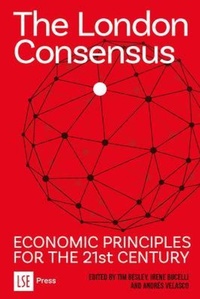
The London Consensus
Economic Principles for the 21st Century
1st Edition
Published on 16. October 2025
672 pages
978-1-911712-45-9 (ISBN)
Description

A generation ago, the so-called Washington Consensus laid out a series of dos and don'ts for policymakers around the world. Today, that vision is recognised as having fallen short in a number of ways - particularly in its neglect of the social and institutional factors that are indispensable for achieving sustained growth and for building fairer and more cohesive societies.
The immense challenges humanity faces are easy to list: climate change, pandemics, social inequalities, the far-reaching effects of the tech revolution and AI, a fragmenting world economy, and a wave of populism and political polarisation that has undermined support for liberal democracy in many countries. It is much harder to identify a set of new ideas - and policies - that will solve these seemingly intractable global problems.
In this new world, political leaders and policymakers need guidance and principles that can assist when choosing among policy alternatives. To this end, the editors of this volume convened over 50 of the world's leading economists and policy experts at the London School of Economics and Political Science (LSE). The London Consensus: Economic Principles for the 21st Century is the result of these exchanges. It is not intended as a one-size-fits-all set of economic remedies, but an exercise in assembling the best available evidence and ideas to foster dialogue, and ultimately to develop a set of principles that can address the urgent political, social and economic tasks ahead.
The immense challenges humanity faces are easy to list: climate change, pandemics, social inequalities, the far-reaching effects of the tech revolution and AI, a fragmenting world economy, and a wave of populism and political polarisation that has undermined support for liberal democracy in many countries. It is much harder to identify a set of new ideas - and policies - that will solve these seemingly intractable global problems.
In this new world, political leaders and policymakers need guidance and principles that can assist when choosing among policy alternatives. To this end, the editors of this volume convened over 50 of the world's leading economists and policy experts at the London School of Economics and Political Science (LSE). The London Consensus: Economic Principles for the 21st Century is the result of these exchanges. It is not intended as a one-size-fits-all set of economic remedies, but an exercise in assembling the best available evidence and ideas to foster dialogue, and ultimately to develop a set of principles that can address the urgent political, social and economic tasks ahead.
More details
Edition
1. Auflage
Language
English
Place of publication
La Vergne
United Kingdom
Target group
College/higher education
Professional and scholarly
Adult education
Product notice
Reflowable
File size
15,92 MB
ISBN-13
978-1-911712-45-9 (9781911712459)
Copyright in bibliographic data and cover images is held by Nielsen Book Services Limited or by the publishers or by their respective licensors: all rights reserved.
Schweitzer Classification
Persons
Tim Besley is School Professor of Economics and Political Science and W. Arthur Lewis Professor of Development Economics at the London School of Economics (LSE). His main research interests are in studying how governments can more effectively design and deliver economic policies. He has extensive policy experience advising the World Bank, International Monetary Fund (IMF) and European Bank for Reconstruction and Development, and, from 2006 to 2009, he served on the Bank of England Monetary Policy Committee. He is also a member of the UK's National Infrastructure Commission and was an academic convenor of the Oxford-LSE Commission on State Fragility,Growth and Development, and joint Chair of the LSE Growth Commission. He is a past President of the European Economic Association (EEA), Econometric Society and Royal Economic Society (RES).
Irene Bucelli is Research Officer at the School of Public Policy and the Centre for Analysis of Social Exclusion at LSE. Her research focuses on the relationship between multidimensional inequality and poverty, exploring both theoretically and empirically the interplay between different forms of disadvantage and their implications for policy. She coordinates the LSE Public Policy Review programme at the School of Public Policy and is managing editor of the LSE Public Policy Review journal.
Andres Velasco is Professor of Public Policy and Dean of the School of Public Policy at LSE. Between 2006 and 2010 he served as Minister of Finance of Chile. He is also an Associate Fellow at Chatham House, the Royal Institute
of International Affairs, and a Research Fellow at the Centre for Economic Policy Research (CEPR). In 2023-24 he served on the Task Force on Fiscal Policy for Health; during 2021-23 he was part of the High-Level Advisory Group to the IMF and the World Bank; in 2017-18 he was a member of the G20 Eminent Persons Group on Financial Governance; during 2015-16 he co-chaired the Global Panel on the Future of the Multilateral Lending Institutions; in 2013-16 he was a member of the Global Oceans Commission. Before coming to LSE, he held professorial appointments at the Harvard Kennedy School (HKS), Columbia School of International Public and Affairs
(SIPA) and the New York University Economics Department. His research has been published in leading academic journals including the American Economic Review, the Journal of Political Economy, the Quarterly Journal of Economics and the Journal of Economic Theory. In 2006 he received the Inter-American Development Bank Award for Excellence in Economic Research.
Irene Bucelli is Research Officer at the School of Public Policy and the Centre for Analysis of Social Exclusion at LSE. Her research focuses on the relationship between multidimensional inequality and poverty, exploring both theoretically and empirically the interplay between different forms of disadvantage and their implications for policy. She coordinates the LSE Public Policy Review programme at the School of Public Policy and is managing editor of the LSE Public Policy Review journal.
Andres Velasco is Professor of Public Policy and Dean of the School of Public Policy at LSE. Between 2006 and 2010 he served as Minister of Finance of Chile. He is also an Associate Fellow at Chatham House, the Royal Institute
of International Affairs, and a Research Fellow at the Centre for Economic Policy Research (CEPR). In 2023-24 he served on the Task Force on Fiscal Policy for Health; during 2021-23 he was part of the High-Level Advisory Group to the IMF and the World Bank; in 2017-18 he was a member of the G20 Eminent Persons Group on Financial Governance; during 2015-16 he co-chaired the Global Panel on the Future of the Multilateral Lending Institutions; in 2013-16 he was a member of the Global Oceans Commission. Before coming to LSE, he held professorial appointments at the Harvard Kennedy School (HKS), Columbia School of International Public and Affairs
(SIPA) and the New York University Economics Department. His research has been published in leading academic journals including the American Economic Review, the Journal of Political Economy, the Quarterly Journal of Economics and the Journal of Economic Theory. In 2006 he received the Inter-American Development Bank Award for Excellence in Economic Research.
Content
Preface
1. Towards a London Economic Consensus:
an introduction
Tim Besley and Andres Velasco
PART I: INNOVATION AND PRODUCTIVITY
2. Fostering green and inclusive productivity growth
Philippe Aghion and John Van Reenen
Response to Philippe Aghion and John Van Reenen
Diane Coyle
Response to Philippe Aghion and John Van Reenen
Timo Boppart
3. On productivism
Dani Rodrik
Response to Dani Rodrik
Jean Pisani-Ferry
Response to Dani Rodrik
Pierre-Olivier Gourinchas
PART II: TRADE
4. International trade since the Washington Consensus:
the gains and the pains
Dave Donaldson
Response to Dave Donaldson
Thomas Sampson
Response to Dave Donaldson
Anthony Venables
5. Export-led growth
Ricardo Hausmann
Response to Ricardo Hausmann
Isabela Manelici
Response to Ricardo Hausmann
Danny Quah
PART III: MACROECONOMIC POLICY
6. Fiscal policy and public debt
Ricardo Reis and Andres Velasco
Response to Ricardo Reis and Andres Velasco
Olivier Blanchard
Response to Ricardo Reis and Andres Velasco
Chryssi Giannitsarou
7. Monetary and financial policies
Helene Rey
Response to Helene Rey
Paul Tucker
Response to Helene Rey
Sebnem Kalemli-OEzcan
PART IV: LABOUR MARKET
8. Labour markets and the future of work
Christopher Pissarides
Response to Christopher Pissarides
Kirsten Sehnbruch
9. Labour markets and gender inequality
Oriana Bandiera and Barbara Petrongolo
Response to Oriana Bandiera and Barbara Petrongolo
Ashwini Deshpande
Response to Oriana Bandiera and Barbara Petrongolo
Almudena Sevilla
PART V COHESION, EQUITY AND SOCIAL POLICY
10. Is there a 'new consensus' on inequality?
Francisco H. G. Ferreira
Response to Francisco H. G. Ferreira
Ravi Kanbur
Response to Francisco H. G. Ferreira
Nora Lustig
11. Welfare state
Nicholas Barr
Response to Nicholas Barr
Santiago Levy
Response to Nicholas Barr
Paul Johnson
12. Addressing the learning crisis: an emergent consensus
Lant Pritchett
Response to Lant Pritchett
Pedro Carneiro
Response to Lant Pritchett
Miguel Urquiola
13. Towards resilient and sustainable universal health- care coverage
Alistair McGuire, Joan Costa-i-Font and Ranjeeta Thomas
Response to Alistair McGuire, Joan Costa-i-Font
and Ranjeeta Thomas
Carol Propper
Response to Alistair McGuire, Joan Costa-i-Font
and Ranjeeta Thomas
Michael Marmot
PART VI: ENVIRONMENT AND CLIMATE CHANGE
14. Climate and environment: what we know and what we need to know
Robin Burgess and Tim Dobermann
15. Tackling climate change in low- and middle-income countries
Elizabeth Robinson and Chukwumerije Okereke
PART VII: POLITICAL ECONOMY AND STATE CAPACITY
16. From liberal economic policies to liberal political institutions? Democracy, development clusters and wellbeing
Tim Besley and Torsten Persson
Response to Tim Besley and Torsten Persson
Margaret Levi
Response to Tim Besley and Torsten Persson
Leonard Wantchekon
17. State capacity
Dan Honig, Adnan Khan and Joana Naritomi
Response to Dan Honig, Adnan Khan and Joana Naritomi
Matthew Andrews
Response to Dan Honig, Adnan Khan and Joana Naritomi
Ernesto Dal Bo
Afterword
Pranab Bardhan
List of figures and tables
About the editors and contributors
Index
1. Towards a London Economic Consensus:
an introduction
Tim Besley and Andres Velasco
PART I: INNOVATION AND PRODUCTIVITY
2. Fostering green and inclusive productivity growth
Philippe Aghion and John Van Reenen
Response to Philippe Aghion and John Van Reenen
Diane Coyle
Response to Philippe Aghion and John Van Reenen
Timo Boppart
3. On productivism
Dani Rodrik
Response to Dani Rodrik
Jean Pisani-Ferry
Response to Dani Rodrik
Pierre-Olivier Gourinchas
PART II: TRADE
4. International trade since the Washington Consensus:
the gains and the pains
Dave Donaldson
Response to Dave Donaldson
Thomas Sampson
Response to Dave Donaldson
Anthony Venables
5. Export-led growth
Ricardo Hausmann
Response to Ricardo Hausmann
Isabela Manelici
Response to Ricardo Hausmann
Danny Quah
PART III: MACROECONOMIC POLICY
6. Fiscal policy and public debt
Ricardo Reis and Andres Velasco
Response to Ricardo Reis and Andres Velasco
Olivier Blanchard
Response to Ricardo Reis and Andres Velasco
Chryssi Giannitsarou
7. Monetary and financial policies
Helene Rey
Response to Helene Rey
Paul Tucker
Response to Helene Rey
Sebnem Kalemli-OEzcan
PART IV: LABOUR MARKET
8. Labour markets and the future of work
Christopher Pissarides
Response to Christopher Pissarides
Kirsten Sehnbruch
9. Labour markets and gender inequality
Oriana Bandiera and Barbara Petrongolo
Response to Oriana Bandiera and Barbara Petrongolo
Ashwini Deshpande
Response to Oriana Bandiera and Barbara Petrongolo
Almudena Sevilla
PART V COHESION, EQUITY AND SOCIAL POLICY
10. Is there a 'new consensus' on inequality?
Francisco H. G. Ferreira
Response to Francisco H. G. Ferreira
Ravi Kanbur
Response to Francisco H. G. Ferreira
Nora Lustig
11. Welfare state
Nicholas Barr
Response to Nicholas Barr
Santiago Levy
Response to Nicholas Barr
Paul Johnson
12. Addressing the learning crisis: an emergent consensus
Lant Pritchett
Response to Lant Pritchett
Pedro Carneiro
Response to Lant Pritchett
Miguel Urquiola
13. Towards resilient and sustainable universal health- care coverage
Alistair McGuire, Joan Costa-i-Font and Ranjeeta Thomas
Response to Alistair McGuire, Joan Costa-i-Font
and Ranjeeta Thomas
Carol Propper
Response to Alistair McGuire, Joan Costa-i-Font
and Ranjeeta Thomas
Michael Marmot
PART VI: ENVIRONMENT AND CLIMATE CHANGE
14. Climate and environment: what we know and what we need to know
Robin Burgess and Tim Dobermann
15. Tackling climate change in low- and middle-income countries
Elizabeth Robinson and Chukwumerije Okereke
PART VII: POLITICAL ECONOMY AND STATE CAPACITY
16. From liberal economic policies to liberal political institutions? Democracy, development clusters and wellbeing
Tim Besley and Torsten Persson
Response to Tim Besley and Torsten Persson
Margaret Levi
Response to Tim Besley and Torsten Persson
Leonard Wantchekon
17. State capacity
Dan Honig, Adnan Khan and Joana Naritomi
Response to Dan Honig, Adnan Khan and Joana Naritomi
Matthew Andrews
Response to Dan Honig, Adnan Khan and Joana Naritomi
Ernesto Dal Bo
Afterword
Pranab Bardhan
List of figures and tables
About the editors and contributors
Index
